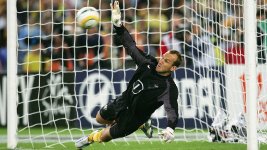
Part I – The Presence at the Heart of a Nation
There are footballers who define eras, and there are footballers who seem to sit just outside time. Observers. Archivists. Presences who make sense only when the game is slowed down, when the crowd hushes, when the ball inches toward the space between chance and catastrophe. Mark Schwarzer belongs to the latter. He was the calm inside the cyclone, the stillness that unnerved strikers, the long shadow at the back of Australian football’s long road to relevance.
Long before anyone spoke of Australia belonging in Asia, long before the Socceroos were regulars at World Cups, Schwarzer was already there. An Australian abroad, a pilgrim of the goalmouth. When he left Sydney in the early 1990s, he did not do so with a map, because Australian football had no maps then. You simply went, like sailors once did toward an imagined horizon, toward possibility.
Goalkeeping, at its most poetic, is a craft of anticipation. A craft for the introvert, for the patient, for those who understand that the most decisive moments of a match are often the quiet ones. In these years, he learned the temperament that would define him: unflappable, disciplined, permanently operating in the realm where nerves melted into clarity.
But Australia is not a country that produces goalkeepers who are widely worshipped. If we are honest, it barely worships football at all. And so the great irony is that Schwarzer’s destiny was shaped in places where he was almost invisible. He trained alone, improved alone, and carried that solitude with him when he left for Germany in 1994, a young Australian goalkeeper arriving at Kaiserslautern, where Bundesliga forwards were bigger, faster, hungrier, and far less forgiving.
What he learned in Germany was not just technique, but presence. The posture of command. The ability to instruct defenders without drama, without bombast, with the quiet confidence of someone who knows exactly where everyone needs to be.
When he finally left for England, it was not with the desperation of a young man searching for opportunity, but with the quiet assurance of a goalkeeper who had already survived the world’s hardest apprenticeship. His English adventure began at Bradford City, an unremarkable stop by reputation but a deeply formative one in narrative. It was in these years that Schwarzer developed the most underrated aspect of his game: the ability to play behind teams that were not always stronger, not always safer, not always good enough to protect him from storms.
He learned to survive chaos. Better than survive, he learned to look untroubled by it.

Mark Schwarzer. In charge.
Great goalkeepers don’t always find great clubs. Some find the right ones instead, Schwarzer found Middlesbrough.
For a decade, he was the one constant in a club that was never static. Managers arrived and departed, players rotated, fortunes swayed, but in goal there was always the same broad-shouldered Australian with the same calm expression, as though he had stepped out of a different season, a different rhythm altogether.
Teesside embraced him not because he was spectacular, but because he seemed to play with a moral seriousness. Everything he did looked honest. His saves were not theatrical; they were necessary. His positioning was so immaculate that the extraordinary often looked ordinary. A parry that another keeper might stretch into the highlight reel became, for Schwarzer, simply the result of standing in the right place at the right time.
This, more than anything, is the secret of his greatness: he made difficult saves look easy. He made easy saves look inevitable.
In 2004, he helped Middlesbrough win the League Cup, the club’s first major trophy. Two years later, he stood at the heart of one of the most improbable runs in modern English football, Boro’s journey to the UEFA Cup final. There were nights, especially in those wild comebacks against Basel and Steaua Bucharest, when the Riverside felt like the centre of Europe.
There is a particular kind of immortality earned in provincial football cities. It comes from being the sort of player who ties a community to its dreams. Schwarzer became that, a quiet titan, beloved not for celebrity but for reliability, for dignity, for the strange sacredness of knowing that your goalkeeper will not let you down.
For eleven seasons at Middlesbrough, Schwarzer was both anchor and witness. The North East of England can be football at its most operatic, and Boro gave him no shortage of drama. Few foreign players, let alone goalkeepers, have embedded themselves so deeply into the club’s emotional fabric.
Mark Schwarzer’s affection for Middlesbrough was never about glamour. In fact, it was the opposite: his bond with the club grew out of a place that rewarded graft, loyalty, and durability, all qualities that ran through his entire career. Schwarzer was never merely passing through. He turned down moves, stayed through rebuilding cycles, and remained even when the club was no longer fashionable or flying in the league. He valued long-term belonging over short-term opportunity, and Boro fans admired that deeply.
And in return, the club and supporters treated him as one of their own. For an Australian footballer who had travelled halfway around the world, that mattered.
That mythology began earlier than most remember. In 1993, a 20 year old Schwarzer announced himself on the international stage by saving two penalties in a shootout against Canada, sending Australia through to the final phase of 1994 World Cup qualifying. It was a first glimpse of a pattern that would come to define his relationship with the national team: when the moment narrowed to a single breath, Schwarzer remained.
Australia had lived for decades with its own ghost, the sense that qualification was always an arena of improbable cruelty. When they met Uruguay again in 2005, the narrative felt scripted by fate. The first leg in Montevideo had been brutal, a psychological assault disguised as football. The return leg in Sydney was a collision of anxiety and hope.
Penalty shootouts are cruel to everyone except goalkeepers. For once, the night belonged to the man in gloves.
The two saves, from Darío Rodríguez and Marcelo Zalayeta, live not just in the country’s football memory, but in its emotional memory. They unlocked something. They made Australia believe not just that the team could finally go to a World Cup, but that football belonged to the national story.
When the winning penalty was scored and the country exhaled, Schwarzer did not sprint wildly. He absorbed the moment with a sort of serene astonishment, as if grateful simply to have been allowed to save what needed to be saved.
It was perfect. It was iconic. It was Australian.
And yet, the true detail lies not in what he did on the pitch -though his interventions in Germany were sharp, vital, and assured- but in how he carried himself beyond the chalk. Schwarzer was never tempted by the celebrity currents of the new A-League era or the FIFA circus. He was always the measured voice, the thoughtful professional, the one who spoke with the cadence of someone who had lived the hard miles abroad. In press conferences, he sounded closer to a Bundesliga goalkeeper than an Australian one. That was part of his significance. He represented the footballer who belonged to the world as much as he belonged to home.
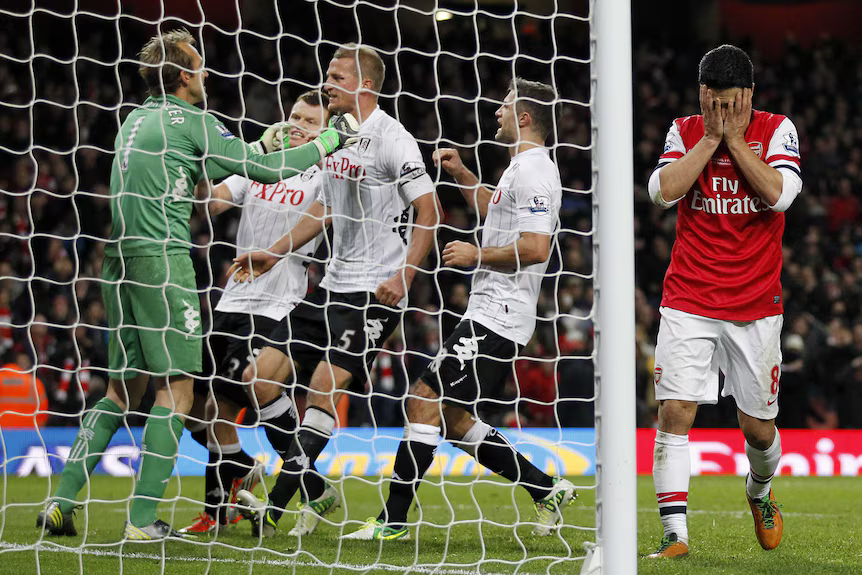
Schwarzer celebrates after saving Mikel Arteta’s penalty during Fulham’s 3–3 draw with Arsenal in 2012.
He arrived in 2008, a free transfer who immediately became the backbone of an improbable transition. Under Roy Hodgson, Fulham were a side defined by shape, patience, and the almost ecclesiastical cleanliness of its lines. Schwarzer fit beautifully. If Middlesbrough had taught him endurance, Fulham gave him a canvas on which to show the higher art of his craft: the positioning, the geometry, the goalkeeping intelligence.
And then came the Europa League run of 2009 to 10, a campaign still spoken of in Fulham households with the kind of devotion normally reserved for pilgrimage stories.
The image of Schwarzer, sleeves rolled down, shoulders square, marshalling a defence held together by will and meticulous organisation, is part of the club’s folklore. In Hamburg, in Basel, in Turin, he was not the hero with the golden save, though he made more than a few, but the guardian of equilibrium. He kept the improbable alive.
The quarter final demolition of Juventus is remembered for Bobby Zamora’s nonchalant finish and Clint Dempsey’s audacious chip. But hidden in that night is Schwarzer’s command of every defensive moment. A glove here, a fingertip there, a shout that carried through the noise like a conductor’s cue. He held a fragile dream intact long enough for Craven Cottage to explode.
In the final in Hamburg, Fulham fell at the last moment to Diego Forlan and Atletico Madrid. But defeat does not diminish mythology. Schwarzer walked off the pitch that night with the aura of a keeper who had given everything and lost only to the cruelty inherent in football’s highest stages. It felt, even then, like the closing chapter of an age he had defined.
Yet his story, characteristically, refused the linear.
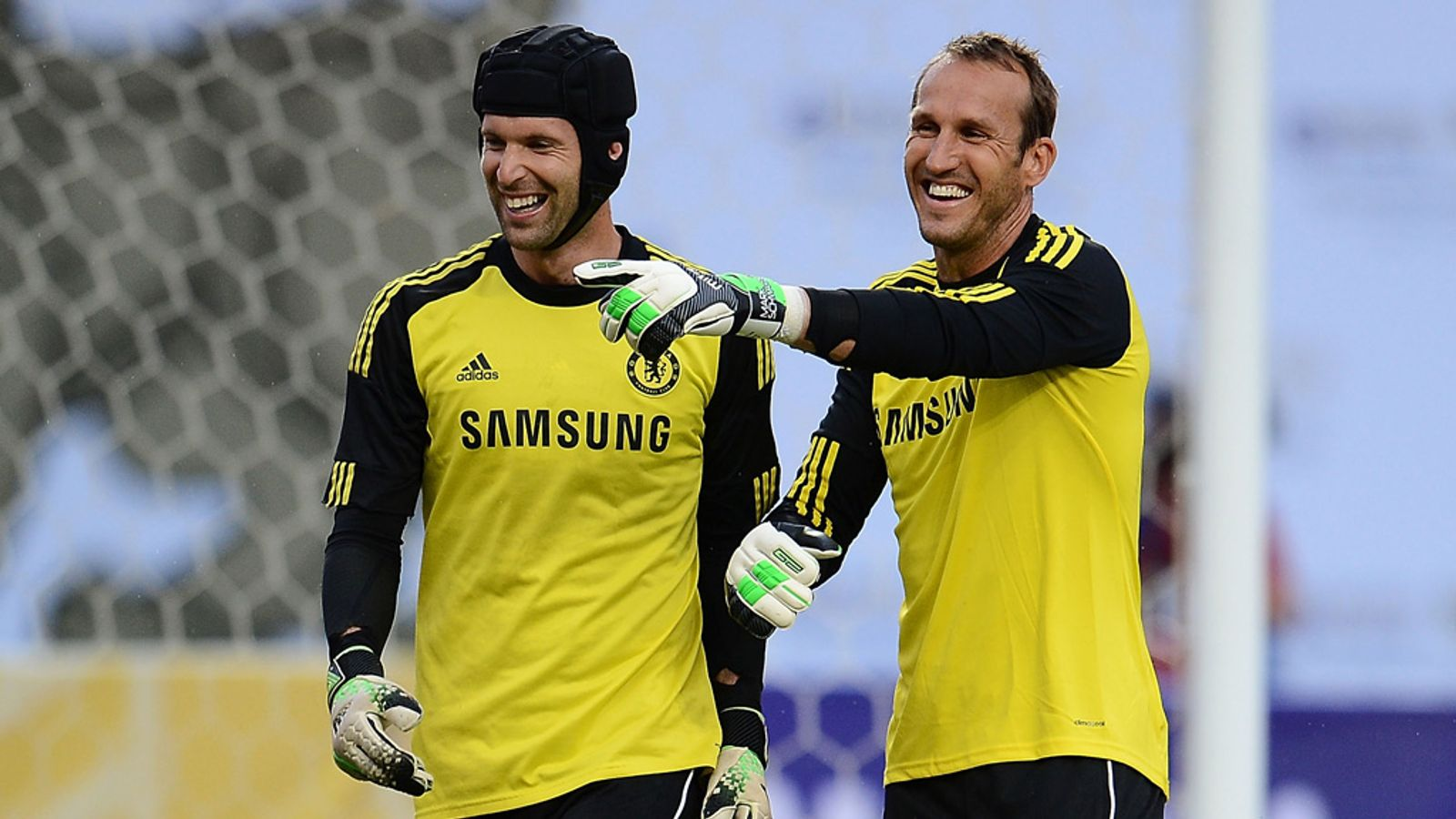
Schwarzer alongside Petr Čech during training at Chelsea.
There is something gently amusing in how the latter years of Schwarzer’s career have been retold. The shorthand is “veteran backup”. But the deeper truth is that he became a specialist in a rare footballing art: extending relevance through reliability.
Most players decline abruptly. Schwarzer did not. He simply moved to clubs where his preparation, knowledge, and steadiness became invaluable. When Chelsea signed him at 40, it was not a sentimental gesture but a decision rooted in respect. José Mourinho knew the worth of a goalkeeper who treated every training session as if it were a qualifier in Montevideo.
His performance in the Champions League quarter final against Paris Saint Germain in 2014, was not merely competent. It was commanding. The man who had guarded Marconi’s posts in the early 1990s now guarded Chelsea’s in the biggest moments European football could offer. And he did it without drama, without any sense that he was performing a miracle. To Schwarzer, goalkeeping was goalkeeping. The ball was the ball. The job was the job.
When he moved to Leicester in 2015, the move appeared to be the final, quiet chapter of an unusually long book. Yet fate, mischievous as ever, had other plans.
Leicester City’s title run in 2015 to 16 has been mythologised to the point of unreality. Everyone remembers Vardy’s goals, Kanté’s omnipresence, Ranieri’s grin. Fewer recall that behind first choice keeper Kasper Schmeichel was Schwarzer, 43 years old, trusted by his teammates, integral to the training ground culture that held the squad together.
He did not play a minute in that league season. But symbolism matters. He became a Premier League champion, not as an ornament, but as a veteran sage. A goalkeeper who had seen everything: relegation battles, cup finals, World Cups, heartbreaks, miracles. He was the quiet adult in a dressing room full of rising flames.
The Premier League medal was not a coda. It was a cosmic nod, an acknowledgment that football occasionally rewards the faithful.
Schwarzer always sounded like someone who had been writing the story in his head as he lived it.
He spoke about angles, momentum, the psychology of one on ones. He spoke about leadership as something expressed in tone, not volume. He spoke about football as a craft rather than a spectacle. In this sense, he was a goalkeeper perfectly suited to Australia, a country that has often refracted association football through drama, conflict, and cultural tension. Schwarzer was the rare figure who grounded the game in calm.
His presence helped normalise professionalism in an era when Australia needed models more than stars. He represented the Australian player who could endure in Europe not through flamboyance but through excellence. Younger keepers such as Mathew Ryan, Mitch Langerak, and Andrew Redmayne often cite Schwarzer not just for inspiration but as a template.
He was proof that the quiet path could still lead to greatness.
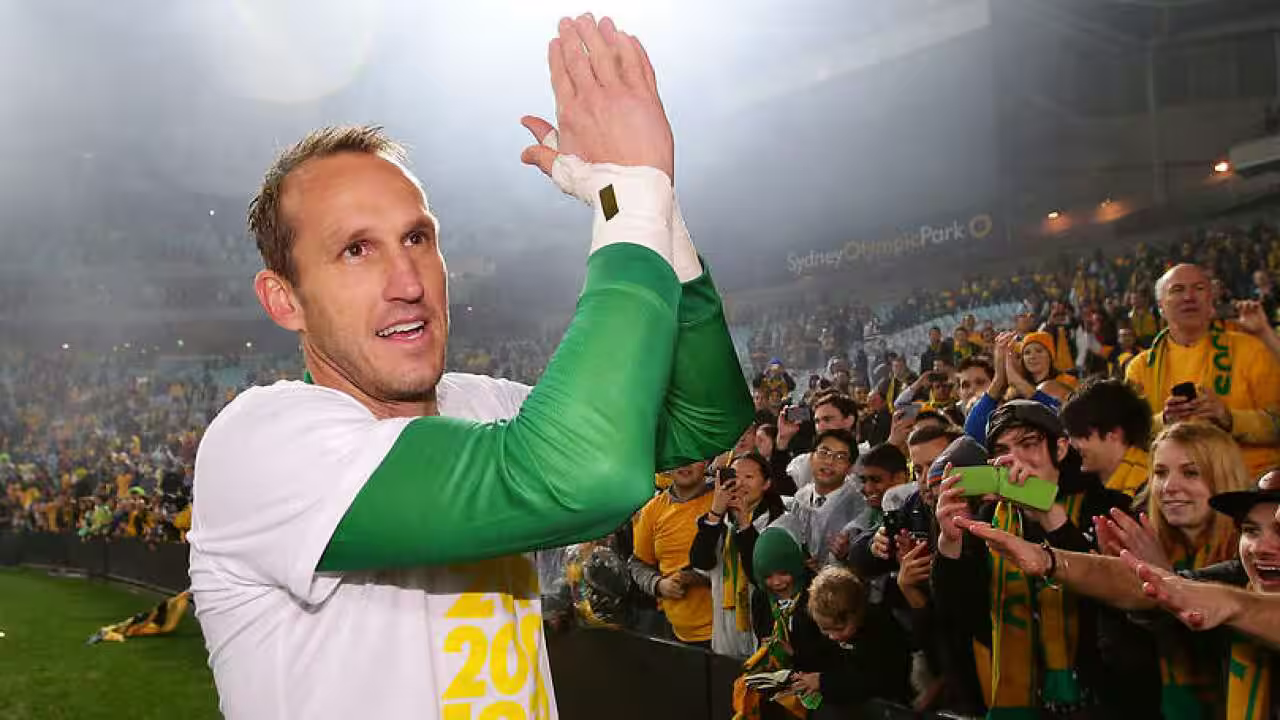
Schwarzer salutes the crowd.
Football careers often end loudly, with farewell tours, tearful press conferences, and laps of honour beneath floodlights. Mark Schwarzer’s did not. It ended in the way he played: calm, understated, almost meditative. You could blink and miss the moment the gloves were hung up. He never needed the centre of the frame. He simply needed to guard it.
In November 2013, Schwarzer was set to be named in Ange Postecoglou’s squad for a friendly with Costa Rica before deciding to walk away.
When he explained his decision, it was with the same clarity that had defined his career.
“I felt that I couldn't give it the commitment that I feel needed to be given to represent your country at a high level and also the World Cup,” Schwarzer said on Fox Sports.
“Physically I feel really good, but mentally it was the biggest challenge.
“I just knew it was the right time to move on and pass on the baton as they say and sit back and let someone else take over.”
There was no drama in the explanation. Just acceptance. And yet, perhaps no Australian footballer has left behind a more complete body of work.
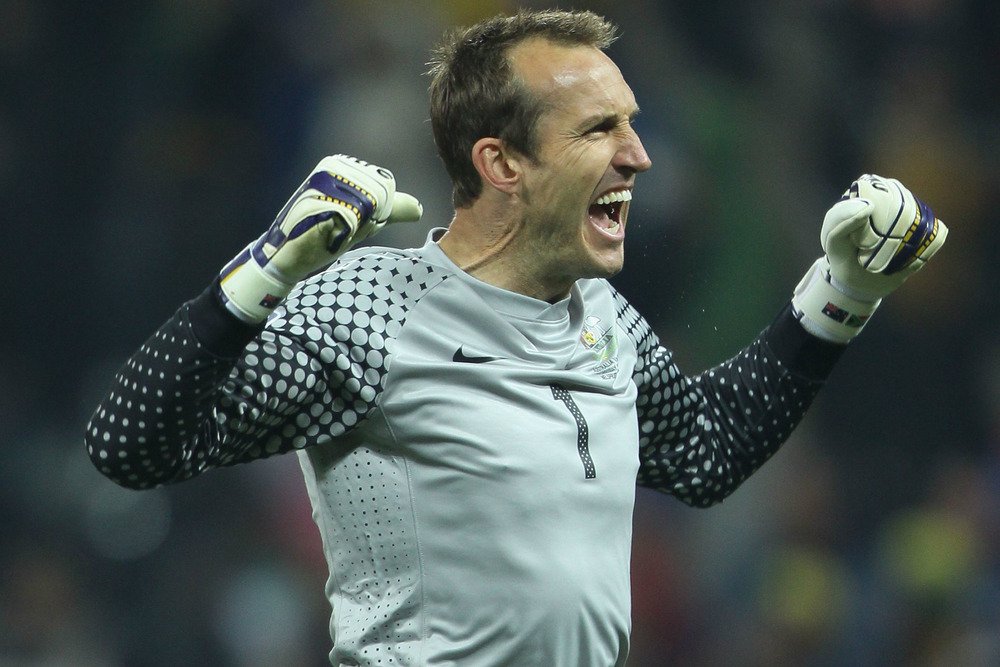
Schwarzer celebrates Australia’s World Cup win over Serbia in 2010.
There is a particular fascination in how Schwarzer’s career seems to stitch together the entire modern history of Australian football. When he started, the NSL was a patchwork of ethnic clubs fighting for survival under a government and media landscape that scarcely acknowledged their existence. The country’s most promising players left almost by stealth, hoping for a chance and often finding only hardship.
By the time Schwarzer retired, Australia had reached four consecutive World Cups, joined Asia, established a relatively stable A League, and watched a generation of players find pathways he had carved by example. If he was not the first European based Socceroos star, he was the most enduring symbol of what professionalism abroad could look like: not chaotic, not peripheral, but integrated, respected, essential.
He became the bridge.
If Harry Kewell and Mark Viduka carried the flair and cultural clout, Schwarzer carried the reliability, the day in, day out credibility. He was the Australian footballer Europe did not treat as exotic. He was simply a goalkeeper, and often the best one on the pitch.
When you trace his life in the game, what emerges is not a single heroic arc but a constellation of them: Kaiserslautern, Bradford, Boro, Fulham, Chelsea, Leicester; Montevideo, Sydney, Kaiserslautern again in 2006, Rustenburg, Porto Alegre; relegation scraps and European finals and quiet Tuesday nights where a single punched cross made the difference between a point won and two lost.
His career is not a highlight reel. It is a ledger of responsibility.
His positioning was immaculate, a sort of geographical intelligence learned through years of facing more shots than a top tier keeper normally would. It allowed him to make saves look deceptively simple. That simplicity, however, was not simplicity at all. It was mastery.
His patience was psychological. When forwards rushed, he waited. When a volley appeared inevitable, Schwarzer held his ground an instant longer than the laws of nerve should allow. This micro pause, this refusal to flinch, often forced opponents into decisions they did not want to make. Goalkeepers often talk about making themselves big. Schwarzer made the moment big instead.
And his presence, that was the intangible. A defender glancing over his shoulder saw the same expression every time: calm, analytical, unmoved. Panic never travelled as far as the six yard box. Shoulders square, gloves ready, eyes narrowing only slightly as the ball entered his zone. This was Schwarzer’s signature. Some goalkeepers radiate fury. Some attempt charisma. Schwarzer radiated steadiness.
He kept goal like a man taking notes.
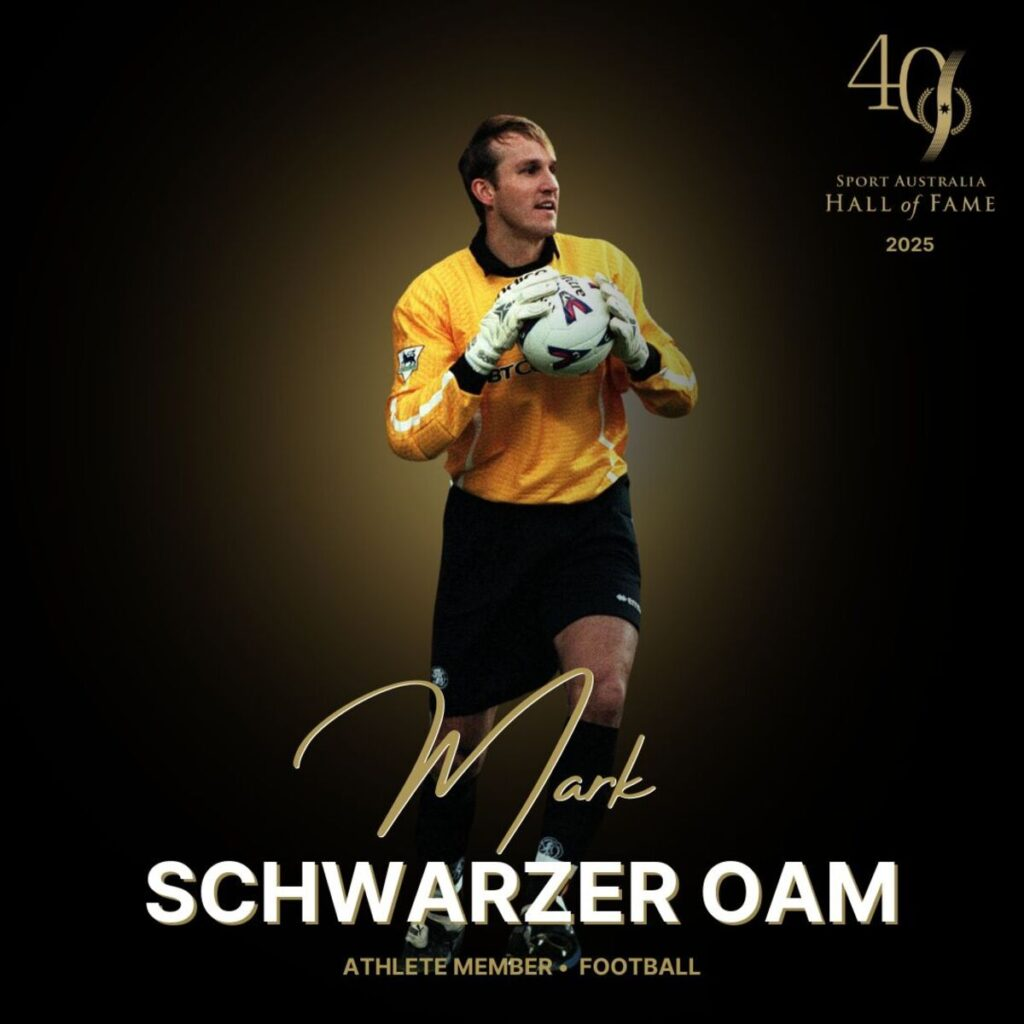
Mark Schwarzer OAM, inducted into the Sport Australia Hall of Fame in 2025.
If you ask Australians to name their most important footballers, the answers differ wildly by generation. Some swear by Kewell’s brilliance, others by Viduka’s presence or Cahill’s relentlessness. But ask them to name the most trusted player, the one whose mere selection eased the collective anxiety of a nation still forming its footballing self esteem, and the name is often Schwarzer.
He was, for two decades, the stabilising force in a national team that frequently felt like a travelling theatre troupe, new managers, new systems, new eras. Through all the experiments and reinventions, Schwarzer remained the constant. You cannot measure that kind of significance in clean sheets alone. It is measured in belief.
Consider the two moments that bookend the Socceroos’ transformation.
In 2001, Schwarzer was the sole shining figure in Montevideo, keeping the scoreline remotely respectable as Australia’s World Cup dreams once again dissolved. It was a haunting night, one that hardened him.
In 2005, he became the liberator. Two penalty saves. A nation released from 32 years of claustrophobic sporting trauma. Between those two Uruguay games lies the entire emotional geology of Australian football’s coming of age.
His presence in 2010, in the 2011 Asian Cup run, and even in the early qualifiers for 2014 carried symbolic power. His retirement from international football, quiet and unembellished, marked not just the end of a career but the end of an Australian era. The next generation inherited standards that had been forged, tested, and verified by a man who set the bar not through ego but through endurance.
There is no bluster. No theatrics. He breaks down moments instead of dramatising them. He talks about body shapes, distance between defensive lines, momentum shifts within matches. Listening to Schwarzer analyse a goalkeeper is like watching a craftsman inspect joinery. He notices the hinge, the pressure, the angle, the detail that everything else depends on.
His voice carries weight because it is the voice of someone who did the work for 25 years without asking for applause.
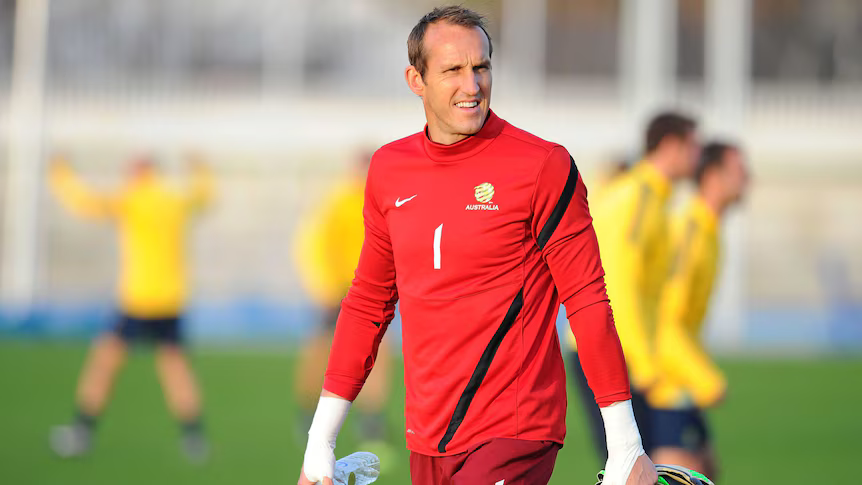
Schwarzer, steady to the end.
In the end, Schwarzer’s significance lies not in the trophies, though he collected them quietly at every stage, nor in the heroic performances, though there were many. It lies in the way he dignified every aspect of goalkeeping. He made reliability romantic. He made professionalism poetic. He embodied the idea that greatness does not always shout.
Football loves its flawed geniuses, its tragic idols, its artists of chaos. Schwarzer was none of these. He was a craftsman who found transcendence through repetition. He made the difficult appear routine. He made the extraordinary appear orderly.
There is a certain beauty in that.
As a fan of football, I have always gravitated toward stories of the unspectacular made spectacular, of the quiet figure whose imprint becomes louder with time. Mark Schwarzer belongs to that lineage. He is not just Australia’s greatest goalkeeper. He is one of its most important footballers, a man who turned a marginal sporting nation into a credible one, one save at a time.
And when you look back across the expanse of his career, the cold mornings in Germany, the decade in Teesside, the magic in West London, the nights in green and gold that rewrote a nation’s identity, what endures most is the steadiness. The sense that, so long as he stood between the posts, the world could tilt, wobble, rumble, roar, but it would not fall.
He was the goalkeeper who kept a continent calm.
He was, in every meaningful sense of the word, extraordinary.
Long before anyone spoke of Australia belonging in Asia, long before the Socceroos were regulars at World Cups, Schwarzer was already there. An Australian abroad, a pilgrim of the goalmouth. When he left Sydney in the early 1990s, he did not do so with a map, because Australian football had no maps then. You simply went, like sailors once did toward an imagined horizon, toward possibility.
The Boy From the Western Suburbs
In the myth making years that followed, fans liked to imagine Schwarzer as a natural giant. Born fully formed at six foot four, swallowing crosses and saving penalties in his sleep. But his footballing roots were modest, suburban, shaped by the humbler rhythms of Marconi Stallions, one of the great multicultural incubators of the old NSL. The young Schwarzer was not flashy, nor particularly flamboyant. But there was something in the way he studied games, the way he watched angles as much as he watched players. He was already a student of the geometry of threat.Goalkeeping, at its most poetic, is a craft of anticipation. A craft for the introvert, for the patient, for those who understand that the most decisive moments of a match are often the quiet ones. In these years, he learned the temperament that would define him: unflappable, disciplined, permanently operating in the realm where nerves melted into clarity.
But Australia is not a country that produces goalkeepers who are widely worshipped. If we are honest, it barely worships football at all. And so the great irony is that Schwarzer’s destiny was shaped in places where he was almost invisible. He trained alone, improved alone, and carried that solitude with him when he left for Germany in 1994, a young Australian goalkeeper arriving at Kaiserslautern, where Bundesliga forwards were bigger, faster, hungrier, and far less forgiving.
Germany: The Finishing School
For a boy from Sydney, Germany was a different air. The pitches were closer to ice than grass. The dressing rooms were ferociously competitive. The margins for error were microscopic. Most Australians fell away quickly in those years. Schwarzer endured.What he learned in Germany was not just technique, but presence. The posture of command. The ability to instruct defenders without drama, without bombast, with the quiet confidence of someone who knows exactly where everyone needs to be.
When he finally left for England, it was not with the desperation of a young man searching for opportunity, but with the quiet assurance of a goalkeeper who had already survived the world’s hardest apprenticeship. His English adventure began at Bradford City, an unremarkable stop by reputation but a deeply formative one in narrative. It was in these years that Schwarzer developed the most underrated aspect of his game: the ability to play behind teams that were not always stronger, not always safer, not always good enough to protect him from storms.
He learned to survive chaos. Better than survive, he learned to look untroubled by it.
The Middlesbrough Years: A Keeper and a Community
Mark Schwarzer. In charge.
Great goalkeepers don’t always find great clubs. Some find the right ones instead, Schwarzer found Middlesbrough.
For a decade, he was the one constant in a club that was never static. Managers arrived and departed, players rotated, fortunes swayed, but in goal there was always the same broad-shouldered Australian with the same calm expression, as though he had stepped out of a different season, a different rhythm altogether.
Teesside embraced him not because he was spectacular, but because he seemed to play with a moral seriousness. Everything he did looked honest. His saves were not theatrical; they were necessary. His positioning was so immaculate that the extraordinary often looked ordinary. A parry that another keeper might stretch into the highlight reel became, for Schwarzer, simply the result of standing in the right place at the right time.
This, more than anything, is the secret of his greatness: he made difficult saves look easy. He made easy saves look inevitable.
In 2004, he helped Middlesbrough win the League Cup, the club’s first major trophy. Two years later, he stood at the heart of one of the most improbable runs in modern English football, Boro’s journey to the UEFA Cup final. There were nights, especially in those wild comebacks against Basel and Steaua Bucharest, when the Riverside felt like the centre of Europe.
There is a particular kind of immortality earned in provincial football cities. It comes from being the sort of player who ties a community to its dreams. Schwarzer became that, a quiet titan, beloved not for celebrity but for reliability, for dignity, for the strange sacredness of knowing that your goalkeeper will not let you down.
For eleven seasons at Middlesbrough, Schwarzer was both anchor and witness. The North East of England can be football at its most operatic, and Boro gave him no shortage of drama. Few foreign players, let alone goalkeepers, have embedded themselves so deeply into the club’s emotional fabric.
Mark Schwarzer’s affection for Middlesbrough was never about glamour. In fact, it was the opposite: his bond with the club grew out of a place that rewarded graft, loyalty, and durability, all qualities that ran through his entire career. Schwarzer was never merely passing through. He turned down moves, stayed through rebuilding cycles, and remained even when the club was no longer fashionable or flying in the league. He valued long-term belonging over short-term opportunity, and Boro fans admired that deeply.
And in return, the club and supporters treated him as one of their own. For an Australian footballer who had travelled halfway around the world, that mattered.
The Socceroos and a Nation’s Catharsis
If Middlesbrough gave Schwarzer a footballing home, the Socceroos gave him myth.That mythology began earlier than most remember. In 1993, a 20 year old Schwarzer announced himself on the international stage by saving two penalties in a shootout against Canada, sending Australia through to the final phase of 1994 World Cup qualifying. It was a first glimpse of a pattern that would come to define his relationship with the national team: when the moment narrowed to a single breath, Schwarzer remained.
Australia had lived for decades with its own ghost, the sense that qualification was always an arena of improbable cruelty. When they met Uruguay again in 2005, the narrative felt scripted by fate. The first leg in Montevideo had been brutal, a psychological assault disguised as football. The return leg in Sydney was a collision of anxiety and hope.
Penalty shootouts are cruel to everyone except goalkeepers. For once, the night belonged to the man in gloves.
The two saves, from Darío Rodríguez and Marcelo Zalayeta, live not just in the country’s football memory, but in its emotional memory. They unlocked something. They made Australia believe not just that the team could finally go to a World Cup, but that football belonged to the national story.
When the winning penalty was scored and the country exhaled, Schwarzer did not sprint wildly. He absorbed the moment with a sort of serene astonishment, as if grateful simply to have been allowed to save what needed to be saved.
It was perfect. It was iconic. It was Australian.
Mark Schwarzer: An Australian Footballing Icon
If the night against Uruguay became the emotional axis of Australian football, the years that followed established Schwarzer as something more than a goalkeeper. He became a kind of national emblem, the face of competence in a country still learning to take the global game seriously. When Australia finally walked into the World Cup in 2006, Schwarzer was its tall, vigilant sentinel.And yet, the true detail lies not in what he did on the pitch -though his interventions in Germany were sharp, vital, and assured- but in how he carried himself beyond the chalk. Schwarzer was never tempted by the celebrity currents of the new A-League era or the FIFA circus. He was always the measured voice, the thoughtful professional, the one who spoke with the cadence of someone who had lived the hard miles abroad. In press conferences, he sounded closer to a Bundesliga goalkeeper than an Australian one. That was part of his significance. He represented the footballer who belonged to the world as much as he belonged to home.
Fulham: The Cottage and the Quiet Miracle
Schwarzer celebrates after saving Mikel Arteta’s penalty during Fulham’s 3–3 draw with Arsenal in 2012.
And then came the Europa League run of 2009 to 10, a campaign still spoken of in Fulham households with the kind of devotion normally reserved for pilgrimage stories.
The image of Schwarzer, sleeves rolled down, shoulders square, marshalling a defence held together by will and meticulous organisation, is part of the club’s folklore. In Hamburg, in Basel, in Turin, he was not the hero with the golden save, though he made more than a few, but the guardian of equilibrium. He kept the improbable alive.
The quarter final demolition of Juventus is remembered for Bobby Zamora’s nonchalant finish and Clint Dempsey’s audacious chip. But hidden in that night is Schwarzer’s command of every defensive moment. A glove here, a fingertip there, a shout that carried through the noise like a conductor’s cue. He held a fragile dream intact long enough for Craven Cottage to explode.
In the final in Hamburg, Fulham fell at the last moment to Diego Forlan and Atletico Madrid. But defeat does not diminish mythology. Schwarzer walked off the pitch that night with the aura of a keeper who had given everything and lost only to the cruelty inherent in football’s highest stages. It felt, even then, like the closing chapter of an age he had defined.
Yet his story, characteristically, refused the linear.
A Career That Refused to End
Schwarzer alongside Petr Čech during training at Chelsea.
There is something gently amusing in how the latter years of Schwarzer’s career have been retold. The shorthand is “veteran backup”. But the deeper truth is that he became a specialist in a rare footballing art: extending relevance through reliability.
Most players decline abruptly. Schwarzer did not. He simply moved to clubs where his preparation, knowledge, and steadiness became invaluable. When Chelsea signed him at 40, it was not a sentimental gesture but a decision rooted in respect. José Mourinho knew the worth of a goalkeeper who treated every training session as if it were a qualifier in Montevideo.
His performance in the Champions League quarter final against Paris Saint Germain in 2014, was not merely competent. It was commanding. The man who had guarded Marconi’s posts in the early 1990s now guarded Chelsea’s in the biggest moments European football could offer. And he did it without drama, without any sense that he was performing a miracle. To Schwarzer, goalkeeping was goalkeeping. The ball was the ball. The job was the job.
When he moved to Leicester in 2015, the move appeared to be the final, quiet chapter of an unusually long book. Yet fate, mischievous as ever, had other plans.
Leicester City’s title run in 2015 to 16 has been mythologised to the point of unreality. Everyone remembers Vardy’s goals, Kanté’s omnipresence, Ranieri’s grin. Fewer recall that behind first choice keeper Kasper Schmeichel was Schwarzer, 43 years old, trusted by his teammates, integral to the training ground culture that held the squad together.
He did not play a minute in that league season. But symbolism matters. He became a Premier League champion, not as an ornament, but as a veteran sage. A goalkeeper who had seen everything: relegation battles, cup finals, World Cups, heartbreaks, miracles. He was the quiet adult in a dressing room full of rising flames.
The Premier League medal was not a coda. It was a cosmic nod, an acknowledgment that football occasionally rewards the faithful.
The Keeper Who Was Also a Chronicler
There is something deeply mythological about Schwarzer because he feels like a character who understands the mythology of his own journey. In interviews, he speaks with the measured clarity of a player who watched the game from a vantage point others do not have. Goalkeepers are observers. They are analysts long before such terms existed. They see patterns before they become moments.Schwarzer always sounded like someone who had been writing the story in his head as he lived it.
He spoke about angles, momentum, the psychology of one on ones. He spoke about leadership as something expressed in tone, not volume. He spoke about football as a craft rather than a spectacle. In this sense, he was a goalkeeper perfectly suited to Australia, a country that has often refracted association football through drama, conflict, and cultural tension. Schwarzer was the rare figure who grounded the game in calm.
His presence helped normalise professionalism in an era when Australia needed models more than stars. He represented the Australian player who could endure in Europe not through flamboyance but through excellence. Younger keepers such as Mathew Ryan, Mitch Langerak, and Andrew Redmayne often cite Schwarzer not just for inspiration but as a template.
He was proof that the quiet path could still lead to greatness.
Mark Schwarzer: His Enduring Legacy
Schwarzer salutes the crowd.
Football careers often end loudly, with farewell tours, tearful press conferences, and laps of honour beneath floodlights. Mark Schwarzer’s did not. It ended in the way he played: calm, understated, almost meditative. You could blink and miss the moment the gloves were hung up. He never needed the centre of the frame. He simply needed to guard it.
In November 2013, Schwarzer was set to be named in Ange Postecoglou’s squad for a friendly with Costa Rica before deciding to walk away.
When he explained his decision, it was with the same clarity that had defined his career.
“I felt that I couldn't give it the commitment that I feel needed to be given to represent your country at a high level and also the World Cup,” Schwarzer said on Fox Sports.
“Physically I feel really good, but mentally it was the biggest challenge.
“I just knew it was the right time to move on and pass on the baton as they say and sit back and let someone else take over.”
There was no drama in the explanation. Just acceptance. And yet, perhaps no Australian footballer has left behind a more complete body of work.
The Keeper Who Spanned Eras
Schwarzer celebrates Australia’s World Cup win over Serbia in 2010.
By the time Schwarzer retired, Australia had reached four consecutive World Cups, joined Asia, established a relatively stable A League, and watched a generation of players find pathways he had carved by example. If he was not the first European based Socceroos star, he was the most enduring symbol of what professionalism abroad could look like: not chaotic, not peripheral, but integrated, respected, essential.
He became the bridge.
If Harry Kewell and Mark Viduka carried the flair and cultural clout, Schwarzer carried the reliability, the day in, day out credibility. He was the Australian footballer Europe did not treat as exotic. He was simply a goalkeeper, and often the best one on the pitch.
When you trace his life in the game, what emerges is not a single heroic arc but a constellation of them: Kaiserslautern, Bradford, Boro, Fulham, Chelsea, Leicester; Montevideo, Sydney, Kaiserslautern again in 2006, Rustenburg, Porto Alegre; relegation scraps and European finals and quiet Tuesday nights where a single punched cross made the difference between a point won and two lost.
His career is not a highlight reel. It is a ledger of responsibility.
Technique as Philosophy
For all the mythologising, Schwarzer’s greatness was built not on athleticism, but on something more abstract. He kept football in the same way certain musicians approach rhythm, as an underlying structure, something unglamorous yet decisive. To him, goalkeeping had three dimensions: positioning, patience, and presence. Everything else orbited those principles.His positioning was immaculate, a sort of geographical intelligence learned through years of facing more shots than a top tier keeper normally would. It allowed him to make saves look deceptively simple. That simplicity, however, was not simplicity at all. It was mastery.
His patience was psychological. When forwards rushed, he waited. When a volley appeared inevitable, Schwarzer held his ground an instant longer than the laws of nerve should allow. This micro pause, this refusal to flinch, often forced opponents into decisions they did not want to make. Goalkeepers often talk about making themselves big. Schwarzer made the moment big instead.
And his presence, that was the intangible. A defender glancing over his shoulder saw the same expression every time: calm, analytical, unmoved. Panic never travelled as far as the six yard box. Shoulders square, gloves ready, eyes narrowing only slightly as the ball entered his zone. This was Schwarzer’s signature. Some goalkeepers radiate fury. Some attempt charisma. Schwarzer radiated steadiness.
He kept goal like a man taking notes.
Legacy in Green and Gold
Mark Schwarzer OAM, inducted into the Sport Australia Hall of Fame in 2025.
If you ask Australians to name their most important footballers, the answers differ wildly by generation. Some swear by Kewell’s brilliance, others by Viduka’s presence or Cahill’s relentlessness. But ask them to name the most trusted player, the one whose mere selection eased the collective anxiety of a nation still forming its footballing self esteem, and the name is often Schwarzer.
He was, for two decades, the stabilising force in a national team that frequently felt like a travelling theatre troupe, new managers, new systems, new eras. Through all the experiments and reinventions, Schwarzer remained the constant. You cannot measure that kind of significance in clean sheets alone. It is measured in belief.
Consider the two moments that bookend the Socceroos’ transformation.
In 2001, Schwarzer was the sole shining figure in Montevideo, keeping the scoreline remotely respectable as Australia’s World Cup dreams once again dissolved. It was a haunting night, one that hardened him.
In 2005, he became the liberator. Two penalty saves. A nation released from 32 years of claustrophobic sporting trauma. Between those two Uruguay games lies the entire emotional geology of Australian football’s coming of age.
His presence in 2010, in the 2011 Asian Cup run, and even in the early qualifiers for 2014 carried symbolic power. His retirement from international football, quiet and unembellished, marked not just the end of a career but the end of an Australian era. The next generation inherited standards that had been forged, tested, and verified by a man who set the bar not through ego but through endurance.
The Keeper Who Became a Voice
One of the most striking things about Schwarzer’s post playing life is how naturally he has transitioned into the role of analyst, host, and chronicler of the game. It makes perfect sense. He had always seen football from the vantage point of both participant and observer. In his commentary work, he speaks with the same clarity that once defined his positioning in goal.There is no bluster. No theatrics. He breaks down moments instead of dramatising them. He talks about body shapes, distance between defensive lines, momentum shifts within matches. Listening to Schwarzer analyse a goalkeeper is like watching a craftsman inspect joinery. He notices the hinge, the pressure, the angle, the detail that everything else depends on.
His voice carries weight because it is the voice of someone who did the work for 25 years without asking for applause.
Why Mark Schwarzer Matters
Schwarzer, steady to the end.
In the end, Schwarzer’s significance lies not in the trophies, though he collected them quietly at every stage, nor in the heroic performances, though there were many. It lies in the way he dignified every aspect of goalkeeping. He made reliability romantic. He made professionalism poetic. He embodied the idea that greatness does not always shout.
Football loves its flawed geniuses, its tragic idols, its artists of chaos. Schwarzer was none of these. He was a craftsman who found transcendence through repetition. He made the difficult appear routine. He made the extraordinary appear orderly.
There is a certain beauty in that.
As a fan of football, I have always gravitated toward stories of the unspectacular made spectacular, of the quiet figure whose imprint becomes louder with time. Mark Schwarzer belongs to that lineage. He is not just Australia’s greatest goalkeeper. He is one of its most important footballers, a man who turned a marginal sporting nation into a credible one, one save at a time.
And when you look back across the expanse of his career, the cold mornings in Germany, the decade in Teesside, the magic in West London, the nights in green and gold that rewrote a nation’s identity, what endures most is the steadiness. The sense that, so long as he stood between the posts, the world could tilt, wobble, rumble, roar, but it would not fall.
He was the goalkeeper who kept a continent calm.
He was, in every meaningful sense of the word, extraordinary.
Part II – The Architecture of His Craft
For all the mythology that surrounds Mark Schwarzer, the Uruguay saves, the Europa League run, the decade as Middlesbrough’s quiet pillar, the essence of his greatness is technical. He was a goalkeeper built on fundamentals, a specialist in the invisible margins of the craft. Where other keepers relied on reflex or theatrics, Schwarzer’s game was founded on positioning, geometry, timing, and sheer consistency. To understand him is to understand the art of the unflashy.
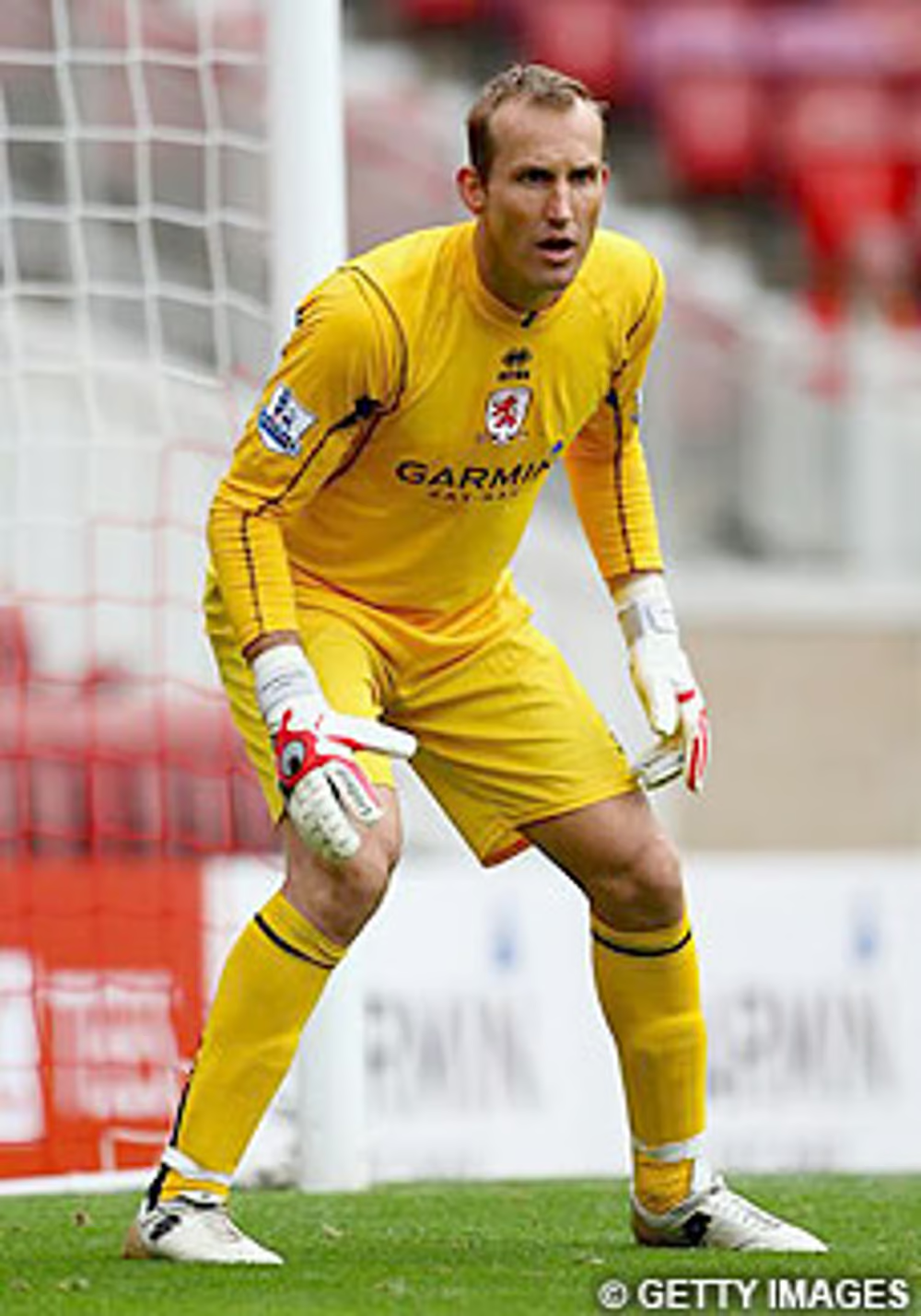
Schwarzer marshals his area while playing for Middlesbrough.
Schwarzer’s most defining attribute was his sense of position. For a keeper of his size (1.94m), he was remarkably economical with movement. His starting points were disciplined, conservative without being passive. Rather than rushing to the edge of the six yard box or sitting deep on his line, he occupied the “decision line,” a zone where he could still react to shots but also influence crosses and cutbacks.
This allowed him to make difficult saves look routine. Because he rarely overcommitted, his footwork remained tidy: short, lateral steps that kept his weight centred and his shoulders square. It meant he did not need the spectacular dive unless the situation truly demanded it. Schwarzer’s biggest saves often came without the flourish of airborne photography. They were the saves of a goalkeeper who had already done the thinking 0.5 seconds before the ball was struck.
This meant two things tactically.
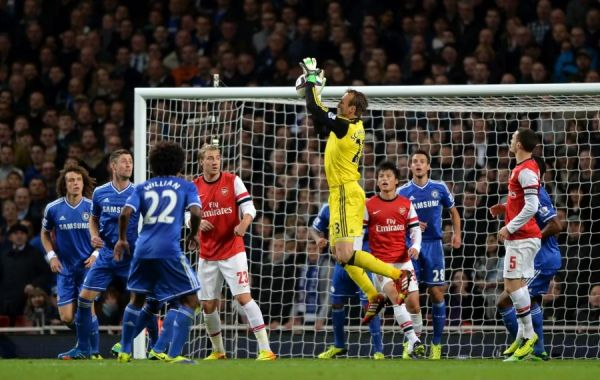
Schwarzer rises to claim a cross in Chelsea colours against Arsenal.
Schwarzer may not have been flamboyant, but he was commanding, particularly under the high ball. His judgment of flight and timing made him one of the Premier League’s most reliable aerial keepers.
He applied a simple rule: if he came, he claimed.
There were no half steps, no aborted leaps. His take offs were strong because they were committed. He entered traffic with broad shoulders, high knees, and authoritative voice projection, giving defenders a psychological licence to focus solely on their duel, knowing Schwarzer would clear the space if he chose to intervene.
Teams like Fulham, who often defended deep, depended on this dominance. Against sides like Stoke, Bolton, or early era Everton, where crossing volume was enormous, Schwarzer’s ability to “reset the box” with a single catch relieved sustained pressure.
Schwarzer did the opposite.
He held the pause.
He delayed.
By staying upright longer than most keepers, he forced strikers to make the first decision, often a rushed or imperfect one. Because he remained balanced, he could spread late, extend his frame, or drop into a reactive block.
The Uruguay save in 2005 is the quintessential example. He waited for Darío Rodríguez’s penalty to declare its height, then sprang. This micro patience defined his style in open play as well.
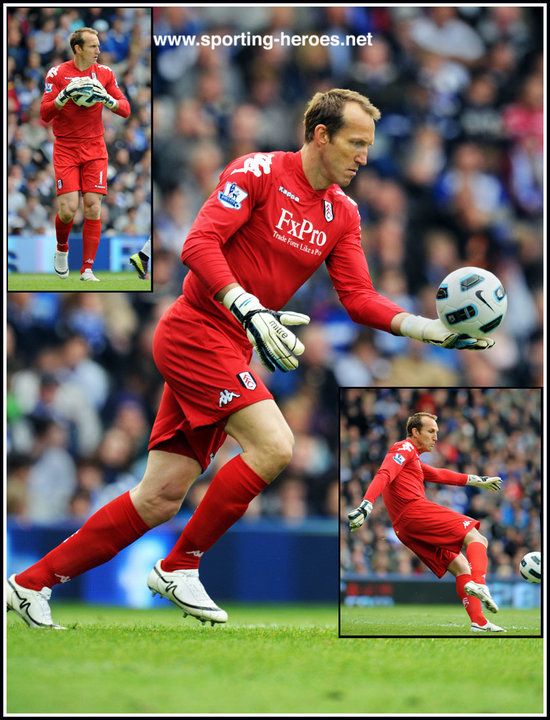
Schwarzer distributes the ball for Fulham.
Schwarzer was not a modern “quarterback goalkeeper.” He was trained in a more traditional era, and his distribution followed a risk managed model.
Long, targeted kicks into channels for Viduka at national level or Zamora at Fulham.
Clipped diagonals to the full back line when unpressed.
Quick throws to ignite counters, especially under Hodgson’s compact, transition oriented system.
He did not break lines with passes like Alisson or Ederson, but he also did not put his team into danger. His distribution philosophy was simple but tactically effective: maintain momentum, avoid turnovers, and trust the midfield structure.
This meant he reduced the angle of the shot before the striker realised it. He pushed off from clean, stable bases. His large frame could extend fully without technical compromise.
Even in his forties at Chelsea, this foundation allowed him to perform at Champions League level when called upon.
He was the metronome of the defensive line.
His ability to “pre coach” defensive actions, often shifting his back four a step earlier, spotting overloads, identifying triggers, reduced chaos. He was, tactically, a defensive coordinator wearing goalkeeper gloves.
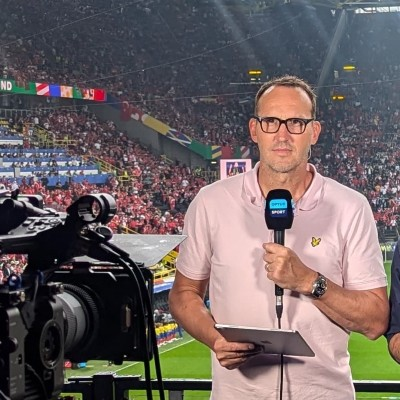
Schwarzer as a football pundit.
Schwarzer saw football through patterns. His preparation was forensic, studying striker habits, preferred shooting angles, pre shot cues. This analytical mindset is why he transitioned so seamlessly into punditry. He had been analysing the game his entire career from the best vantage point on the pitch.
In a Premier League era overwhelmed by shot stoppers, sweepers, and distribution wizards, Schwarzer was the rare figure who proved that control, not explosion, is the true currency of elite goalkeeping.
1. Positioning: The Foundation of Everything
Schwarzer marshals his area while playing for Middlesbrough.
Schwarzer’s most defining attribute was his sense of position. For a keeper of his size (1.94m), he was remarkably economical with movement. His starting points were disciplined, conservative without being passive. Rather than rushing to the edge of the six yard box or sitting deep on his line, he occupied the “decision line,” a zone where he could still react to shots but also influence crosses and cutbacks.
This allowed him to make difficult saves look routine. Because he rarely overcommitted, his footwork remained tidy: short, lateral steps that kept his weight centred and his shoulders square. It meant he did not need the spectacular dive unless the situation truly demanded it. Schwarzer’s biggest saves often came without the flourish of airborne photography. They were the saves of a goalkeeper who had already done the thinking 0.5 seconds before the ball was struck.
2. Handling and Ball Security
Where many Premier League keepers relied on parries, Schwarzer placed immense value on clean catches, a slightly old school preference that provided enormous defensive stability. His technique was textbook: body behind the ball, hands soft but secure, eyes never leaving the trajectory.This meant two things tactically.
- Counter attacks started with him, not the second phase.
His catches allowed for immediate distribution into wide channels, especially at Middlesbrough and Fulham where transitions were central to the game model. - Defensive confidence increased.
Centre backs played with the knowledge that Schwarzer was unlikely to spill a straightforward shot. That security shapes an entire block: defenders hold their line a metre higher, full backs can squeeze inward, midfielders defend forward.
3. Cross Management and Aerial Dominance
Schwarzer rises to claim a cross in Chelsea colours against Arsenal.
Schwarzer may not have been flamboyant, but he was commanding, particularly under the high ball. His judgment of flight and timing made him one of the Premier League’s most reliable aerial keepers.
He applied a simple rule: if he came, he claimed.
There were no half steps, no aborted leaps. His take offs were strong because they were committed. He entered traffic with broad shoulders, high knees, and authoritative voice projection, giving defenders a psychological licence to focus solely on their duel, knowing Schwarzer would clear the space if he chose to intervene.
Teams like Fulham, who often defended deep, depended on this dominance. Against sides like Stoke, Bolton, or early era Everton, where crossing volume was enormous, Schwarzer’s ability to “reset the box” with a single catch relieved sustained pressure.
4. One on One Situations: Patience as a Weapon
The single most underrated feature of Schwarzer’s game was his refusal to commit early in one on one moments. Many keepers attempt to win the moment through aggression: rushing the striker, spreading early, or diving at feet.Schwarzer did the opposite.
He held the pause.
He delayed.
By staying upright longer than most keepers, he forced strikers to make the first decision, often a rushed or imperfect one. Because he remained balanced, he could spread late, extend his frame, or drop into a reactive block.
The Uruguay save in 2005 is the quintessential example. He waited for Darío Rodríguez’s penalty to declare its height, then sprang. This micro patience defined his style in open play as well.
5. Distribution: Pragmatic, Not Playmaking
Schwarzer distributes the ball for Fulham.
Long, targeted kicks into channels for Viduka at national level or Zamora at Fulham.
Clipped diagonals to the full back line when unpressed.
Quick throws to ignite counters, especially under Hodgson’s compact, transition oriented system.
He did not break lines with passes like Alisson or Ederson, but he also did not put his team into danger. His distribution philosophy was simple but tactically effective: maintain momentum, avoid turnovers, and trust the midfield structure.
6. Footwork and Reaction Saves
Schwarzer’s reactions remained sharp deep into his late thirties, and the reason was mechanical: his footwork was superb. He never crossed his feet, never took unnecessary backward steps, and always set early.This meant he reduced the angle of the shot before the striker realised it. He pushed off from clean, stable bases. His large frame could extend fully without technical compromise.
Even in his forties at Chelsea, this foundation allowed him to perform at Champions League level when called upon.
7. Leadership and Defensive Organisation
Schwarzer was not loud, but he was authoritative. He communicated in concise, functional cues: distances, line height, body orientation. At Fulham, where Hodgson drilled a famously rigid 4 4 2 block, Schwarzer’s organisational clarity was fundamental.He was the metronome of the defensive line.
His ability to “pre coach” defensive actions, often shifting his back four a step earlier, spotting overloads, identifying triggers, reduced chaos. He was, tactically, a defensive coordinator wearing goalkeeper gloves.
8. The Analytical Mind Behind the Technique
Schwarzer as a football pundit.
Schwarzer saw football through patterns. His preparation was forensic, studying striker habits, preferred shooting angles, pre shot cues. This analytical mindset is why he transitioned so seamlessly into punditry. He had been analysing the game his entire career from the best vantage point on the pitch.
Conclusion: A Keeper Made of Craft, Not Chaos
Mark Schwarzer was not defined by one skill. He was defined by the absence of weaknesses. His game was a harmonious balance of geometry, timing, certainty, and restraint. He mastered the fundamentals so completely that he elevated them into an art form.In a Premier League era overwhelmed by shot stoppers, sweepers, and distribution wizards, Schwarzer was the rare figure who proved that control, not explosion, is the true currency of elite goalkeeping.
Honours & Achievements
- 2008–09: Fulham Player of the Year
- 2009: Awarded the Medal of the Order of Australia (OAM)
- 2009: Football Media Association Australia International Player of the Year
- 2009 & 2010: FFA Australian Football Awards: Footballer of the Year
- 2010: Australian Professional Football Association Player of the Year
- 2014: Awarded the Alex Tobin OAM Medal
- 2021: Inducted into the Football Australia Hall of Fame
- 2025: Inducted into the Sport Australia Hall of Fame