Football 360 recently made a mini documentary about the possibility of promotion relegation in Australia. In it Vince Rugari pours cold water on the idea asking, "where would the money come from?"

 football360.com.au
The question reminds me of discussing universal healthcare in the USA around 2010. On the one hand, the viability and benefit of universal healthcare has an absolute consensus across the worlds market democracies. On the other hand, within the bubble of USA politics, it is easy to pour cold water on the idea and even confident advocates can struggle to explain how universal healthcare works. Similarly, there are so few countries that lack promotion and relegation that it can be hard to measure the costs and benefits of it, since you have too few countries to compare with, and likewise, within the bubble of Australian football, skeptics confidently say it won't work here, and it is difficult even for passionate advocates to explain precisely why it would. Over the last few years I have been trying to understand this myself. Precisely what are the benefits of P&R? Are they really big enough to outdo the costs unique to the Australian sporting landscape? From my -admittedly lay- understanding of the sports economics literature, there are short and long term benefits that will pay for the cost many times over.
Short term benefits
If we implemented P&R tomorrow, there are 5 short term benefits I am aware of
1) A-league crowds having a small rise, probably around 15%
2) Big boost in 2nd division crowds
3) Owners willing to fund bigger deficits
4) A small improvement in the quality of the national team
5) A small improvement in transfer revenue
Lets go through these one at a time.
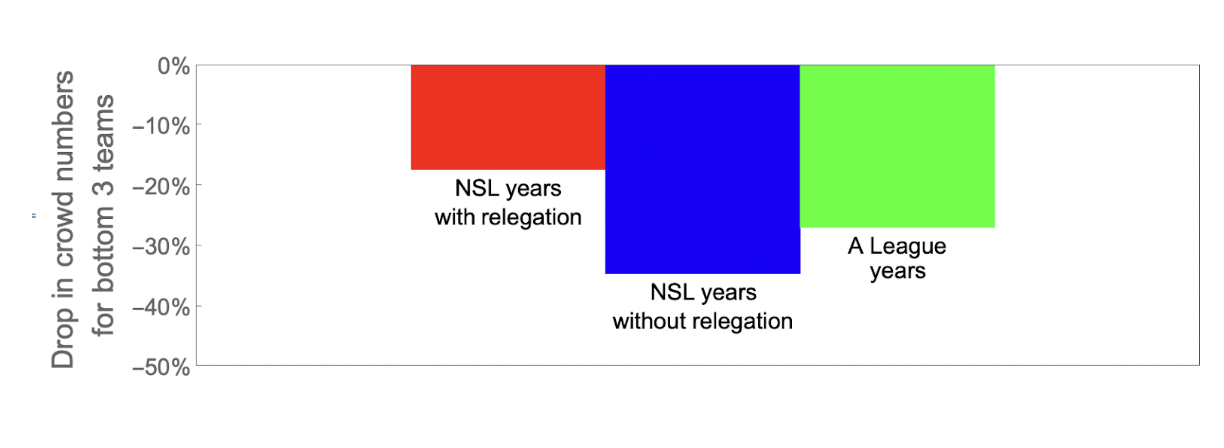
Crowds in the top division: Mexico recently introduced a closed shop at the top. Excluding years affected by COVID, their crowds dropped roughly 15% from averaging 23k to averaging around 20k, around 15%. This is perfectly consistent with theory. The top league benefits go to teams at the bottom of the ladder who still have something to play for when they realise they can't finish first. Even in the ad hoc promotion and relegation system we had in the first 16 years of the NSL, we see this effect. To compare like with like as much as possible, I choose eras where the league had roughly the same number of teams - the first 7 years of the NSL, compare it with the first 7 years after the ad hoc P&R was scrapped, and the last 7 years of the A-league, removing COVID affected years.
 The top division in the short term also benefits from a less divided game as fans of lower tier clubs tune in occasionally to see who they might be playing in the future.
2nd tier crowds: When Mexico transitioned to a closed shop, there was a much more dramatic drop in 2nd tier crowds - from around 4500 to 2500 if I exclude Covid affected years. Again this is consistent with theory, the lower parts of the pyramid benefit even more than the top once you open it up. No matter how bad things get, you still have hope in an open system and there is a more reason to dream and invest in players. We saw some hints of the life an open pyramid could breathe into lower divisions when NPL youtube audiences surged when the Australian championship was announced. In Australia, even amongst those who advocate for P&R often say we should build the tiers first before opening them up. One risk of that is that the 2nd division may have be unsustainable in a closed system but viable in an open system. Stefan Szymanski argued in detail that this is exactly what happened to minor league baseball in the USA. It is hard to extrapolate from the Australian championship to a home and away, but I would estimate a realistic target for a 10 team home and away league would be crowd averages of around 1500-2000 in a closed league which probably means around 2500-3000 in an open league. Those numbers are probably enough to make a closed league work, but counter intuitively there are more risks in a closed league than an open one.
Owners willing to run bigger deficits: The third benefit is probably the most important, even if it probably makes people squeamish. For all the complaints about A-league finances, it should be pointed out that clubs are spending roughly 4.8 million a year on player wages which is probably only half their revenue. The fair play capped spending on player wages initially at 90% of revenue, implying there were clubs that were spending in excess of that. Even the harsher cap on English third division clubs appears to exceed the fraction of revenue spent on players. The economic theory behind this is pretty simple. Club owners receive two benefits from spending money on a club - extra revenue and amenity value. The amenity value captures the passion and joy of your football team doing well as well as the prestige that comes in owning it. Since the amenity value is attractive to owners even in mediocre leagues, club owners tend to deficit spend. A cynic would call it sports-washing, an optimist might call it sports philanthropy. In an open system, there is a huge benefit to getting promoted and a huge cost to getting relegated. An owner will then spend more than what they would in a closed system to prevent relegation and try and secure promotion. With each round of A-league expansion, there were always rejected bids. In an open system, those interested investors aren't turned away, they can invest in a club lower down the pyramid and get them promoted, driving spending up across the board. For those wanting to know where the money comes from, in the short term a lot of it comes from sportwashing philanthropy.
Small improvements in quality: The last two benefits really come from the same effect. Even in the short term, P&R helps the quality of a domestic league as clubs at the bottom buy big midseason to avoid the drop. Since transfer revenues and the quality of the national league at least partly depend on the quality of the domestic league, both will rise slightly if we introduce P&R tomorrow. Mexico's ELO has been remarkably stable over the last 40 years, always very close to its recent rolling average of around 1860. Since denying access to the top tier their national team's ELO has hit a new plateau around 40 points lower and their transfer revenue has not kept up with football inflation.
Long term benefits
A system of promotion and relegation is like investing in a Superannuation - the costs are flat but the benefits accumulate over time. There are three known, long term benefits of opening the pyramid.
1) Faster growth in crowds
2) Faster increase in quality
3) Higher participation rate
Faster growth in crowds: One worry Australian football fans have about promotion and relegation is what happens if a club gets promoted before they are big enough to survive at a higher level. However, according to Roger Noll, one way an open pyramid grows their crowds is precisely through clubs climbing higher than they can handle. If a club gets promoted, they gain more in crowds than they lose if they get relegated the next season. Successive seasons of yoyoing up and down the divisions can transition a club not ready for the big time into a club making waves at the highest level. Incredibly, as ad-hoc as the P&R system the NSL had in its first 16 years, we still see this effect despite P&R being decided by "smoke filled board rooms" rather than football merit. In those 16 years I see 4 instances where a club got promoted the year after relegation.
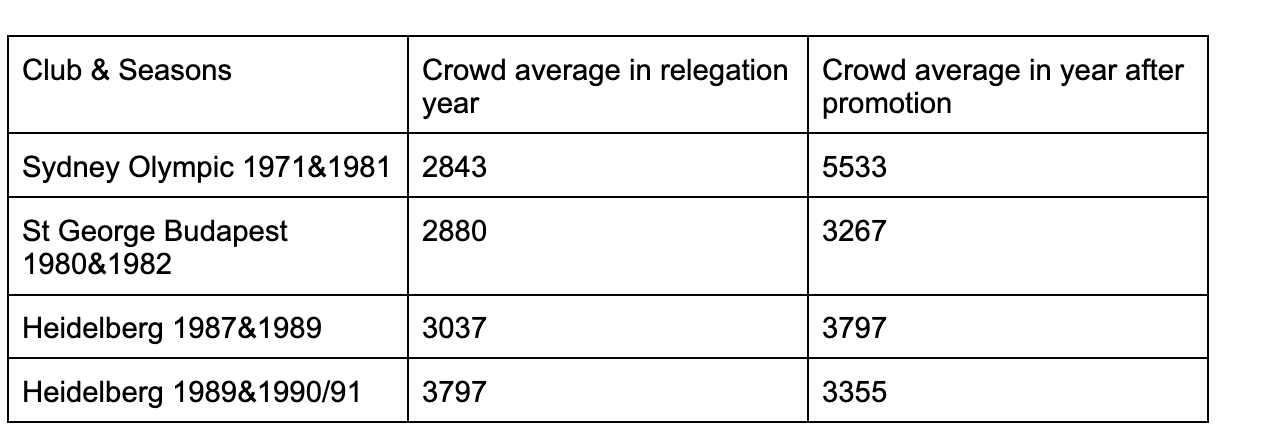 Three out of four times a club yo-yoed they gained in crowds and the average gain was 800 across the 4 clubs. Both these numbers are strikingly similar to yoyo clubs I looked at in Japan and England. The difference is how often clubs yoyo. In England there is an average of 1 club a year getting promoted to the EPL the year after relegation, four times the rate the NSL had. To maximize the benefits of P&R, you need to have a system where yo-yoing happens regularly. A club growing their fan base by 800 every year doesn't sound like a lot. But countries that have had P&R for a century have had these benefits accumulate over a century. Just like a Superannuation, these benefits add up over time.
Faster growth in quality: P&R is also predicted to improve the quality of a league over time faster than a closed shop. This is hard to empirically prove due to the fact that there are so few countries without promotion and relegation. However, in Australia we have seen NPL clubs improve there results against A-league clubs year on year, with Victoria being the most impressive state and having the deepest, connected pyramid. The national team's elo improved from the start of the NSL until the mid 90s, shortly after the pulling up the draw bridge, before there was a plateau and then decline, though, to be fair we do appear to be improving again but probably not to the same level. The National Curriculum says that the golden age of youth development is between the age of 10 and 13. This means that those born 1967 to 1980 spent their entire skills acquisition phase in a ecosystem with ad hoc promotion and relegation. If we compare the careers of those players born in those birth years with the rest of history, the contrast is pretty stark!
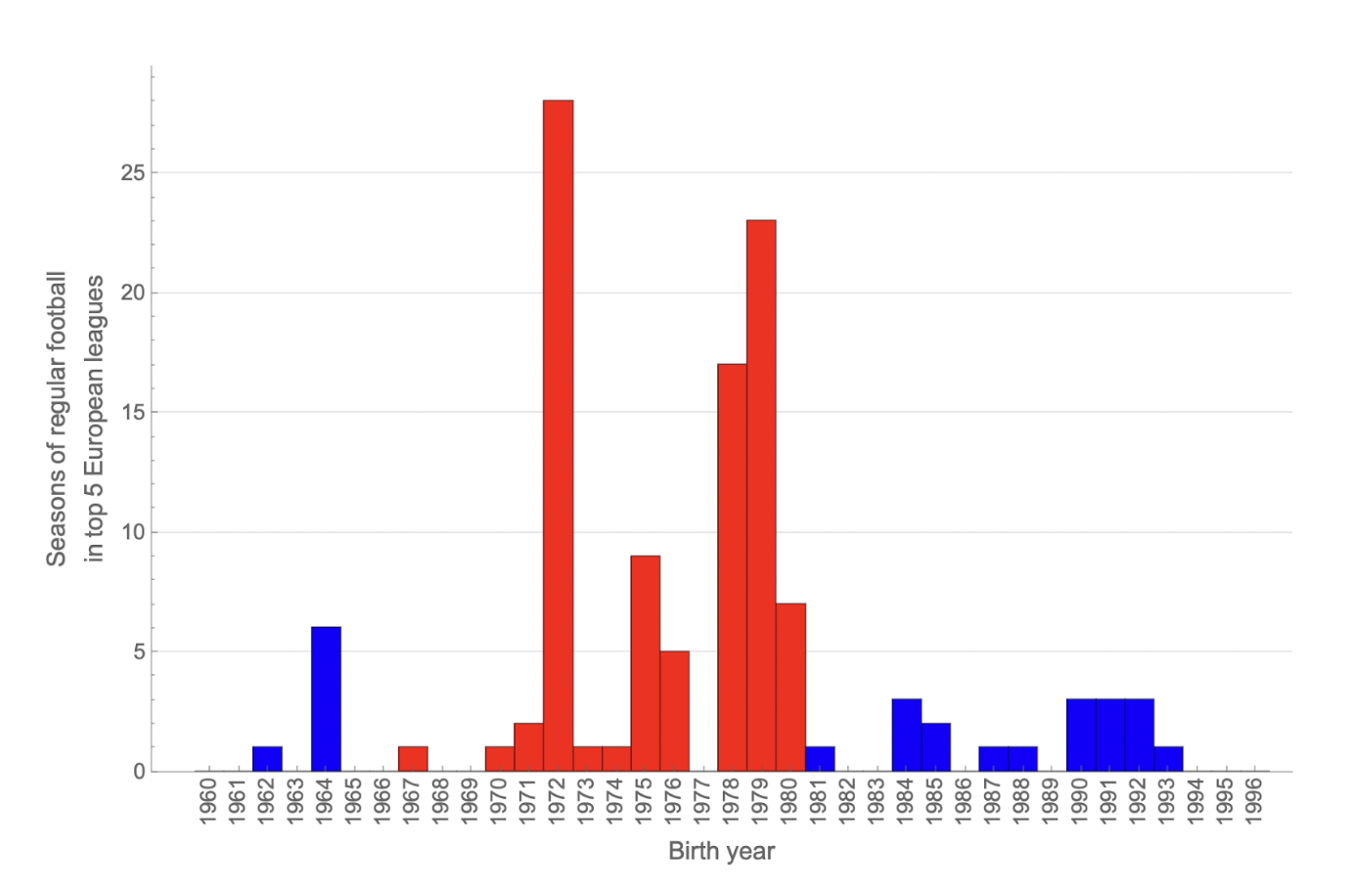 There are many other factors at play here, but it is worth pointing out the only evidence we have for P&R in Australia points in the same direction economic theory says it should - connecting the pyramid leads to football improving over time.
Higher participation rate: Finally, a less known benefit discovered by Hyungwoong Pyun and others is that an open pyramid boosts the participation rate. As impressive as our participation numbers sound, consider that England is only twice the size of Australia yet has roughly ten times the participation rate. The exact way in which a pyramid gets more people playing the game isn't precisely known. However, you can give a fairly common sense explanation that it works just like any other business. If you are at the bottom of the pyramid and you desire to rise to the top, how do you get revenue? It is too low down the ladder to get crowds, sponsors or sell players. Your only means of success is getting very good at enticing both kids and adults to play football. Having the carrot of promotion all the way to the big time means that you get an army of small business competing on getting more to play the game. Moreover, the number of fans that turn up to games in domestic competitions grows with the number of football participants. If we reach our potential, we could quadruple the size of the market of potential fans.
Once again it is worth noting that the cautious approach of getting tiers strong enough before connecting them carries a risk of dampening this long term benefit. If you preselect who are the favoured clubs who will appear at the top of the pyramid, you risk signalling that this isn't really something those at the bottom should aspire to and dampening their ambition, missing out on the participation rate getting turbo charged.
But our country is too spread out
One of the most common objections is to point to how spread out our country is. However, Australia isn't as unique in this as people might suppose. Here is a map of clubs in Kazakhstan's second division, where the longest trip takes teams farther than the distance from Brisbane to Adelaide
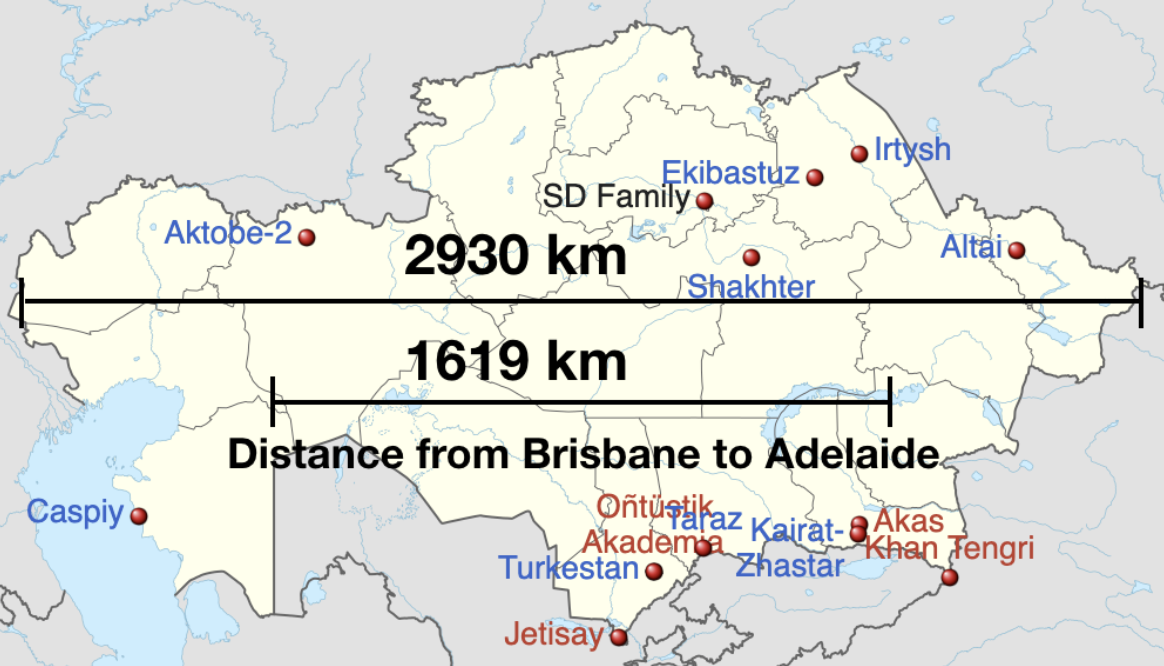 And yet Kazakhstan manages to sustain a connected pyramid with a second division averaging just 620 spectators per match. Sports philanthropy, transfers, local sponsors and grassroots revenue turns out to be plenty to cover the travel costs and keep the pyramid sustainable, despite this not being a prestigious football country.
But other, richer codes don't pull it off
This is a pretty interesting topic, as it isn't just Australia where other sports lack promotion and relegation, yet nearly every football pyramid in the world is connected. No one has looked carefully at the exact reasons, but one possibility is that football is just unique. Football is such a simple and accessible sport. Even in Australia, it has a participation rate which dwarfs other codes. This means that the law of large numbers works in clubs favour in a competitive system, there are so many grassroots clubs that the odds of the occasional one being an outlier that vastly exceeds any realistic expectations is actually high. However, Stefan Szymanski made a persuasive argument that promotion and relegation would have saved America's minor league system, suggesting it could work in other codes. That raises the question, why don't other codes that could pull off this system take the plunge and implement it?
I suspect the answer is that football just has more drive to implement promotion and relegation because it is a low scoring game. If a match is meaningless, football has an enormous negative in that there are very few goals compared to other sports, which can make it feel like there is very little action. If a match is meaningful, the low scoring nature of football goes from a net negative to a net positive. You sit on the edge of your seat on a knife edge covering your mouth in horror at every near miss and screaming with joy if that darn ball finally crosses the line in a moment that could be the difference between your club getting relegated or staying up. Promotion and relegation means every goal, near miss and even scoreless draws are part of a larger season long narrative that drives fans wild. Our small but passionate football media do an amazing job trying to conjure stories in the absence of promotion of relegation. I think our football coverage is amongst the best in the world. But the reality is, creating stories without promotion and relegation is always going to be running up hill - kind of like trying to do political horse race journalism in a one party state. Put another way, how many AFL or NRL fans are advocating for promotion and relegation in their code? Not many, which is a major reason they don't have it even if they would benefit from it. Even in Australia, promotion and relegation is much more popular amongst football fans.
The cumulative case
Perhaps the strongest case against P&R is the cumulative case that doesn't point to one unique aspect that makes it hard to implement P&R in Australia, but the combined set of obstacles. This case was best articulated by Joe Gorman who argued
"Nowhere else in the world has such a perfect storm of problems that would prevent a successful implementation. Few countries have equalisation measures such as the salary cap, which in the event of promotion and relegation would have to be immediately scrapped. No country has so many other professional codes of football to compete with, along with such huge distances and such a small population base. No other country has such enormous and unresolved questions around the identity of its best lower-league clubs."
I do admit I feel the force of this argument. But what at first sounds like reasoned skepticism presents as obstacles to promotion to relegation the very things that the system solves. We aren't the only country with other codes to compete with, but the cumulative effect of many decades of promotion and relegation grows the sport so that those codes stop being a threat. Revenue to pay for extra travel is a problem, but an open pyramid is precisely the mechanism to overcome that problem. Even the identity problems, if they are still an obstacle in todays Australia where even our far right tends to be a rainbow coalition, an open pyramid provides the competitive environment needed for clubs to innovate to find ways to evolve their identity and attract new fans.
Truth be told, the economics of promotion and relegation is complicated, as is Australia's unique environment. However, I've always thought there is value in listening to people who spend their whole life studying a complex areas. I don't understand everything about immunology, but those who study it for a living vouch for the necessity of vaccines. When I asked two of the best football economists in the world, who happened to be very familiar with Australia's unique problems, they both advocated for a system of promotion and relegation as what we need to fix football in our country. That ought to carry a lot of weight.
To many, it seems that promotion and relegation is what we get as a reward for when football has arrived in this country, rather than a means to get there in the first place. However, what seems like cautious wisdom, could be throwing away the opportunity to make football work in our country. If we wait for football to prosperous enough to bring it about, the risk is we could be waiting forever.
Introducing our brand new series BREAKING BARRIERS: Episode 1 - Game Changer is LIVE NOW
Episode One of BREAKING BARRIERS, a Bruce Originals series on football360.com.au following an aspirational grassroots football project.
football360.com.au
The question reminds me of discussing universal healthcare in the USA around 2010. On the one hand, the viability and benefit of universal healthcare has an absolute consensus across the worlds market democracies. On the other hand, within the bubble of USA politics, it is easy to pour cold water on the idea and even confident advocates can struggle to explain how universal healthcare works. Similarly, there are so few countries that lack promotion and relegation that it can be hard to measure the costs and benefits of it, since you have too few countries to compare with, and likewise, within the bubble of Australian football, skeptics confidently say it won't work here, and it is difficult even for passionate advocates to explain precisely why it would. Over the last few years I have been trying to understand this myself. Precisely what are the benefits of P&R? Are they really big enough to outdo the costs unique to the Australian sporting landscape? From my -admittedly lay- understanding of the sports economics literature, there are short and long term benefits that will pay for the cost many times over.
Short term benefits
If we implemented P&R tomorrow, there are 5 short term benefits I am aware of
1) A-league crowds having a small rise, probably around 15%
2) Big boost in 2nd division crowds
3) Owners willing to fund bigger deficits
4) A small improvement in the quality of the national team
5) A small improvement in transfer revenue
Lets go through these one at a time.
Crowds in the top division: Mexico recently introduced a closed shop at the top. Excluding years affected by COVID, their crowds dropped roughly 15% from averaging 23k to averaging around 20k, around 15%. This is perfectly consistent with theory. The top league benefits go to teams at the bottom of the ladder who still have something to play for when they realise they can't finish first. Even in the ad hoc promotion and relegation system we had in the first 16 years of the NSL, we see this effect. To compare like with like as much as possible, I choose eras where the league had roughly the same number of teams - the first 7 years of the NSL, compare it with the first 7 years after the ad hoc P&R was scrapped, and the last 7 years of the A-league, removing COVID affected years.
2nd tier crowds: When Mexico transitioned to a closed shop, there was a much more dramatic drop in 2nd tier crowds - from around 4500 to 2500 if I exclude Covid affected years. Again this is consistent with theory, the lower parts of the pyramid benefit even more than the top once you open it up. No matter how bad things get, you still have hope in an open system and there is a more reason to dream and invest in players. We saw some hints of the life an open pyramid could breathe into lower divisions when NPL youtube audiences surged when the Australian championship was announced. In Australia, even amongst those who advocate for P&R often say we should build the tiers first before opening them up. One risk of that is that the 2nd division may have be unsustainable in a closed system but viable in an open system. Stefan Szymanski argued in detail that this is exactly what happened to minor league baseball in the USA. It is hard to extrapolate from the Australian championship to a home and away, but I would estimate a realistic target for a 10 team home and away league would be crowd averages of around 1500-2000 in a closed league which probably means around 2500-3000 in an open league. Those numbers are probably enough to make a closed league work, but counter intuitively there are more risks in a closed league than an open one.
Owners willing to run bigger deficits: The third benefit is probably the most important, even if it probably makes people squeamish. For all the complaints about A-league finances, it should be pointed out that clubs are spending roughly 4.8 million a year on player wages which is probably only half their revenue. The fair play capped spending on player wages initially at 90% of revenue, implying there were clubs that were spending in excess of that. Even the harsher cap on English third division clubs appears to exceed the fraction of revenue spent on players. The economic theory behind this is pretty simple. Club owners receive two benefits from spending money on a club - extra revenue and amenity value. The amenity value captures the passion and joy of your football team doing well as well as the prestige that comes in owning it. Since the amenity value is attractive to owners even in mediocre leagues, club owners tend to deficit spend. A cynic would call it sports-washing, an optimist might call it sports philanthropy. In an open system, there is a huge benefit to getting promoted and a huge cost to getting relegated. An owner will then spend more than what they would in a closed system to prevent relegation and try and secure promotion. With each round of A-league expansion, there were always rejected bids. In an open system, those interested investors aren't turned away, they can invest in a club lower down the pyramid and get them promoted, driving spending up across the board. For those wanting to know where the money comes from, in the short term a lot of it comes from sport
Small improvements in quality: The last two benefits really come from the same effect. Even in the short term, P&R helps the quality of a domestic league as clubs at the bottom buy big midseason to avoid the drop. Since transfer revenues and the quality of the national league at least partly depend on the quality of the domestic league, both will rise slightly if we introduce P&R tomorrow. Mexico's ELO has been remarkably stable over the last 40 years, always very close to its recent rolling average of around 1860. Since denying access to the top tier their national team's ELO has hit a new plateau around 40 points lower and their transfer revenue has not kept up with football inflation.
Long term benefits
A system of promotion and relegation is like investing in a Superannuation - the costs are flat but the benefits accumulate over time. There are three known, long term benefits of opening the pyramid.
1) Faster growth in crowds
2) Faster increase in quality
3) Higher participation rate
Faster growth in crowds: One worry Australian football fans have about promotion and relegation is what happens if a club gets promoted before they are big enough to survive at a higher level. However, according to Roger Noll, one way an open pyramid grows their crowds is precisely through clubs climbing higher than they can handle. If a club gets promoted, they gain more in crowds than they lose if they get relegated the next season. Successive seasons of yoyoing up and down the divisions can transition a club not ready for the big time into a club making waves at the highest level. Incredibly, as ad-hoc as the P&R system the NSL had in its first 16 years, we still see this effect despite P&R being decided by "smoke filled board rooms" rather than football merit. In those 16 years I see 4 instances where a club got promoted the year after relegation.
Faster growth in quality: P&R is also predicted to improve the quality of a league over time faster than a closed shop. This is hard to empirically prove due to the fact that there are so few countries without promotion and relegation. However, in Australia we have seen NPL clubs improve there results against A-league clubs year on year, with Victoria being the most impressive state and having the deepest, connected pyramid. The national team's elo improved from the start of the NSL until the mid 90s, shortly after the pulling up the draw bridge, before there was a plateau and then decline, though, to be fair we do appear to be improving again but probably not to the same level. The National Curriculum says that the golden age of youth development is between the age of 10 and 13. This means that those born 1967 to 1980 spent their entire skills acquisition phase in a ecosystem with ad hoc promotion and relegation. If we compare the careers of those players born in those birth years with the rest of history, the contrast is pretty stark!
Higher participation rate: Finally, a less known benefit discovered by Hyungwoong Pyun and others is that an open pyramid boosts the participation rate. As impressive as our participation numbers sound, consider that England is only twice the size of Australia yet has roughly ten times the participation rate. The exact way in which a pyramid gets more people playing the game isn't precisely known. However, you can give a fairly common sense explanation that it works just like any other business. If you are at the bottom of the pyramid and you desire to rise to the top, how do you get revenue? It is too low down the ladder to get crowds, sponsors or sell players. Your only means of success is getting very good at enticing both kids and adults to play football. Having the carrot of promotion all the way to the big time means that you get an army of small business competing on getting more to play the game. Moreover, the number of fans that turn up to games in domestic competitions grows with the number of football participants. If we reach our potential, we could quadruple the size of the market of potential fans.
Once again it is worth noting that the cautious approach of getting tiers strong enough before connecting them carries a risk of dampening this long term benefit. If you preselect who are the favoured clubs who will appear at the top of the pyramid, you risk signalling that this isn't really something those at the bottom should aspire to and dampening their ambition, missing out on the participation rate getting turbo charged.
But our country is too spread out
One of the most common objections is to point to how spread out our country is. However, Australia isn't as unique in this as people might suppose. Here is a map of clubs in Kazakhstan's second division, where the longest trip takes teams farther than the distance from Brisbane to Adelaide
But other, richer codes don't pull it off
This is a pretty interesting topic, as it isn't just Australia where other sports lack promotion and relegation, yet nearly every football pyramid in the world is connected. No one has looked carefully at the exact reasons, but one possibility is that football is just unique. Football is such a simple and accessible sport. Even in Australia, it has a participation rate which dwarfs other codes. This means that the law of large numbers works in clubs favour in a competitive system, there are so many grassroots clubs that the odds of the occasional one being an outlier that vastly exceeds any realistic expectations is actually high. However, Stefan Szymanski made a persuasive argument that promotion and relegation would have saved America's minor league system, suggesting it could work in other codes. That raises the question, why don't other codes that could pull off this system take the plunge and implement it?
I suspect the answer is that football just has more drive to implement promotion and relegation because it is a low scoring game. If a match is meaningless, football has an enormous negative in that there are very few goals compared to other sports, which can make it feel like there is very little action. If a match is meaningful, the low scoring nature of football goes from a net negative to a net positive. You sit on the edge of your seat on a knife edge covering your mouth in horror at every near miss and screaming with joy if that darn ball finally crosses the line in a moment that could be the difference between your club getting relegated or staying up. Promotion and relegation means every goal, near miss and even scoreless draws are part of a larger season long narrative that drives fans wild. Our small but passionate football media do an amazing job trying to conjure stories in the absence of promotion of relegation. I think our football coverage is amongst the best in the world. But the reality is, creating stories without promotion and relegation is always going to be running up hill - kind of like trying to do political horse race journalism in a one party state. Put another way, how many AFL or NRL fans are advocating for promotion and relegation in their code? Not many, which is a major reason they don't have it even if they would benefit from it. Even in Australia, promotion and relegation is much more popular amongst football fans.
The cumulative case
Perhaps the strongest case against P&R is the cumulative case that doesn't point to one unique aspect that makes it hard to implement P&R in Australia, but the combined set of obstacles. This case was best articulated by Joe Gorman who argued
"Nowhere else in the world has such a perfect storm of problems that would prevent a successful implementation. Few countries have equalisation measures such as the salary cap, which in the event of promotion and relegation would have to be immediately scrapped. No country has so many other professional codes of football to compete with, along with such huge distances and such a small population base. No other country has such enormous and unresolved questions around the identity of its best lower-league clubs."
I do admit I feel the force of this argument. But what at first sounds like reasoned skepticism presents as obstacles to promotion to relegation the very things that the system solves. We aren't the only country with other codes to compete with, but the cumulative effect of many decades of promotion and relegation grows the sport so that those codes stop being a threat. Revenue to pay for extra travel is a problem, but an open pyramid is precisely the mechanism to overcome that problem. Even the identity problems, if they are still an obstacle in todays Australia where even our far right tends to be a rainbow coalition, an open pyramid provides the competitive environment needed for clubs to innovate to find ways to evolve their identity and attract new fans.
Truth be told, the economics of promotion and relegation is complicated, as is Australia's unique environment. However, I've always thought there is value in listening to people who spend their whole life studying a complex areas. I don't understand everything about immunology, but those who study it for a living vouch for the necessity of vaccines. When I asked two of the best football economists in the world, who happened to be very familiar with Australia's unique problems, they both advocated for a system of promotion and relegation as what we need to fix football in our country. That ought to carry a lot of weight.
To many, it seems that promotion and relegation is what we get as a reward for when football has arrived in this country, rather than a means to get there in the first place. However, what seems like cautious wisdom, could be throwing away the opportunity to make football work in our country. If we wait for football to prosperous enough to bring it about, the risk is we could be waiting forever.