Most weeks I hear fans and pundits saying that the A-League is out of balance and playing too many youth. Without naming names, I have heard one pundit claim that young players aren't earning their spots. Another has called it a boys league, and multiple others imply the sheer numbers of young players getting a go signals a decline in on field quality. Indeed, we are playing a lot more youth than we used to. This season -despite Western United going into hibernation reducing the cohort of Australian A league clubs to 10- the number of young Australian players getting minutes this season hasn't changed much from last year. Thus indicating we might be an even more youth friendly league than we were in 2024!
However, it would be a mistake to assume just because the players are younger that they are inferior. As the old saying goes "if you are good enough, you are old enough". From my view, the first graduates of A-league academies are already often better than the prime age players they are replacing. In fact, the data I will share in this article demonstrates that, if anything, A-league clubs are being too conservative in giving minutes to youth. Especially considering that young players are more likely to improve over the course of the season. I would argue that clubs should be even more youth friendly than just always playing their best XI on the day. A prime age player that is similar quality -or even slightly better at the start of a season than a young player- will probably be weaker after a dozen rounds, than a young talent if the latter is given a chance to play week in week out. However, it seems that clubs are actually playing older players at the cost of results.
There are currently 38 young Australian players with enough minutes this season to make Fotmob's list of highest ranking players. Of those, 23 kids have a rating in the top half of players, with only 15 below average.* This suggests that young players actually have to be above average in order to get game time, contrary to belief that they are dragging the quality of teams down. So much for not earning their spots!
Fotmob ratings aren't everyone's cup of tea, I've even seen people mock the use of them. Well it isn't just mobile phone rating apps showing youth are pulling their weight. Arguably the most important measure of all is how many games your team wins. Regardless of whether you look at the average age of a squad or the starting XI of a teams last game**, backing youth this season has led to more success.

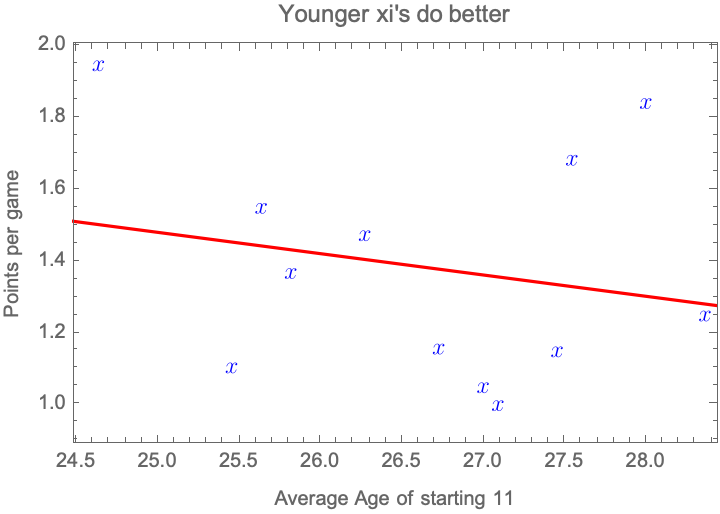
To be fair the correlation in both cases is pretty small, around 40% of the variation in results can be explained by the age of the squads and 20% by the age of the starting XI. However, to even have no correlation between results and age would be a big green flag to be more aggressive in playing youth. After many years of watching Aussies abroad in 2nd tier leagues such as the Danish Superliga, Jupiler league, Eredivisie and Austrian Bundesliga, it is not unusual to see young players who are below the level get a start with the aim to develop them through game time and sell them on. The extra revenue means that you can buy better players in other positions, meaning the average quality of the team goes up even if it is carrying the young players.
In our case we get a small, noisy negative correlation. This is actually pretty unusual in Australian history and suggests a big jump in the quality of Australian football is coming over the next few years. A few years ago, the PFA commissioned a report to try and understand the production of our golden generation, and the legendary Andrew Howe looked at how much success was tied to the age of a team. The result was the graph below where Andrew plots the variation of results as a function of the average age. A score of 1 means that the age of a team is a perfect predictor of their success with older being better, and a score of -1 means it is again a perfect predictor but the younger the better. A score of zero means age does not matter. If you look at the dashed line rolling through the noise of year to year scores, that is the "rolling average" which almost always is above zero, indicating that experience brings success.

When that dashed line was low, it was times a generation came through that was higher quality than the generation it replaced. In contrast, the so called "missing generation" corresponds to the rolling average being high as the younger players were not good enough to replace the older ones. Of the first 45 seasons in Australian football history, there are just 7 seasons when playing youth led to better results and just two eras when the rolling average in the above graph dropped below zero, the late 80s, early 90s, and the late 90s. I'll leave it to NSL aficionado's to remind us of the players that came through in those two eras but I'd expect the names to be familiar to all but the most casual Socceroo fans! But for those who truly don't know, the late 80s and early 90s was the era that brought us names like Zelic, Okon as well as the current Socceroos coach, Popovic, and we started seeing success for the first time in international youth tournaments. The second era took us to another level again with the golden generation. The rolling average has dropped to zero for just the third time in Australian history.
I don't want to overstate the jump in quality we are seeing - the next crop of players look a lot better than anything produced in the A league era, but they still are tracking as a cohort to have less successful club careers than that amazing generation born between 1975 and 1980. I suspect this will be more like that first jump in quality we saw in the early 90s. Nevertheless, coaches need to ignore the noise from pundits who keep associating youth with low quality. Jets are sitting top of the table with one of the youngest squads in the league, and Melbourne City managed to make the round of 16 in the ACL Elite with the youngest squad in the competition. If anything, they did better before the transfer window when they had an injury crisis and had to rely on their academy even more.
Youth aren't just keeping clubs afloat with transfer revenue, more often than not this season they are just better. It's time to back the kids!
* This list excludes M. Evagorou-Alao whose birth year I cannot find, as well as players ineligible for Australia, including all NZ players, and Charbel Shamoon.
** Scores and data recorded at the end of matches on Friday the 6th of March
| 24/25 season | 25/26 season* |
number of u23s | 18 | 16 |
number of u22s | 19 | 16 |
number of u21s | 27 | 33 |
number of u20s | 25 | 26 |
number of u19s | 19 | 15 |
number of u18s | 6 | 5 |
number of u17s | 3 | 4 |
However, it would be a mistake to assume just because the players are younger that they are inferior. As the old saying goes "if you are good enough, you are old enough". From my view, the first graduates of A-league academies are already often better than the prime age players they are replacing. In fact, the data I will share in this article demonstrates that, if anything, A-league clubs are being too conservative in giving minutes to youth. Especially considering that young players are more likely to improve over the course of the season. I would argue that clubs should be even more youth friendly than just always playing their best XI on the day. A prime age player that is similar quality -or even slightly better at the start of a season than a young player- will probably be weaker after a dozen rounds, than a young talent if the latter is given a chance to play week in week out. However, it seems that clubs are actually playing older players at the cost of results.
There are currently 38 young Australian players with enough minutes this season to make Fotmob's list of highest ranking players. Of those, 23 kids have a rating in the top half of players, with only 15 below average.* This suggests that young players actually have to be above average in order to get game time, contrary to belief that they are dragging the quality of teams down. So much for not earning their spots!
Fotmob ratings aren't everyone's cup of tea, I've even seen people mock the use of them. Well it isn't just mobile phone rating apps showing youth are pulling their weight. Arguably the most important measure of all is how many games your team wins. Regardless of whether you look at the average age of a squad or the starting XI of a teams last game**, backing youth this season has led to more success.
To be fair the correlation in both cases is pretty small, around 40% of the variation in results can be explained by the age of the squads and 20% by the age of the starting XI. However, to even have no correlation between results and age would be a big green flag to be more aggressive in playing youth. After many years of watching Aussies abroad in 2nd tier leagues such as the Danish Superliga, Jupiler league, Eredivisie and Austrian Bundesliga, it is not unusual to see young players who are below the level get a start with the aim to develop them through game time and sell them on. The extra revenue means that you can buy better players in other positions, meaning the average quality of the team goes up even if it is carrying the young players.
In our case we get a small, noisy negative correlation. This is actually pretty unusual in Australian history and suggests a big jump in the quality of Australian football is coming over the next few years. A few years ago, the PFA commissioned a report to try and understand the production of our golden generation, and the legendary Andrew Howe looked at how much success was tied to the age of a team. The result was the graph below where Andrew plots the variation of results as a function of the average age. A score of 1 means that the age of a team is a perfect predictor of their success with older being better, and a score of -1 means it is again a perfect predictor but the younger the better. A score of zero means age does not matter. If you look at the dashed line rolling through the noise of year to year scores, that is the "rolling average" which almost always is above zero, indicating that experience brings success.
When that dashed line was low, it was times a generation came through that was higher quality than the generation it replaced. In contrast, the so called "missing generation" corresponds to the rolling average being high as the younger players were not good enough to replace the older ones. Of the first 45 seasons in Australian football history, there are just 7 seasons when playing youth led to better results and just two eras when the rolling average in the above graph dropped below zero, the late 80s, early 90s, and the late 90s. I'll leave it to NSL aficionado's to remind us of the players that came through in those two eras but I'd expect the names to be familiar to all but the most casual Socceroo fans! But for those who truly don't know, the late 80s and early 90s was the era that brought us names like Zelic, Okon as well as the current Socceroos coach, Popovic, and we started seeing success for the first time in international youth tournaments. The second era took us to another level again with the golden generation. The rolling average has dropped to zero for just the third time in Australian history.
I don't want to overstate the jump in quality we are seeing - the next crop of players look a lot better than anything produced in the A league era, but they still are tracking as a cohort to have less successful club careers than that amazing generation born between 1975 and 1980. I suspect this will be more like that first jump in quality we saw in the early 90s. Nevertheless, coaches need to ignore the noise from pundits who keep associating youth with low quality. Jets are sitting top of the table with one of the youngest squads in the league, and Melbourne City managed to make the round of 16 in the ACL Elite with the youngest squad in the competition. If anything, they did better before the transfer window when they had an injury crisis and had to rely on their academy even more.
Youth aren't just keeping clubs afloat with transfer revenue, more often than not this season they are just better. It's time to back the kids!
* This list excludes M. Evagorou-Alao whose birth year I cannot find, as well as players ineligible for Australia, including all NZ players, and Charbel Shamoon.
** Scores and data recorded at the end of matches on Friday the 6th of March