"La Vieille Dame" - The Old Lady of French Football
)
Kylian Mbappe looks at the French Cup trophy after winning the final in his last game for PSG.
The Coupe de France is affectionately known as "La Vieille Dame" - the Old Lady, a nickname that captures both its age and its prestige. Born in 1917, it is one of the oldest national football competitions in the world, and it carries with it a sense of gravitas, memory, and ritual.
Where the league is hierarchical and predictable, the Coupe stands apart - open to every club in the country, from tiny village sides to European giants. It embodies a kind of footballing democracy that feels increasingly rare. This is an historical reflection on one the world football’s greatest domestic cup tournaments.
The Republic on the Pitch: The Historical Significance of the Coupe de France
I. Prologue: A Tournament Like No Other
Every nation with football in its bloodstream cultivates a mythology around its domestic cup competitions. England celebrates the whimsy of “giant-killings" in the FA Cup. Spain stages the Copa del Rey with royal pomp, Italy’s Coppa Italia with operatic intensity. But nowhere is a national cup competition more inseparable from a nation’s political imagination than in France where the Coupe de France has, for more than a century, functioned as a living stage upon which France performs its self-conception.
The Coupe is not merely a football tournament. It is a ritual. It is France, in its sprawling, contradictory entirety, placed onto the same patch of grass. On one night in May each year, in the cavernous amphitheatre of the Stade de France, factory workers from Normandy, postal clerks from Corsica, grain farmers from the Auvergne, and million-euro athletes from Paris or Marseille stand under the same tricolore flag. They enter the same tunnel. They line up before the same Marseillaise. And for 90 minutes, they are accorded equal footing. The great fiction of French equality perhaps fiction, perhaps aspiration briefly becomes reality.
This is why, to understand the Coupe de France, one must understand it not as a sporting competition but as the most enduring cultural mirror of the French Republic itself. To trace its history is to trace a century of French anxieties, aspirations, ruptures, and reconciliations. And to grasp its continued importance is to realise that the Coupe remains one of the last places where France still gathers, physically, symbolically, and emotionally, as a whole.
II. Origins in Ashes: A Cup Born from War (1916–1920)
The Coupe de France was not conceived in jubilation, but in trauma. During the First World War, French sport like the rest of French life was dismembered. Hundreds of footballers died in the trenches. Clubs dissolved, stadiums became hospitals, and the very continuity of organised sport seemed frivolous in the face of national catastrophe.
Yet even as the war raged, a group of administrators led by Henri Delaunay. The visionary -later instrumental in creating the European Championship- sought to imagine a postwar France rebuilt not only through infrastructure but through institutions that could heal civic bonds. Football, which had only recently taken root in France, was seen as fertile ground for unity.
In 1916, amid artillery fire and national mourning, the Comité Français Interfédéral established a competition open to every club in the country, professional or amateur, Catholic or secular, Parisian or provincial. The idea was revolutionary. Other nations’ cup competitions were already decades old, but none had been designed with universality as a founding principle. The Coupe’s DNA was explicitly democratic.
When the war ended, France faced the staggering task of reassembling itself. Rail lines were twisted scrap. Villages were hollow shells. The national psyche was both triumphant and shattered. Across this landscape, the Coupe de France emerged as a modest yet profoundly symbolic ritual a fresh start in a scarred country.
Red Star Paris then a working-class club with anarchist sympathies won the inaugural tournament in 1918. Their victory represented more than footballing success. The Coupe had made its first statement -- this was a competition for everyone, and its champions would reflect the diversity, turbulence, and resilience of the nation.
III. The Cup as Republican Theatre (1920s–1930s)
By the 1920s, the French state increasingly recognised the power of the Coupe to serve as a kind of civic glue. In a time of social upheaval labour strikes, anti-clerical battles, and economic shocks the tournament presented an image of national coherence. The symbolism was irresistible: the entire footballing territory entering a single, unified competition, without distinction of caste or geography.
The early rounds were an anthropological wonder. Clubs representing factory floors, shipyards, coal mining communities, railway worker unions, colonial regiments, and university societies all entered the same draw as the aristocratic clubs of Paris or the rising industrial teams of the Nord. Every village could dream of drawing one of France’s giants, every titan could be made to trudge to a muddy rural pitch where the wind cut across the fields like a blade.
In this era, the Coupe de France became a cultural phenomenon even more than a sporting contest. Newspapers chronicled its early rounds like media anthropologists mapping the national subconscious. The cup tie became a genre of French literature a narrative of improbable encounters and inverted hierarchies, a travelling carnival of possibility.
The Stade Olympique Yves-du-Manoir in Colombes, which hosted the final for decades, became a French football shrine. Crowds spilled beyond capacity. Flags of every departement fluttered. The final began to resemble a national feast day one part Bastille Day, one part the agricultural Salon, one part a mass pilgrimage. Presidents attended. Poets wrote odes. Schoolchildren collected match reports like devotional cards.
IV. War Again: Football in Occupation and Resistance (1939–1945)
The Second World War tested the Coupe’s symbolic identity more ferociously than the first. The German occupation fractured France into zones of control, collaboration, and resistance. The Vichy regime sought to reorganise French sport under its authoritarian ideology of “National Revolution,” emphasising rural virtue and anti-urban resentment. Many feared the Coupe open to all, cosmopolitan, egalitarian might be dismantled as an ideological threat.
Yet the competition persisted, albeit in altered form. It was played even during occupation, often under perilous conditions. Matches went ahead under blackout rules. Teams traveled through checkpoints and curfews. Jewish players and administrators were banned, some were deported. Clubs in the “free zone” played separately from those in the occupied zone. The Coupe, once a symbol of unity, became a map of fracture.
But in this period, something unexpected happened: the Coupe became a discreet site of resistance.
Some teams intentionally fielded banned or persecuted individuals under false names. Matches provided cover for secret political meetings. Supporters used games as opportunities to exchange information or supplies. The Coupe's continuation under occupation allowed ordinary people to gather in ways that might otherwise have been prohibited. It became a quiet symbol of continuity proof that France’s civic spirit still burned beneath the ash.
When war ended in 1945, the Coupe de France final won by Racing Club Paris—was celebrated as an act of national restoration. France, once again, returned to the pitch.
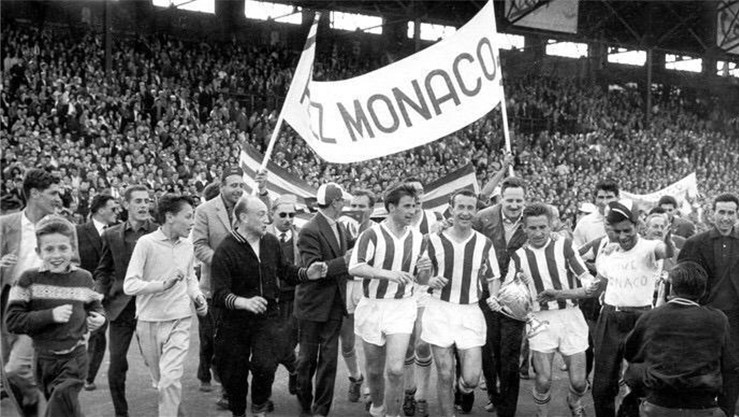
Monaco win the Coupe de France in 1960
V. A Mirror of Industrial France (1945–1970)
The postwar decades were the golden industrial age of the Coupe de France, an era when the social identity of clubs was inseparable from the trades and industries that surrounded them. Under the Fourth and Fifth Republics, France undertook massive projects of reconstruction and modernisation. New industries sprouted; new working-class suburbs'banlieues' grew the state extended its bureaucratic reach through every facet of life.
In this landscape, football clubs became avatars of industrial identity. Lens was the miners. Saint-Étienne was the factory floor. Lyon was silk and banking. Sochaux was a Peugeot company town in the purest sense.
And yet all of them entered the same competition.
The Coupe thus served as a yearly referendum on the changing geography of French labour. When a mining club reached the latter stages, it symbolised not only sporting achievement but a political statement -- the working class still had muscle in national culture. When suburban clubs rose, they reflected the growth of new urban labour patterns. When provincial clubs claimed glory, they challenged the hegemony of Paris.
The tournament produced a gallery of working-class epics. In 1957, Toulouse beat Angers in a final remembered for its ferocity and its symbolism: two provincial cities vying for national recognition. In 1968, Saint-Étienne won the first of many doubles, representing the peak of provincial industrial power at a time when Paris’s dominance was in question.
The Coupe final became a national ritual of modernisation. Trains carried thousands of supporters to Paris, transforming the voyage into a modern French Republican procession. Radios crackled with the voice of Georges Briquet or Roger Couderc bringing the action to listeners who saw in the Coupe not just football, but the theatre of class and identity.
VI. May ’68, Social Shake-ups, and the Role of Football
No discussion of French society can ignore the cultural earthquake of May 1968, when revolution—in rhetoric if not in reality seemed briefly possible. Students occupied universities, workers occupied factories, and the very structure of French society wobbled.
Football was not immune. The Coupe de France final of 1968 was delayed by strikes, the tournament became orbitally connected to the unrest, a reminder that even national rituals could be disrupted by political transformation. When the final was eventually played, Saint-Étienne defeated Bordeaux, but the match felt oddly out of sync with the nation. Where once the Coupe had provided cohesion, in 1968 it represented continuity in a country that suddenly desired rupture.
Yet in the long term, the tournament would absorb the legacy of ’68. The idea of open participation, of democratic access, of bottom-up agency all resonated with the ideological shifts of the era. The Coupe, already a symbol of equality, became more explicitly associated with French pluralism. Its later expansions into overseas territories, immigrant-heavy urban clubs, and small-town amateur associations reflected a broader national movement toward diversity even if the ideal was often more aspirational than real.
VII. The Post-Industrial Age and the Search for Identity (1970–1990)
By the 1970s and 1980s, France faced deindustrialisation. Mines shuttered. Factories moved. The working-class bastions that had defined much of the Coupe’s folklore found themselves in decline. Towns once buoyed by industrial pride struggled with unemployment, depopulation, and social fragmentation.
The Coupe de France became, almost inadvertently, a museum of lost geographies.
Lens, Valenciennes, Roubaix, Saint-Étienne, these were clubs whose identity had been forged in industry. Their cup runs during this era carried a nostalgic resonance: they were reminders of a France slipping away. The Coupe symbolised not only opportunity but loss.
During this period, a new force emerged: Paris Saint-Germain, founded only in 1970. Their first Coupe victory in 1982, won dramatically via penalties against Saint-Étienne, marked the symbolic rise of Parisian modernity over provincial industrial tradition. PSG’s ascent would eventually reshape the entire identity of French football and, by extension, the Coupe—though in the 1980s they still represented an underdog in search of identity.
Marseille, under the controversial businessman Bernard Tapie, also used the Coupe as a national stage to reframe itself: a cosmopolitan, rebellious port city challenging Paris. Their 1989 triumph, celebrated with the fervour of a political rally, hinted at a new era: the age of money, media, and modern football.
But throughout these transformations, the Coupe retained its democratic façade.
VIII. Overseas France Enters the Pitch
One of the most distinctive and politically charged developments in the history of the Coupe was the integration of France’s overseas departments and territories. Martinique, Guadeloupe, French Guiana, Réunion, Mayotte, New Caledonia, Tahiti, and others began to participate more consistently from the 1960s onward.
This was not merely a sporting decision. It was an assertion of political geography. By allowing teams from far-flung islands and territories to compete in a national tournament, France was performing symbolically and institutionally that the idea that these territories were integral to the Republic.
A Coupe de France match played in Réunion or Martinique was more than a football game. It was a quiet act of statecraft: proof that France extended its institutions far beyond the European mainland.
When an overseas team advanced to the later rounds, the national media seized on the story as evidence of multicultural harmony though at times the coverage veered toward exoticisation. Still, the inclusion of overseas France gave the Coupe a rare kind of global geography -- a competition in which Europe, the Caribbean, the Indian Ocean, and the Pacific all occupied the same bracket.
As debates over colonial legacy, autonomy, and identity continue in France, the Coupe remains one of the few spaces where overseas territories participate in a national ritual without intermediary. A club from an island thousands of kilometres away can at least in theory dface Paris Saint-Germain in the same competition. Few nations can claim anything like this.
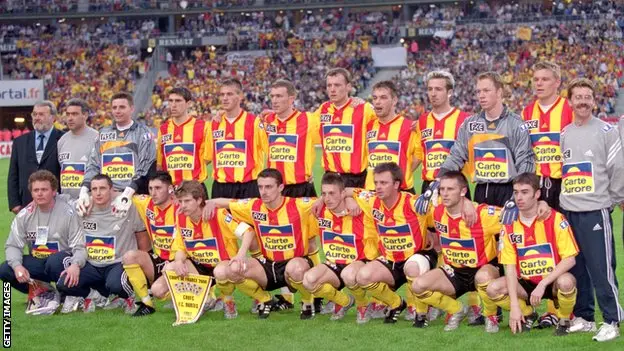
A team of shopkeepers, teachers, customs officers and labourers lined up in the 2000 Coupe de France final
IX. The Golden Age of “Petits Poucets”: Democratic Fairytale (1990–2010)
If the Coupe’s early years established its democratic ethos, the turn of the century confirmed its place as the world’s most egalitarian major football competition. During the 1990s and 2000s, France experienced an explosion of “Petits Poucets” (literally “Little Thumbs,” after the French Tom Thumb) a term used for tiny amateur sides that made improbable deep runs.
This era embedded the Coupe deep into the national imagination as a generator of modern folklore.
Calais RUFC, 2000: The Ultimate Underdog
No story captures the Coupe’s significance better than Calais RUFC, a team of drilling workers, teachers, and customs officers who reached the final in 2000. Their journey playing in borrowed kits, practicing on uneven municipal pitches became a national obsession. When they defeated Bordeaux in the quarterfinal and knocked out Strasbourg in the semi, France experienced a collective emotional event.
The Calais final, played against Nantes, remains one of the most symbolically charged sporting events in modern French memory. Though Calais lost, the moment when the Nantes captain insisted the Calais captain lift the trophy with him has become an iconic image of French sportsmanship and republican equality. It was theatre of the highest order emotionally manipulative but utterly irresistible.
Other Underdog Epics
US Quevilly reached the semifinal in 2010 and the final in 2012.
Carquefou, a village club, defeated Marseille in 2008.
Clermont Foot, then semi-professional, knocked out PSG in 1997.
The Coupe became a generator of social fables stories that reaffirmed the possibility of upward mobility, collective identity, and shared joy in an era increasingly shaped by inequality and disillusionment.
X. The Stade de France and the Rewriting of Ritual
In 1998, France inaugurated the Stade de France as the host of Coupe finals. The timing was symbolic: the country had just won the World Cup, beating Brazil in a cathartic demonstration of multicultural unity. The new stadium was the crown jewel of a resurgent France, and the Coupe final became a yearly homecoming ritual within its vast concrete bowl.
Yet the move also introduced tension. Colombes had been a nostalgic symbol of early French republicanism a place where the working class felt at home. The Stade de France, vast and modern, felt more corporate, more remote, more controlled.
Still, the Coupe adapted. The final became a sensory feast: fireworks, choreographies, presidential handshakes, lavish broadcasts. The spectacle grew, but the tension between spectacle and grassroots remained a central theme of the modern Coupe.
XI. PSG, Dominance, and the Crisis of Meaning (2010–Present)
Qatari ownership transformed Paris Saint-Germain into a global powerhouse after 2011, and their dominance of the Coupe winning it 6 times between 2015 and 2021 produced an uneasy relationship between republican egalitarianism and market capitalism.
For some, PSG’s dominance represented a new era of excellence. For others, it felt like the erosion of the Coupe’s democratic character.
Yet paradoxically, PSG’s presence also intensified the underdog myth. Every time a village club drew PSG, the narrative exploded with new life. Their 2021 loss to tiny Rumilly-Vallières in the semi-final was one of the biggest shocks in decades. Even giants can stumble in the Coupe a reminder that money might bend football, but cannot break the Coupe’s cultural logic.
Banlieue Football
Many of France’s footballers come from the banlieues districts often stigmatised but deeply productive in talent. Coupe matches played in these suburbs often reveal the intense local solidarities that shape modern French identity. When clubs like Sarcelles, Bobigny, or Ivry make deep runs, the Coupe highlights a France often invisible in mainstream narratives.
Immigration and Integration
The Coupe has always been a vehicle for integration. Immigrant communities North African, West African, Portuguese, Turkish, and Armenian have built local clubs that compete vigorously in the competition. In doing so, they map their presence onto the national landscape.
Rural France
Conversely, the Coupe remains a refuge for rural identity. Many “Petits Poucets” hail from small towns grappling with depopulation and declining public services. A Coupe run becomes a form of civic revival.
Thus the Coupe is a rare institution that simultaneously represents -- the urban multicultural present the rural ancestral past, the overseas periphery and the elite metropolitan centre
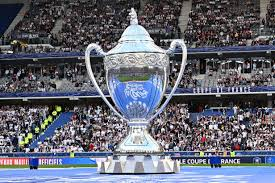
The Coupe De France in prepraation for the final.
XIII. Political Imagery -- Presidents, Trophies, and National Ritual
Every Coupe final is attended by the President of France. This is not ceremonial nicety but republican theatre. Photographs of presidents handing the trophy to humble provincial captains are used—consciously or not to reinforce the image of the French state as a unifying, paternal entity.
The Marseillaise, sung in a stadium filled with working-class supporters, becomes a moment of national communion. Even those who rarely feel connected to the state often feel, if only briefly, part of something larger.
The Coupe final is one of the few remaining events in French life that reliably creates a unified national audience.
XIV. The Coupe in the Globalised Era -- Challenges and Defences
The 21st century has posed existential challenges to national cup competitions everywhere -- fixture congestion, commercial prioritisation of European competitions, dominance of wealthy clubs, decreased media attention,.and shifts in fan culture
The Coupe has not been immune. Some top clubs have fielded weakened teams. The calendar has been strained. Audiences fluctuate.
And yet the Coupe endures. It defends itself through narrative abundance. No other French sporting event produces as many stories. No competition better reflects the national ideal of égalité. No trophy is so accessible in principle to so many people.
XV. Case Studies: Five Matches That Explain the Coupe
1. Calais vs Nantes, 2000
The purest underdog story in modern French football. Proof that the Coupe can suspend social hierarchies.
2. Saint-Étienne vs Valenciennes, 1957
Two industrial clubs asserting working-class identity in postwar France.
3. PSG vs Strasbourg, 1982
Paris emerging as a modern force, reflecting France’s shift toward metropolitan dominance.
4. Quevilly vs Rennes, 2012
A semi-professional club reminding France that the Coupe remains unpredictable in an era of predictability.
5. Overseas teams in early rounds (multiple years)
The Republic made spatially literal: France as a global entity competing within a single tournament.
XVI. The Coupe’s Cultural Legacy
The Coupe de France occupies a unique cultural position -- It is a repository of communal memory. It is a stage for amateur heroism. It is a ritual of national cohesion. It is a moral narrative about equality. It is a counterweight to the commercialisation of sport. It is accessible in a way no other major trophy is. Its significance lies not in the sporting prestige of winning it, but in the symbolic prestige of participating in it.
When a rural club hosts a Ligue 1 giant in a stadium built for 800 spectators, it is not merely a game—it is an expression of France’s enduring belief in the possibility of parity.
XVII. Why the Coupe Still Matters Today
In a time of political fragmentation, economic anxiety, and cultural division, the Coupe de France remains one of the few institutions capable of generating a sense of collective belonging.
It matters because -- it connects past and present it binds the centre to the periphery it celebrates diversity without erasing local identity, it allows ordinary citizens to experience national significance and it constructs an annual civic narrative accessible to all. If the Republic is an imagined community, the Coupe is one of its most powerful imaginations.
XVIII. Epilogue -- The Republic on Grass
As the Marseillaise rings out at each final, the Coupe de France reminds France of the ideals it professes but does not always practice: equality, fraternity, opportunity, unity.
On a rectangular patch of grass, those ideals briefly take form. A baker’s apprentice can outrun a millionaire defender. A village can humble a metropolis. A teacher can score past a global superstar. An amateur club can become, for one night, the centre of the national story.
The Coupe de France is more than a tournament. It is France dreaming itself. It is the Republic, imperfect but aspirational, enacted before millions. It is a century-old theatre in which the national identity is contested, affirmed, and reinvented.
In a fragmented age, that makes it not merely historically significant but indispensable.
Further reading
Coupe de France - La Folle Epopée by Pierre-Marie Descamps (French edition only)
Watch
BeIN Sport Connect Australia from December 20th
Kylian Mbappe looks at the French Cup trophy after winning the final in his last game for PSG.
The Coupe de France is affectionately known as "La Vieille Dame" - the Old Lady, a nickname that captures both its age and its prestige. Born in 1917, it is one of the oldest national football competitions in the world, and it carries with it a sense of gravitas, memory, and ritual.
Where the league is hierarchical and predictable, the Coupe stands apart - open to every club in the country, from tiny village sides to European giants. It embodies a kind of footballing democracy that feels increasingly rare. This is an historical reflection on one the world football’s greatest domestic cup tournaments.
The Republic on the Pitch: The Historical Significance of the Coupe de France
I. Prologue: A Tournament Like No Other
Every nation with football in its bloodstream cultivates a mythology around its domestic cup competitions. England celebrates the whimsy of “giant-killings" in the FA Cup. Spain stages the Copa del Rey with royal pomp, Italy’s Coppa Italia with operatic intensity. But nowhere is a national cup competition more inseparable from a nation’s political imagination than in France where the Coupe de France has, for more than a century, functioned as a living stage upon which France performs its self-conception.
The Coupe is not merely a football tournament. It is a ritual. It is France, in its sprawling, contradictory entirety, placed onto the same patch of grass. On one night in May each year, in the cavernous amphitheatre of the Stade de France, factory workers from Normandy, postal clerks from Corsica, grain farmers from the Auvergne, and million-euro athletes from Paris or Marseille stand under the same tricolore flag. They enter the same tunnel. They line up before the same Marseillaise. And for 90 minutes, they are accorded equal footing. The great fiction of French equality perhaps fiction, perhaps aspiration briefly becomes reality.
This is why, to understand the Coupe de France, one must understand it not as a sporting competition but as the most enduring cultural mirror of the French Republic itself. To trace its history is to trace a century of French anxieties, aspirations, ruptures, and reconciliations. And to grasp its continued importance is to realise that the Coupe remains one of the last places where France still gathers, physically, symbolically, and emotionally, as a whole.
II. Origins in Ashes: A Cup Born from War (1916–1920)
The Coupe de France was not conceived in jubilation, but in trauma. During the First World War, French sport like the rest of French life was dismembered. Hundreds of footballers died in the trenches. Clubs dissolved, stadiums became hospitals, and the very continuity of organised sport seemed frivolous in the face of national catastrophe.
Yet even as the war raged, a group of administrators led by Henri Delaunay. The visionary -later instrumental in creating the European Championship- sought to imagine a postwar France rebuilt not only through infrastructure but through institutions that could heal civic bonds. Football, which had only recently taken root in France, was seen as fertile ground for unity.
In 1916, amid artillery fire and national mourning, the Comité Français Interfédéral established a competition open to every club in the country, professional or amateur, Catholic or secular, Parisian or provincial. The idea was revolutionary. Other nations’ cup competitions were already decades old, but none had been designed with universality as a founding principle. The Coupe’s DNA was explicitly democratic.
When the war ended, France faced the staggering task of reassembling itself. Rail lines were twisted scrap. Villages were hollow shells. The national psyche was both triumphant and shattered. Across this landscape, the Coupe de France emerged as a modest yet profoundly symbolic ritual a fresh start in a scarred country.
Red Star Paris then a working-class club with anarchist sympathies won the inaugural tournament in 1918. Their victory represented more than footballing success. The Coupe had made its first statement -- this was a competition for everyone, and its champions would reflect the diversity, turbulence, and resilience of the nation.
III. The Cup as Republican Theatre (1920s–1930s)
By the 1920s, the French state increasingly recognised the power of the Coupe to serve as a kind of civic glue. In a time of social upheaval labour strikes, anti-clerical battles, and economic shocks the tournament presented an image of national coherence. The symbolism was irresistible: the entire footballing territory entering a single, unified competition, without distinction of caste or geography.
The early rounds were an anthropological wonder. Clubs representing factory floors, shipyards, coal mining communities, railway worker unions, colonial regiments, and university societies all entered the same draw as the aristocratic clubs of Paris or the rising industrial teams of the Nord. Every village could dream of drawing one of France’s giants, every titan could be made to trudge to a muddy rural pitch where the wind cut across the fields like a blade.
In this era, the Coupe de France became a cultural phenomenon even more than a sporting contest. Newspapers chronicled its early rounds like media anthropologists mapping the national subconscious. The cup tie became a genre of French literature a narrative of improbable encounters and inverted hierarchies, a travelling carnival of possibility.
The Stade Olympique Yves-du-Manoir in Colombes, which hosted the final for decades, became a French football shrine. Crowds spilled beyond capacity. Flags of every departement fluttered. The final began to resemble a national feast day one part Bastille Day, one part the agricultural Salon, one part a mass pilgrimage. Presidents attended. Poets wrote odes. Schoolchildren collected match reports like devotional cards.
IV. War Again: Football in Occupation and Resistance (1939–1945)
The Second World War tested the Coupe’s symbolic identity more ferociously than the first. The German occupation fractured France into zones of control, collaboration, and resistance. The Vichy regime sought to reorganise French sport under its authoritarian ideology of “National Revolution,” emphasising rural virtue and anti-urban resentment. Many feared the Coupe open to all, cosmopolitan, egalitarian might be dismantled as an ideological threat.
Yet the competition persisted, albeit in altered form. It was played even during occupation, often under perilous conditions. Matches went ahead under blackout rules. Teams traveled through checkpoints and curfews. Jewish players and administrators were banned, some were deported. Clubs in the “free zone” played separately from those in the occupied zone. The Coupe, once a symbol of unity, became a map of fracture.
But in this period, something unexpected happened: the Coupe became a discreet site of resistance.
Some teams intentionally fielded banned or persecuted individuals under false names. Matches provided cover for secret political meetings. Supporters used games as opportunities to exchange information or supplies. The Coupe's continuation under occupation allowed ordinary people to gather in ways that might otherwise have been prohibited. It became a quiet symbol of continuity proof that France’s civic spirit still burned beneath the ash.
When war ended in 1945, the Coupe de France final won by Racing Club Paris—was celebrated as an act of national restoration. France, once again, returned to the pitch.
Monaco win the Coupe de France in 1960
V. A Mirror of Industrial France (1945–1970)
The postwar decades were the golden industrial age of the Coupe de France, an era when the social identity of clubs was inseparable from the trades and industries that surrounded them. Under the Fourth and Fifth Republics, France undertook massive projects of reconstruction and modernisation. New industries sprouted; new working-class suburbs'banlieues' grew the state extended its bureaucratic reach through every facet of life.
In this landscape, football clubs became avatars of industrial identity. Lens was the miners. Saint-Étienne was the factory floor. Lyon was silk and banking. Sochaux was a Peugeot company town in the purest sense.
And yet all of them entered the same competition.
The Coupe thus served as a yearly referendum on the changing geography of French labour. When a mining club reached the latter stages, it symbolised not only sporting achievement but a political statement -- the working class still had muscle in national culture. When suburban clubs rose, they reflected the growth of new urban labour patterns. When provincial clubs claimed glory, they challenged the hegemony of Paris.
The tournament produced a gallery of working-class epics. In 1957, Toulouse beat Angers in a final remembered for its ferocity and its symbolism: two provincial cities vying for national recognition. In 1968, Saint-Étienne won the first of many doubles, representing the peak of provincial industrial power at a time when Paris’s dominance was in question.
The Coupe final became a national ritual of modernisation. Trains carried thousands of supporters to Paris, transforming the voyage into a modern French Republican procession. Radios crackled with the voice of Georges Briquet or Roger Couderc bringing the action to listeners who saw in the Coupe not just football, but the theatre of class and identity.
VI. May ’68, Social Shake-ups, and the Role of Football
No discussion of French society can ignore the cultural earthquake of May 1968, when revolution—in rhetoric if not in reality seemed briefly possible. Students occupied universities, workers occupied factories, and the very structure of French society wobbled.
Football was not immune. The Coupe de France final of 1968 was delayed by strikes, the tournament became orbitally connected to the unrest, a reminder that even national rituals could be disrupted by political transformation. When the final was eventually played, Saint-Étienne defeated Bordeaux, but the match felt oddly out of sync with the nation. Where once the Coupe had provided cohesion, in 1968 it represented continuity in a country that suddenly desired rupture.
Yet in the long term, the tournament would absorb the legacy of ’68. The idea of open participation, of democratic access, of bottom-up agency all resonated with the ideological shifts of the era. The Coupe, already a symbol of equality, became more explicitly associated with French pluralism. Its later expansions into overseas territories, immigrant-heavy urban clubs, and small-town amateur associations reflected a broader national movement toward diversity even if the ideal was often more aspirational than real.
VII. The Post-Industrial Age and the Search for Identity (1970–1990)
By the 1970s and 1980s, France faced deindustrialisation. Mines shuttered. Factories moved. The working-class bastions that had defined much of the Coupe’s folklore found themselves in decline. Towns once buoyed by industrial pride struggled with unemployment, depopulation, and social fragmentation.
The Coupe de France became, almost inadvertently, a museum of lost geographies.
Lens, Valenciennes, Roubaix, Saint-Étienne, these were clubs whose identity had been forged in industry. Their cup runs during this era carried a nostalgic resonance: they were reminders of a France slipping away. The Coupe symbolised not only opportunity but loss.
During this period, a new force emerged: Paris Saint-Germain, founded only in 1970. Their first Coupe victory in 1982, won dramatically via penalties against Saint-Étienne, marked the symbolic rise of Parisian modernity over provincial industrial tradition. PSG’s ascent would eventually reshape the entire identity of French football and, by extension, the Coupe—though in the 1980s they still represented an underdog in search of identity.
Marseille, under the controversial businessman Bernard Tapie, also used the Coupe as a national stage to reframe itself: a cosmopolitan, rebellious port city challenging Paris. Their 1989 triumph, celebrated with the fervour of a political rally, hinted at a new era: the age of money, media, and modern football.
But throughout these transformations, the Coupe retained its democratic façade.
VIII. Overseas France Enters the Pitch
One of the most distinctive and politically charged developments in the history of the Coupe was the integration of France’s overseas departments and territories. Martinique, Guadeloupe, French Guiana, Réunion, Mayotte, New Caledonia, Tahiti, and others began to participate more consistently from the 1960s onward.
This was not merely a sporting decision. It was an assertion of political geography. By allowing teams from far-flung islands and territories to compete in a national tournament, France was performing symbolically and institutionally that the idea that these territories were integral to the Republic.
A Coupe de France match played in Réunion or Martinique was more than a football game. It was a quiet act of statecraft: proof that France extended its institutions far beyond the European mainland.
When an overseas team advanced to the later rounds, the national media seized on the story as evidence of multicultural harmony though at times the coverage veered toward exoticisation. Still, the inclusion of overseas France gave the Coupe a rare kind of global geography -- a competition in which Europe, the Caribbean, the Indian Ocean, and the Pacific all occupied the same bracket.
As debates over colonial legacy, autonomy, and identity continue in France, the Coupe remains one of the few spaces where overseas territories participate in a national ritual without intermediary. A club from an island thousands of kilometres away can at least in theory dface Paris Saint-Germain in the same competition. Few nations can claim anything like this.
A team of shopkeepers, teachers, customs officers and labourers lined up in the 2000 Coupe de France final
IX. The Golden Age of “Petits Poucets”: Democratic Fairytale (1990–2010)
If the Coupe’s early years established its democratic ethos, the turn of the century confirmed its place as the world’s most egalitarian major football competition. During the 1990s and 2000s, France experienced an explosion of “Petits Poucets” (literally “Little Thumbs,” after the French Tom Thumb) a term used for tiny amateur sides that made improbable deep runs.
This era embedded the Coupe deep into the national imagination as a generator of modern folklore.
Calais RUFC, 2000: The Ultimate Underdog
No story captures the Coupe’s significance better than Calais RUFC, a team of drilling workers, teachers, and customs officers who reached the final in 2000. Their journey playing in borrowed kits, practicing on uneven municipal pitches became a national obsession. When they defeated Bordeaux in the quarterfinal and knocked out Strasbourg in the semi, France experienced a collective emotional event.
The Calais final, played against Nantes, remains one of the most symbolically charged sporting events in modern French memory. Though Calais lost, the moment when the Nantes captain insisted the Calais captain lift the trophy with him has become an iconic image of French sportsmanship and republican equality. It was theatre of the highest order emotionally manipulative but utterly irresistible.
Other Underdog Epics
US Quevilly reached the semifinal in 2010 and the final in 2012.
Carquefou, a village club, defeated Marseille in 2008.
Clermont Foot, then semi-professional, knocked out PSG in 1997.
The Coupe became a generator of social fables stories that reaffirmed the possibility of upward mobility, collective identity, and shared joy in an era increasingly shaped by inequality and disillusionment.
X. The Stade de France and the Rewriting of Ritual
In 1998, France inaugurated the Stade de France as the host of Coupe finals. The timing was symbolic: the country had just won the World Cup, beating Brazil in a cathartic demonstration of multicultural unity. The new stadium was the crown jewel of a resurgent France, and the Coupe final became a yearly homecoming ritual within its vast concrete bowl.
Yet the move also introduced tension. Colombes had been a nostalgic symbol of early French republicanism a place where the working class felt at home. The Stade de France, vast and modern, felt more corporate, more remote, more controlled.
Still, the Coupe adapted. The final became a sensory feast: fireworks, choreographies, presidential handshakes, lavish broadcasts. The spectacle grew, but the tension between spectacle and grassroots remained a central theme of the modern Coupe.
XI. PSG, Dominance, and the Crisis of Meaning (2010–Present)
Qatari ownership transformed Paris Saint-Germain into a global powerhouse after 2011, and their dominance of the Coupe winning it 6 times between 2015 and 2021 produced an uneasy relationship between republican egalitarianism and market capitalism.
For some, PSG’s dominance represented a new era of excellence. For others, it felt like the erosion of the Coupe’s democratic character.
Yet paradoxically, PSG’s presence also intensified the underdog myth. Every time a village club drew PSG, the narrative exploded with new life. Their 2021 loss to tiny Rumilly-Vallières in the semi-final was one of the biggest shocks in decades. Even giants can stumble in the Coupe a reminder that money might bend football, but cannot break the Coupe’s cultural logic.
Banlieue Football
Many of France’s footballers come from the banlieues districts often stigmatised but deeply productive in talent. Coupe matches played in these suburbs often reveal the intense local solidarities that shape modern French identity. When clubs like Sarcelles, Bobigny, or Ivry make deep runs, the Coupe highlights a France often invisible in mainstream narratives.
Immigration and Integration
The Coupe has always been a vehicle for integration. Immigrant communities North African, West African, Portuguese, Turkish, and Armenian have built local clubs that compete vigorously in the competition. In doing so, they map their presence onto the national landscape.
Rural France
Conversely, the Coupe remains a refuge for rural identity. Many “Petits Poucets” hail from small towns grappling with depopulation and declining public services. A Coupe run becomes a form of civic revival.
Thus the Coupe is a rare institution that simultaneously represents -- the urban multicultural present the rural ancestral past, the overseas periphery and the elite metropolitan centre
The Coupe De France in prepraation for the final.
XIII. Political Imagery -- Presidents, Trophies, and National Ritual
Every Coupe final is attended by the President of France. This is not ceremonial nicety but republican theatre. Photographs of presidents handing the trophy to humble provincial captains are used—consciously or not to reinforce the image of the French state as a unifying, paternal entity.
The Marseillaise, sung in a stadium filled with working-class supporters, becomes a moment of national communion. Even those who rarely feel connected to the state often feel, if only briefly, part of something larger.
The Coupe final is one of the few remaining events in French life that reliably creates a unified national audience.
XIV. The Coupe in the Globalised Era -- Challenges and Defences
The 21st century has posed existential challenges to national cup competitions everywhere -- fixture congestion, commercial prioritisation of European competitions, dominance of wealthy clubs, decreased media attention,.and shifts in fan culture
The Coupe has not been immune. Some top clubs have fielded weakened teams. The calendar has been strained. Audiences fluctuate.
And yet the Coupe endures. It defends itself through narrative abundance. No other French sporting event produces as many stories. No competition better reflects the national ideal of égalité. No trophy is so accessible in principle to so many people.
XV. Case Studies: Five Matches That Explain the Coupe
1. Calais vs Nantes, 2000
The purest underdog story in modern French football. Proof that the Coupe can suspend social hierarchies.
2. Saint-Étienne vs Valenciennes, 1957
Two industrial clubs asserting working-class identity in postwar France.
3. PSG vs Strasbourg, 1982
Paris emerging as a modern force, reflecting France’s shift toward metropolitan dominance.
4. Quevilly vs Rennes, 2012
A semi-professional club reminding France that the Coupe remains unpredictable in an era of predictability.
5. Overseas teams in early rounds (multiple years)
The Republic made spatially literal: France as a global entity competing within a single tournament.
XVI. The Coupe’s Cultural Legacy
The Coupe de France occupies a unique cultural position -- It is a repository of communal memory. It is a stage for amateur heroism. It is a ritual of national cohesion. It is a moral narrative about equality. It is a counterweight to the commercialisation of sport. It is accessible in a way no other major trophy is. Its significance lies not in the sporting prestige of winning it, but in the symbolic prestige of participating in it.
When a rural club hosts a Ligue 1 giant in a stadium built for 800 spectators, it is not merely a game—it is an expression of France’s enduring belief in the possibility of parity.
XVII. Why the Coupe Still Matters Today
In a time of political fragmentation, economic anxiety, and cultural division, the Coupe de France remains one of the few institutions capable of generating a sense of collective belonging.
It matters because -- it connects past and present it binds the centre to the periphery it celebrates diversity without erasing local identity, it allows ordinary citizens to experience national significance and it constructs an annual civic narrative accessible to all. If the Republic is an imagined community, the Coupe is one of its most powerful imaginations.
XVIII. Epilogue -- The Republic on Grass
As the Marseillaise rings out at each final, the Coupe de France reminds France of the ideals it professes but does not always practice: equality, fraternity, opportunity, unity.
On a rectangular patch of grass, those ideals briefly take form. A baker’s apprentice can outrun a millionaire defender. A village can humble a metropolis. A teacher can score past a global superstar. An amateur club can become, for one night, the centre of the national story.
The Coupe de France is more than a tournament. It is France dreaming itself. It is the Republic, imperfect but aspirational, enacted before millions. It is a century-old theatre in which the national identity is contested, affirmed, and reinvented.
In a fragmented age, that makes it not merely historically significant but indispensable.
Further reading
Coupe de France - La Folle Epopée by Pierre-Marie Descamps (French edition only)
Watch
BeIN Sport Connect Australia from December 20th

