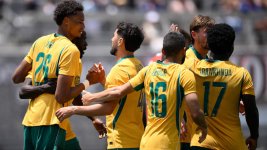
Another game follows a familiar pattern. We concede an enormous amount of possession and territory in the first half, have a bright second half, and play in an ultra-conservative style that has fans questioning why they follow this sport. I get it, and we have vented our frustrations on the pod many times about this game plan. But in the end, there is an argument for it. Most teams that have managed to shock bigger teams and have deep runs in tournaments have been defensively strong, usually with a midblock that quickly transitions into an impenetrable deep block, with three paths to goal: press triggers, counter-attacks, and set pieces. This is exactly what Poppa ball is and, while the details differ, was the philosophy that got us to our best-ever World Cup finish four years ago. In the end, I wait four years for these games, and no matter what we think or say, we are going to play Poppa ball, so we might as well enjoy it and hope it pays off. In light of that, I want to judge Poppa ball by its own game plan, rather than comparing it to Ange ball or other more attacking styles.
Fans should be patient with individual players in this system if they lose the ball. Playing 8 v 5 is the equivalent of trying to keep hold of the ball after conceding three red cards. However, Poppa tries to get us to a superior physical level so that, as the game goes on, some gaps appear and we start to be able to either hold the ball long enough to transition into our attacking shape or execute some of those counter-attacks more effectively. I'm not sure what the solution is. I know when Mooy retired, Arnie seemed to have a plan of making the first 15 minutes of each match look like a cross between rugby and aerial ping pong. Tire the opposition out with anti-football in the early exchanges, then try and play ball when the opposition has a touch of fatigue. Maybe we could try something like that? In any case, it seems that a poor first quarter is just going to be the pattern of our games for the foreseeable future.
Midblock: F
Counter-attack: B+
Set pieces: B+
Pressing triggers: B-
Deep block: C
Let's go through these scores one at a time.
The midblock: For the first time I can remember, the midblock was dysfunctional. The only other time that comes close was when Yazbek and Teague started together, and the midblock struggled for similar reasons: the midfield struggled to plug gaps between the midfield and the back five, with both midfielders often caught too far forward at the same time. Very often, we saw our midfield join the press and pull away from the back five. At that moment, a Swiss attacker would dart in behind our defensive line, forcing them back, and suddenly there was as much as 20 yards between our front five and back five. Souttar would then try to plug the gap by stepping forward, which would leave space behind him.
There were a lot of reasons for this dysfunction, and we conceded a lot of chances in the first 22 minutes before the drinks break. Our press was hyperactive, not always waiting for triggers like a poor touch or pass, or a Swiss player facing backwards or sideways. The danger of this is that when one of our attackers presses, unlike in a high press where all 10 outfield players move forward, we only move our front five forward, which leaves gaps if you press at the wrong time. There was one time Irankunda pressed a player who was facing forward and receiving a well-weighted pass. This led to our defensive line being quickly broken.
Second, Okon and O'Neill failed to glance behind them frequently enough to recognise when they had been pulled apart by Switzerland's movement. When Irvine plays, he is very good at ensuring that there is always one player back when the other moves forward. We partly fixed our leaky midblock in the second quarter by having Herrington race up to plug holes in midfield while Souttar and Circati combined to defend the last line. We conceded one chance in this quarter, as this strategy makes us more open at the back, but Circati had the quality to deflect the shot wide. In the second half, Trewin came into midfield and combined well with Okon: one came back when the other came forward. F
Counter-attack: We threatened with the counter-attack all game, particularly through Irankunda, who had some silky touches and powerful drives forward, even if he often made poor decisions in the final third. Our goal also came from a counter-attack, with a beautiful ball from Burgess finding Metcalf, who then laid it on a plate for Yengi. At this level, a good performance is one where we produce at least one clear-cut chance from a counter-attack, and we did just that. There are areas for improvement, there always are, but in the end, it is a job well done. B+
Set pieces: Unlike the Mexico game, we managed to create chances while conceding none from set pieces. The best chance came in the third minute from Kye Trewin, of all people. Unlucky not to get it on target, but in the end, this once again is a job well done. B+
Pressing triggers: It makes sense that there were rocks and diamonds here. Only Irankunda has played for Popovic before, so perhaps there were always going to be teething issues. It was then to my surprise that Irankunda was at fault for the worst decision in the press. Keep in mind, we only press with five, which means creating a gap between the midfield and back five. So in our system, we should only press when there is a high chance of success. Having said that, Irankunda won the ball a lot and rattled the crossbar as the result of a successful press. There are signs of promise here, but lots to improve. B-
Deep block: This is the hardest to judge. On the one hand, we conceded two chances from a deep block: a beautifully worked move in the seventh minute and a free header at the end of the game. On the other hand, both chances were nearly impossible to defend. In the seventh minute, Souttar is tempted forward, which creates a gap between him and Circati. Circati is then tempted wide due to a runner on his outside. The gap between our wide and central centre-back is a key defensive weakness that top teams have often tried to exploit. The Swiss show lightning-quick interplay, and a first-touch pass into the box finds a runner on the inside of Circati and is virtually undefendable. The least bad thing Circati can do is surrender the wide runner and come in narrow. In the end, we are facing top-class opponents, and it will be very difficult to prevent at least some chances of this calibre. It took class to create chances against us, so I don't judge us too harshly, but we need to find a way to prevent even these chances if we are good enough. C
Our goal, by contrast, was what we need to do more of. A beautifully weighted long pass over the top from Burgess and a perfectly timed run from Metcalf, who put it on a platter for Yengi. One mystery is why Circati's radar has been so off the last three games, not completing a single long pass. His accuracy has been a real asset against Japan in particular, and he has above-average accuracy at Serie A level. Herrington is much more conservative with his long passing compared to what he does at club level, which leaves only Souttar and Burgess to provide the long-range threat. They both gave a couple of exquisite long passes this match to beat Switzerland's press. We need to fix this soon to create more space for our build-up and have all three centre-backs hitting lethal, accurate long passes.
The result of the inexperience, as well as chopping and changing so much, is that there hasn't been a single game where all five aspects of Poppa ball have been executed well at the same time. Sometimes our midblock is top class, but we struggle to transition to a deep block, like in the USA game. Sometimes we execute that transition well, but our set pieces are poor at either end of the pitch, like in the Mexico game. Sometimes our set pieces are good, but we struggle to execute an effective midblock, like the game we just saw. With just six days before the World Cup, I am generally worried we haven't successfully fired on all cylinders. Having said that, perhaps there is cause for optimism in the fact that we have been competitive even when not completely executing the game plan against similar-quality opponents to what we will face in the group. We beat Canada, narrowly lost to the USA and a very good Mexico team who spanked Serbia a few days later, before securing a 1-1 draw against a red-hot Swiss team. It would be much more concerning if we executed the game plan and still lost all four games. But all of those games had fixable problems, and we still got four points from four games. Whether we can fix enough problems in the next week before kick-off time is a question that will keep me up at night.
Why we struggle early
In every game, pundits and commentators keep lamenting, "If only we could play the first half like the second half," but it isn't as easy as that in Poppa's system. Poppa ball means defending with a flat back five. This is sometimes the case even if there are no attackers in a position to pin our wingbacks. This means that there is an 8 v 5 contest in the middle of the park, which even vastly lower-ranked opposition find easy to retain the ball against for extended periods of time. It also means that for the first few seconds after we win the ball, it remains an 8 v 5 contest, making it easy for the counter-press to win the ball back. Watch where we move when we win the ball: the centre-backs need to move away from attackers they are marking to provide a safe backwards option, the wingbacks need to break from the flat back five and push up to provide a progressive passing lane, while the forwards need to find a dangerous position in case there is a counter-attack on. This all takes a few seconds, and in the first 30 minutes, before the opposition tires, our players are going to look second-rate when this badly outnumbered.Fans should be patient with individual players in this system if they lose the ball. Playing 8 v 5 is the equivalent of trying to keep hold of the ball after conceding three red cards. However, Poppa tries to get us to a superior physical level so that, as the game goes on, some gaps appear and we start to be able to either hold the ball long enough to transition into our attacking shape or execute some of those counter-attacks more effectively. I'm not sure what the solution is. I know when Mooy retired, Arnie seemed to have a plan of making the first 15 minutes of each match look like a cross between rugby and aerial ping pong. Tire the opposition out with anti-football in the early exchanges, then try and play ball when the opposition has a touch of fatigue. Maybe we could try something like that? In any case, it seems that a poor first quarter is just going to be the pattern of our games for the foreseeable future.
Giving the game a grade
If you judge Poppa ball on its own terms, you need to ignore possession, balls into the final third, and all the other things we are used to thinking of as signs of dominance. There have been many games where we have won, sometimes by many goals, only to concede the majority of possession and territory, making possession and territorial dominance nothing more than a pyrrhic victory. I'm judging games on five key criteria, which are the elements that need to work for us to get results. These five keys were mentioned both on the pod and in the introduction to this fanview. My grades for those five key parts of Poppa ball are:Midblock: F
Counter-attack: B+
Set pieces: B+
Pressing triggers: B-
Deep block: C
Let's go through these scores one at a time.
The midblock: For the first time I can remember, the midblock was dysfunctional. The only other time that comes close was when Yazbek and Teague started together, and the midblock struggled for similar reasons: the midfield struggled to plug gaps between the midfield and the back five, with both midfielders often caught too far forward at the same time. Very often, we saw our midfield join the press and pull away from the back five. At that moment, a Swiss attacker would dart in behind our defensive line, forcing them back, and suddenly there was as much as 20 yards between our front five and back five. Souttar would then try to plug the gap by stepping forward, which would leave space behind him.
There were a lot of reasons for this dysfunction, and we conceded a lot of chances in the first 22 minutes before the drinks break. Our press was hyperactive, not always waiting for triggers like a poor touch or pass, or a Swiss player facing backwards or sideways. The danger of this is that when one of our attackers presses, unlike in a high press where all 10 outfield players move forward, we only move our front five forward, which leaves gaps if you press at the wrong time. There was one time Irankunda pressed a player who was facing forward and receiving a well-weighted pass. This led to our defensive line being quickly broken.
Second, Okon and O'Neill failed to glance behind them frequently enough to recognise when they had been pulled apart by Switzerland's movement. When Irvine plays, he is very good at ensuring that there is always one player back when the other moves forward. We partly fixed our leaky midblock in the second quarter by having Herrington race up to plug holes in midfield while Souttar and Circati combined to defend the last line. We conceded one chance in this quarter, as this strategy makes us more open at the back, but Circati had the quality to deflect the shot wide. In the second half, Trewin came into midfield and combined well with Okon: one came back when the other came forward. F
Counter-attack: We threatened with the counter-attack all game, particularly through Irankunda, who had some silky touches and powerful drives forward, even if he often made poor decisions in the final third. Our goal also came from a counter-attack, with a beautiful ball from Burgess finding Metcalf, who then laid it on a plate for Yengi. At this level, a good performance is one where we produce at least one clear-cut chance from a counter-attack, and we did just that. There are areas for improvement, there always are, but in the end, it is a job well done. B+
Set pieces: Unlike the Mexico game, we managed to create chances while conceding none from set pieces. The best chance came in the third minute from Kye Trewin, of all people. Unlucky not to get it on target, but in the end, this once again is a job well done. B+
Pressing triggers: It makes sense that there were rocks and diamonds here. Only Irankunda has played for Popovic before, so perhaps there were always going to be teething issues. It was then to my surprise that Irankunda was at fault for the worst decision in the press. Keep in mind, we only press with five, which means creating a gap between the midfield and back five. So in our system, we should only press when there is a high chance of success. Having said that, Irankunda won the ball a lot and rattled the crossbar as the result of a successful press. There are signs of promise here, but lots to improve. B-
Deep block: This is the hardest to judge. On the one hand, we conceded two chances from a deep block: a beautifully worked move in the seventh minute and a free header at the end of the game. On the other hand, both chances were nearly impossible to defend. In the seventh minute, Souttar is tempted forward, which creates a gap between him and Circati. Circati is then tempted wide due to a runner on his outside. The gap between our wide and central centre-back is a key defensive weakness that top teams have often tried to exploit. The Swiss show lightning-quick interplay, and a first-touch pass into the box finds a runner on the inside of Circati and is virtually undefendable. The least bad thing Circati can do is surrender the wide runner and come in narrow. In the end, we are facing top-class opponents, and it will be very difficult to prevent at least some chances of this calibre. It took class to create chances against us, so I don't judge us too harshly, but we need to find a way to prevent even these chances if we are good enough. C
The goals
The goal we conceded was an absolute dog's breakfast! No fewer than six Socceroos were at fault for Switzerland's goal. Perhaps it should give us comfort that such a good opponent required so many mistakes for us to concede. Herrington has an aerial clearance that unfortunately doesn't find a teammate. A real feature of Lucas is how good he is at turning aerial clearances into attacking passes, but this was a rare exception. Irankunda didn't help with his off-the-ball movement, making him difficult to find. One of our midfielders is defending wide, which leaves the other midfielder isolated. The other midfielder needs to plug the hole in the centre of the park, looking to put pressure on any pass in behind and, at worst, buying time for his teammates to get their block set. Instead, they race into a poorly chosen duel and two-thirds of the pitch is completely unoccupied! Normally there is one extra number in this sort of situation, as Metcalf, McGree and, to a lesser degree, Irankunda are good at racing towards the space to plug that hole and provide an extra number in midfield. Volpato, in his first game for the Roos, remains high and wide near the Swiss 18-yard box. The Swiss have an age to measure their pass, but even then, we have two chances to limit the damage if Trewin tucks in narrow close to Circati and forces the Swiss attacker to run outside him. Instead, he is ahead of the defensive line and leaves a nice little gap to run on the outside of Circati, which has him close enough to the middle to shoot and beat the keeper. Even then, the run was poorly timed and would have been offside if Behich and Herrington didn't keep him onside in a staggered defensive line. For those keeping track, Volpato, Irankunda, one of the midfielders, Trewin, Herrington and Behich all made mistakes to make that goal possible. We can't be that sloppy against the Turks.Our goal, by contrast, was what we need to do more of. A beautifully weighted long pass over the top from Burgess and a perfectly timed run from Metcalf, who put it on a platter for Yengi. One mystery is why Circati's radar has been so off the last three games, not completing a single long pass. His accuracy has been a real asset against Japan in particular, and he has above-average accuracy at Serie A level. Herrington is much more conservative with his long passing compared to what he does at club level, which leaves only Souttar and Burgess to provide the long-range threat. They both gave a couple of exquisite long passes this match to beat Switzerland's press. We need to fix this soon to create more space for our build-up and have all three centre-backs hitting lethal, accurate long passes.
Some realism and optimism going forward
I think Poppa ball, as ugly as it is, has a real chance of being effective and getting better results than what you would expect given where we are on paper. As much as I love our players, the reality is we have very little talent playing regularly in the big five compared to our opponents. Having said that, there are some real worries. It seems to take a few matches to learn how to play Poppa ball well, and a lot of our best players lack experience, leaving Poppa with some tough decisions. We also haven't played the same starting XI two games in a row for a very long time, making it hard to form combinations and execute our game plan well. Part of this is because of conditioning and experimentation, but I suspect that part of it is because our substitutes always look superior to the players who start because of how we are set up. The second half always looks better! A player who impresses as a sub earns a starting role and then struggles because anyone who starts in this system struggles early.The result of the inexperience, as well as chopping and changing so much, is that there hasn't been a single game where all five aspects of Poppa ball have been executed well at the same time. Sometimes our midblock is top class, but we struggle to transition to a deep block, like in the USA game. Sometimes we execute that transition well, but our set pieces are poor at either end of the pitch, like in the Mexico game. Sometimes our set pieces are good, but we struggle to execute an effective midblock, like the game we just saw. With just six days before the World Cup, I am generally worried we haven't successfully fired on all cylinders. Having said that, perhaps there is cause for optimism in the fact that we have been competitive even when not completely executing the game plan against similar-quality opponents to what we will face in the group. We beat Canada, narrowly lost to the USA and a very good Mexico team who spanked Serbia a few days later, before securing a 1-1 draw against a red-hot Swiss team. It would be much more concerning if we executed the game plan and still lost all four games. But all of those games had fixable problems, and we still got four points from four games. Whether we can fix enough problems in the next week before kick-off time is a question that will keep me up at night.