When I first contacted Stefan Szymanski and I asked him a question about his model for national team's success, he thought I was looking for world cup tips! He assured me that Transfermarkt values are a better indicator of quality than pretty much anything else out there. So I was curious. Are the complaints that the on field quality of the A-league seen in poor crowds? I looked at 1st divisions, 2nd divisions, closed shops, and open pyramids all around the world. The crowds are pretty close. Surprisingly, the A-League (which I mark in red) is actually overperforming
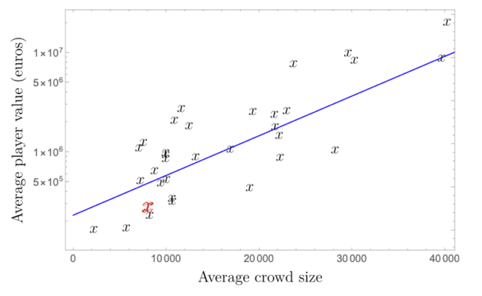
Figure: Relationship between average crowd size and player market value.
The upward trend shows a clear positive correlation between attendance and the average player’s market worth, indicating that clubs drawing larger crowds tend to field higher-valued squads.
I was asked by a mate about Saudi Arabia -who seem to have invested big in bringing foreign talent there- whether it was a counter point to whether quality and crowds go together. I actually put the Saudi league twice in the above plot. One point before, and another after their recent big influx of talent. Perhaps the reason it feels like Saudi crowds feel so disappointing is because people expect modest fluctuations in the quality to make big changes in the crowds. People go, "oh wow look at all these stars!" but then the camera zooms to empty stadiums and people are baffled. But the thing that is so tricky about football crowds is that they grow really slowly with quality.
People are familiar with the phrase "exponential" growth - if you are told your wage at your new job is going to grow exponentially you should be excited (and worried if you are told by your doctor your rash will grow exponentially!). Exponential is famous for being the fastest type of growth. The slowest type of growth is known as "Logarthmic" and this is precisely the type of growth we see with the wages. To give an intuition for this type of growth, have a look at the table below for what crowds are expected when we buy or produce better players.
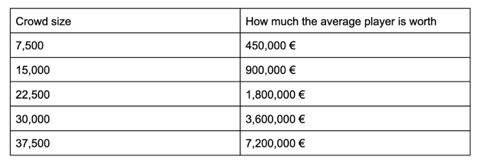
Table: How crowd size correlates with player value.
Summing all professional league, larger crowds tend to reflect and reinforce higher squad valuations, highlighting how fan demand often tracks with the quality and market worth of players on display.
Every time we increase the crowd size by 7500 people, we need to 'double' the worth of the players, whether through imports or better player development. This means that growing the league by improving the quality is very hard, as you are chasing diminishing returns. It also means that to compete with NRL or AFL, we would need squad values of roughly 50 million Australian dollars and competing with the AFL would require a league comparable in riches to the EPL. Increasing crowd averages in our top league is hard, really hard. To be honest, it seems a miracle that the crowds ever reached the level they did. Perhaps it was the fact that the league was new that it overperformed even more than it did. Perhaps it was people thinking the quality was better than it was. Perhaps we have a remarkably passionate football community. In any case, it wouldn't surprise me if crowd averages shrink over time rather than recover.
Another argument that we are underperforming is that we have a much larger participation rate than other codes. But this is argument is lost in the meaning. Football is a sport with a huge participation base where only a few go to games the world over, whereas contact sports have large attendances but few participants. Australia have 1.3 million who play football regularly, compared to 14 million in the UK. Roughly 1 in 30 participants attend the A league compared to 1 in 35 attending the EPL on a given weekend. Looking at leagues around the world, we are once again doing just as expected (in fact the NSL seemed to as well). Where we are underperforming is not in crowd averages, but in total crowds
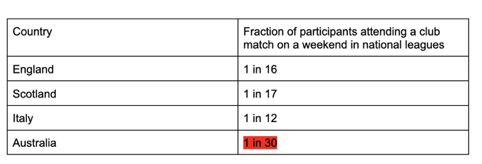
Table 2: Match attendance ratios across selected football nations.
While European leagues see roughly one in every 12 to 17 people attending matches each weekend, Australia lags behind with only one in 30, highlighting the gap in domestic football engagement.
If we are over performing in crowd averages but underperforming in total crowds, it follows that we need more clubs with smaller crowd averages scattered around several national leagues. But this means accepting clubs on a national league with crowds numbering in the hundreds, and on the rare occasion, even less. However, if a club can afford it and wants to do it, then why not?
I suspect a big factor is that our community is deeply driven by the desire to beat AFL and NRL, which means having a more popular top division. The hard but simple truth is that this probably never happens, even if we quadruple the participation rate. If we must compete with the other codes, where we can beat them is that our total community is already bigger. Total crowds could easily outgrow them, even if the top division never overtakes them. This would take a pretty radical change in mindset from the Aussie football community, as well as adopting some hard to swallow truths. The key question is, are we willing to accept the true strengths of football rather than trying to beat other codes at their own game?
Figure: Relationship between average crowd size and player market value.
The upward trend shows a clear positive correlation between attendance and the average player’s market worth, indicating that clubs drawing larger crowds tend to field higher-valued squads.
I was asked by a mate about Saudi Arabia -who seem to have invested big in bringing foreign talent there- whether it was a counter point to whether quality and crowds go together. I actually put the Saudi league twice in the above plot. One point before, and another after their recent big influx of talent. Perhaps the reason it feels like Saudi crowds feel so disappointing is because people expect modest fluctuations in the quality to make big changes in the crowds. People go, "oh wow look at all these stars!" but then the camera zooms to empty stadiums and people are baffled. But the thing that is so tricky about football crowds is that they grow really slowly with quality.
People are familiar with the phrase "exponential" growth - if you are told your wage at your new job is going to grow exponentially you should be excited (and worried if you are told by your doctor your rash will grow exponentially!). Exponential is famous for being the fastest type of growth. The slowest type of growth is known as "Logarthmic" and this is precisely the type of growth we see with the wages. To give an intuition for this type of growth, have a look at the table below for what crowds are expected when we buy or produce better players.
Table: How crowd size correlates with player value.
Summing all professional league, larger crowds tend to reflect and reinforce higher squad valuations, highlighting how fan demand often tracks with the quality and market worth of players on display.
Every time we increase the crowd size by 7500 people, we need to 'double' the worth of the players, whether through imports or better player development. This means that growing the league by improving the quality is very hard, as you are chasing diminishing returns. It also means that to compete with NRL or AFL, we would need squad values of roughly 50 million Australian dollars and competing with the AFL would require a league comparable in riches to the EPL. Increasing crowd averages in our top league is hard, really hard. To be honest, it seems a miracle that the crowds ever reached the level they did. Perhaps it was the fact that the league was new that it overperformed even more than it did. Perhaps it was people thinking the quality was better than it was. Perhaps we have a remarkably passionate football community. In any case, it wouldn't surprise me if crowd averages shrink over time rather than recover.
Another argument that we are underperforming is that we have a much larger participation rate than other codes. But this is argument is lost in the meaning. Football is a sport with a huge participation base where only a few go to games the world over, whereas contact sports have large attendances but few participants. Australia have 1.3 million who play football regularly, compared to 14 million in the UK. Roughly 1 in 30 participants attend the A league compared to 1 in 35 attending the EPL on a given weekend. Looking at leagues around the world, we are once again doing just as expected (in fact the NSL seemed to as well). Where we are underperforming is not in crowd averages, but in total crowds
Table 2: Match attendance ratios across selected football nations.
While European leagues see roughly one in every 12 to 17 people attending matches each weekend, Australia lags behind with only one in 30, highlighting the gap in domestic football engagement.
I suspect a big factor is that our community is deeply driven by the desire to beat AFL and NRL, which means having a more popular top division. The hard but simple truth is that this probably never happens, even if we quadruple the participation rate. If we must compete with the other codes, where we can beat them is that our total community is already bigger. Total crowds could easily outgrow them, even if the top division never overtakes them. This would take a pretty radical change in mindset from the Aussie football community, as well as adopting some hard to swallow truths. The key question is, are we willing to accept the true strengths of football rather than trying to beat other codes at their own game?