Welcome!

By registering with us, you'll be able to discuss, share and private message with other members of our community.

Sign Up Now!

Australian news and politics.

If you look at the above ABS graph (and LFC's numbers), they have always been less under the Coalition going back to 2015. It peaked at 277k, declined to 240k just before COVID hit.

Under Albanese NOM has gone from the record high 528k to 306k but still above the Coalition peak.
So again, the government inherits the policies implemented by the previous government.

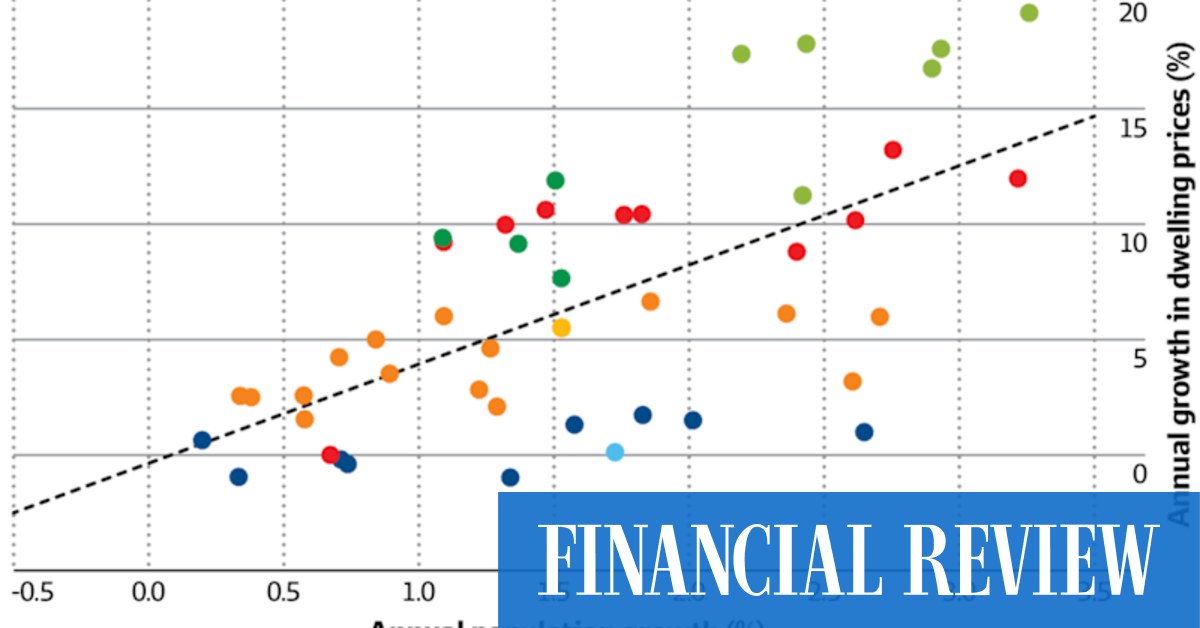
Housing affordability is a big issue. Population growth is not the only cause of housing unaffordability but is a big driver of housing demand. It *has* to be, because people have to live somewhere. With rising demand, prices go up.

To say otherwise is like blaming a 4 litre bucket for overflowing with 8 litres of water rather than turning the tap off.
1% of people own 25% of investment properties. When less own more, then supply diminishes for the others who want to buy. Migrants cant just buy from day 1. No one gets off a plane, walks to an agent, and buys a property. People are not competing with migrants for houses.
 
1% of people own 25% of investment properties. When less own more, then supply diminishes for the others who want to buy. Migrants cant just buy from day 1. No one gets off a plane, walks to an agent, and buys a property. People are not competing with migrants for houses.

That's a simplistic argument as I'm constantly amazed by the numbers of rough sleepers i see daily in my part of suburbia which was never a thing even 15-20 years ago. Not sure how many of these are fobs, but anecdotally it would seem not many. I blame migration pure and simple.
 
That's a simplistic argument as I'm constantly amazed by the numbers of rough sleepers i see daily in my part of suburbia which was never a thing even 15-20 years ago. Not sure how many of these are fobs, but anecdotally it would seem not many. I blame migration pure and simple.
How is it simplistic? 1% own a quarter of the houses. That means every time new houses are being built, they are not being bought by the people living rough, but by people who already own houses. People who don't need multiple properties are taking them, hoarding them, and charging stupid rental rates further creating a division in which people are stuck paying rent, or having to live very poorly in order to save a deposit to get out of the rental hell.

Populations are going to grow. Australia's has to grow, and with birth rates lower, you need migration. Again, migration rates are lower. When you price people out of the market and you hoard properties, you push people to the streets.

In Victoria, which has built more houses than other states, areas with higher population growth did not experience higher property price growth at all. You blame migration because it fits a narrative, not because it is the actual reason.
 
How is it simplistic?
Because residence ownership is not a closed loop system. Do you really think rough sleepers are likely to be part of a future ownership cohort? Not if it's easier for companies to hire a migrant rather than train a non-migrant.

You blame migration because it fits a narrative, not because it is the actual reason.
What narrative is that, and furthermore, please tell me the actual reason.
Near to zero migration Japan has a surplus of housing. However they have also experienced economic stagnation with it's associated problems, due to their low birth rate. Is it wrong of me to support a midpoint between theirs and our migration rate, simply because it doesn't fit your class warfare narrative?
 
Because residence ownership is not a closed loop system. Do you really think rough sleepers are likely to be part of a future ownership cohort? Not if it's easier for companies to hire a migrant rather than train a non-migrant.
So you are complaining about migrants, yet the same people who tell you to complain about them are the ones hiring them??

Many of the rough sleepers have the means to afford rent or deposits, they can't get into the market. I have spent so much time with them, talking to them and hearing their stories. One person was a lawyer, one worked in healthcare. I myself was a 1 week from homelessness. I was very lucky to find an apartment and get accepted for it, or I was 100% on the streets.

What narrative is that, and furthermore, please tell me the actual reason.
Near to zero migration Japan has a surplus of housing. However they have also experienced economic stagnation with it's associated problems, due to their low birth rate. Is it wrong of me to support a midpoint between theirs and our migration rate, simply because it doesn't fit your class warfare narrative?
The narrative of, "let's not fix the actual issues. Don't touch CGT, or Negative Gearing, Investors, Corporate Greed, Inflation caused by companies. We can't tax gas and mining companies".

No no, I have no class warfare. I just want the rich to pay their fair share. If they are going to take our resources, they should pay a fair amount for it so that it goes back to all the people. So we can invest it in housing, healthcare, education, infrastructure etc that benefit every single person. It's not wrong to support something, however when some of the claims get debunked, yet they still keep being peddled, that is when the issue arises.

I too have some concerns about migration, however I don't blame migration for our housing crisis because the data suggests otherwise. Or it suggests that it at least a very minimal impact on the housing market. People like Nathan Birch (300 properties) or the one who admitted to owning 283 on radio are a bigger issues for me than migrants who can -at best- afford one house.
 
My wife has been donating to and helping a bit with a local charity near where we live called "Backpack Bed for Homeless"....

Who originally were called "Swags for Homeless"

They started off literally giving out traditional swags to people who sleep on the streets in and around Brisbane but have expanded their operations Australia-wide via partner charities and now give out backpacks that turn into portable beds with storage.

This rough sleeping crisis has sharply worsened post-pandemic, particularly expanding outside of major city centers as affordability in the rental market has collapsed.

Wife is friendly with the charity founder's.wife who has told her that women and children fleeing family and domestic violence make up one of the largest and fastest-growing cohorts seeking this kind of support. Wife reckons she's going to keep on donating....

But this really is a sobering reality, and what makes it especially heartbreaking right now is how sharply the crisis has deepened across the country. We are seeing a perfect storm where soaring rental prices, a severe shortage of affordable housing, and stagnant income support are pushing ordinary people over the edge.

The current landscape reveals why this is such a critical tipping point for Australia and something needs to be done.

And while long-term solutions like building social housing are essential, they take years. A person sleeping on a freezing pavement or behind a row of shops needs protection immediately.
 
  • Like
Reactions: LFC
From: https://www.abs.gov.au/statistics/people/population/overseas-migration/latest-release

In the year ending 30 June 2025, overseas migration contributed a net gain of 306,000 people to Australia's population. This was a decrease from the net gain of 429,000 people the previous year, and below the financial year record of 538,000 people in 2022-23

Albanese became PM on May 23 2022. ie before the period when the 538k came in. That record is Albanese's. He owns it.


.
There is lag. For example when I was transferred to work overseas, the decision was approved in March but I did not depart until October, although once the decision was made I was ready to fly out the next day. So most of the people who would have migrated in a given financial year, would have been approved the previous financial year. Also, people who were approved prior to covid would have been delayed by the travel ban. Unfortunately, we will never know when a migrant's approval was made and when they arrived.
 
My wife has been donating to and helping a bit with a local charity near where we live called "Backpack Bed for Homeless"....

Who originally were called "Swags for Homeless"

They started off literally giving out traditional swags to people who sleep on the streets in and around Brisbane but have expanded their operations Australia-wide via partner charities and now give out backpacks that turn into portable beds with storage.

This rough sleeping crisis has sharply worsened post-pandemic, particularly expanding outside of major city centers as affordability in the rental market has collapsed.

Wife is friendly with the charity founder's.wife who has told her that women and children fleeing family and domestic violence make up one of the largest and fastest-growing cohorts seeking this kind of support. Wife reckons she's going to keep on donating....

But this really is a sobering reality, and what makes it especially heartbreaking right now is how sharply the crisis has deepened across the country. We are seeing a perfect storm where soaring rental prices, a severe shortage of affordable housing, and stagnant income support are pushing ordinary people over the edge.

The current landscape reveals why this is such a critical tipping point for Australia and something needs to be done.

And while long-term solutions like building social housing are essential, they take years. A person sleeping on a freezing pavement or behind a row of shops needs protection immediately.
It just disgusts me how this has all come to pass. Brazil built thousands of mini cabins for some shelter as a starting point.

Vicious cycle of red tape, funding and politics getting in the way. It's expensive to build new homes and materials and manpower lack.

Germany is in the same hole that the new apartment build target is grossly missed each year. The worst part is the apartments are owned by investment portfolios so the rents are astronomical and not for the average person. In turn some are socially subsidised which also cost the state.
 
So you are complaining about migrants, yet the same people who tell you to complain about them are the ones hiring them??

Many of the rough sleepers have the means to afford rent or deposits, they can't get into the market. I have spent so much time with them, talking to them and hearing their stories. One person was a lawyer, one worked in healthcare. I myself was a 1 week from homelessness. I was very lucky to find an apartment and get accepted for it, or I was 100% on the streets.


The narrative of, "let's not fix the actual issues. Don't touch CGT, or Negative Gearing, Investors, Corporate Greed, Inflation caused by companies. We can't tax gas and mining companies".

No no, I have no class warfare. I just want the rich to pay their fair share. If they are going to take our resources, they should pay a fair amount for it so that it goes back to all the people. So we can invest it in housing, healthcare, education, infrastructure etc that benefit every single person. It's not wrong to support something, however when some of the claims get debunked, yet they still keep being peddled, that is when the issue arises.

I too have some concerns about migration, however I don't blame migration for our housing crisis because the data suggests otherwise. Or it suggests that it at least a very minimal impact on the housing market. People like Nathan Birch (300 properties) or the one who admitted to owning 283 on radio are a bigger issues for me than migrants who can -at best- afford one house.


Which data suggests that population growth driven by record immigration isn't a cause for high house prices?

How many people like Nathan Birch, whoever the hell he is- are there? Hint 75% of investors own one property.
 
Which data suggests that population growth driven by record immigration isn't a cause for high house prices?


"2019 research from Moallemi and Melser find that at least 80% of house price growth is unrelated to immigration".

"However, O'Neil also highlighted that the "very genuine and significant challenges [in] providing safe, affordable housing for Australians" were "not caused by migrants", but rather a long-term lack of "serious housing policy".
How many people like Nathan Birch, whoever the hell he is- are there? Hint 75% of investors own one property.
There are approximately 19,895 people like Nathan Birch.

Ok, so 25% of investors own more than 1 property, which is still too much. It's actually closer to 70% that own one property. 60% of investors are over 60, which doesn't really scream "new migrants". Only 1% are under 30. Even if there was only 1 person like Nathan Birch, that is still not right. No person needs to own more than 2 properties let alone 300. Yet, you will still keep blaming migrants because it's an easy excuse. It's what Pauline screams and the Right Wing media will tell you is the truth. They don't provide any evidence of it, but "just trust us bro".

It is almost impossible for new migrants to purchase a house immediately after arriving in Australia. Temporary migrants are banned from owning homes. So the only migrants that are buying are those getting Permanent Residency, which visas can cost $5000 minimum just to apply. Then there are a whole bunch of other costs involved, and in almost all cases, PR applications take years to process. So these migrants are not waltzing in to Australia, taking the housing, chewing up welfare and stealing jobs. They are also not the migrants the right wing talks about. In many cases, PR migrants are from countries that have strong vetting processes, speak English, and go through a proper process to be approved to enter.
 
@ zimbos.

1. The AFR article is pay-walled.

2. The Australian Institute article has no data to support the claim that immigration doesn't increase house prices. It says 1. that immigration is less than what it might have been had Covid not occurred, and 2. prices went up during COVID when there was no immigration.

On the first point: So what?

The second point has already been de-bunked by the fact that half a million cashed-up ex-pats came home during COVID. Unsurprisingly prices went up.

3. The CIS article can be summarized as : if a 4 litre bucket overflows when you pour 8 litres of water in, the problem is the bucket ie if we could build far more homes than we ever have, (with labor and material costs gooing through the roof) we'd be golden.

4. the 2019 research uses immigration figures prior to 2019. This was at time when house prices went up less and NOM was less. They still found that immigration increases house prices.

Canada recently reduced immigration sharply. House prices ans rents fell almost immediately?

Its always been the case that 1 in 3 people will rent at some stage in their lives. If not investors who is going to risk the capital to house these people that must and choose to rent? The claim that without investors, these people would be owner-occupiers is just fantasy.
 
It just disgusts me how this has all come to pass. Brazil built thousands of mini cabins for some shelter as a starting point.

Vicious cycle of red tape, funding and politics getting in the way. It's expensive to build new homes and materials and manpower lack.

Germany is in the same hole that the new apartment build target is grossly missed each year. The worst part is the apartments are owned by investment portfolios so the rents are astronomical and not for the average person. In turn some are socially subsidised which also cost the state.

I was toying with the idea of buying an apartment in France for a while as a retirement/holiday home and it's quite doable despite a few bits of red tape to overcome.

From what I understand France doesn't have this housing problem and it avoids the worst of the acute shortages seen elsewhere in Western Europe due to its larger existing stock and social housing...

For a holiday/retirement second home, it's one of the more accessible options in Europe and doesn't have the social stigma of second home owners get elsewhere.

So other nations should be looking at France's housing policies in order to boost long term options for people with these housing struggles.

As it happens I'm not going to buy in France and am now thinking about a return to London which is opening again in terms of affordability.
 
@ zimbos.

1. The AFR article is pay-walled.
2. The Australian Institute article has no data to support the claim that immigration doesn't increase house prices. It says 1. that immigration is less than what it might have been had Covid not occurred, and 2. prices went up during COVID when there was no immigration.
There are literally 2 graphs and stats in the article.
On the first point: So what?

The second point has already been de-bunked by the fact that half a million cashed-up ex-pats came home during COVID. Unsurprisingly prices went up.
Ah, so when a fact against is given, its just, "so what". Nice factual response. You realise what you said on the 2nd. No migrants and prices went up. Ex-Pats are not new migrants. So new migrants were not responsible for prices going up.
3. The CIS article can be summarized as : if a 4 litre bucket overflows when you pour 8 litres of water in, the problem is the bucket ie if we could build far more homes than we ever have, (with labor and material costs gooing through the roof) we'd be golden.
Well, is that not true. If supply is higher than demand, prices drop. You said it a few posts ago. Demand increases prices.
4. the 2019 research uses immigration figures prior to 2019. This was at time when house prices went up less and NOM was less. They still found that immigration increases house prices.
Who found that and where is the evidence to back up the claim. Of course the 2019 data would be from then, it can't get data from the future. What it is showing is that housing crisis is an issue that has been around long before blaming migrants for it became an issue.
Canada recently reduced immigration sharply. House prices ans rents fell almost immediately?
Canada's issues are different to Australias. Yes, prices did drop, but in their case it wasn't all migration. It was also Interest Rate Changes, and Economic Contractions. Victoria changed how we tax investments, increased supply, and changed how rates are applied and prices fell. Migration didn't drop, but prices did.
Its always been the case that 1 in 3 people will rent at some stage in their lives. If not investors who is going to risk the capital to house these people that must and choose to rent? The claim that without investors, these people would be owner-occupiers is just fantasy.
Not everyone wants to rent. Where are you getting your facts from? Just to be clear, you've made claims, never backed them up, yet you ask me to, and when I do, you just go, "so what" or "who cares" or you don't actually address the parts that debunk you. Investors have a place, not a place in which 1% of them own 25% of the properties. Not a place in which single individuals own 200 plus properties. The claim that without investors, we would have no places for people to live is fantasy. Again, blaming migrants is a convenient excuse. As was proven in my last post, temporary migrants cannot own, and new migrants are not buying instantly. So blaming migration is a convenient, yet false reasoning. If we cut migration, we cut all migration. We cut European migration too. We cut Israeli migration. We cut American migration.
 
A Sydney man convicted over the assault of a gay couple in the CBD has been released from custody after successfully appealing his sentence.

20-year-old Yaqoob Benshabir – whose uncle is Khaled Sharrouf, one of Australia’s most well-known ISIS terrorists – pleaded guilty over an attack on a gay couple at Wynyard Walk in February 2024.

 
It's probably too simplistic to blame immigration for the housing affordability and availability crisis in Australia....

but the relationship is more complicated than either side of the debate often presents.

Immigration increases demand for housing. If Australia adds hundreds of thousands of people per year, those people need somewhere to live, whether they're international students, (un)skilled migrants, or family migrants. All else being equal, higher population growth puts upward pressure on rents and prices.

The question is whether immigration is the main cause of the affordability crisis or whether it is exposing deeper supply problems.

So I would frame it this way:

Immigration is likely a contributing factor to Australia's current housing shortage because it increases demand. But the severity of the crisis suggests there are also major failures on the supply side. If housing construction had kept pace with population growth for many years, immigration would probably be far less controversial in this debate.

The interesting policy question isn't really "immigration or housing?" but whether Australia can align migration levels, infrastructure investment, and housing construction so they grow together rather than getting out of sync.

And then when it comes to immigration you also have the big business angle....

Businesses often favour a large, flexible workforce because it helps fill jobs, supports growth and can reduce wage pressure. Critics argue this may weaken wage growth and training incentives, while supporters say it addresses skill shortages and helps the economy operate efficiently.

These businesses and business groups wull often lobby governments and politicians for policies that maintain a large flexible labour supply because it reduces recruitment difficulties and wage pressure.

Critics argue this can create an oversupply of workers, weakening employees' bargaining power and slowing wage growth, particularly in sectors with lower skill requirements.

But more workers in the economy means you need more accommodation for them and their families....

It's becoming a vicious circle!!
 
I'm not even against the idea of reducing migration. It's obvious that it would be a contributing factor. The issue is that the rhetoric is that migration is the only problem. It also talks about migration in a manner that "migrants" are only a specific group of people. It creates a view that anyone who isn't white is the problem and it emboldens public acts of racism. It allows those that are part of the cause to get away with it. It creates division amongst the masses, whilst the rich get richer and continue to further entrench the financial divide, buy up the homes, and continue to let the masses suffer.

To me it feels like we all want the same things, but we are addressing the wrong issues.
 
Back
Top