Welcome!

By registering with us, you'll be able to discuss, share and private message with other members of our community.

Sign Up Now!

Poppa Out

Garriock and the FA released the statement PJ referenced above literally within 24 hours of our loss to Egypt.


At the time I found it unprecedented for Football Australia to come out and say the things she did so soon after a World Cup exit. I also agree that it was choice words by Garriok especially as mentioned by PJ's post.

The FA are never going to not back Poppa after extending his deal literally only weeks earlier. What people think and say in private compared to what they say publicly are often not aligned.

Whatever happens I am of the firm belief that Tony Popovic still being the Socceroos manager post Asian Cup is nowhere near worth winning the thing.
 
https://theconversation.com/the-soc...they-have-some-tough-decisions-to-make-286354
The thing I find hard is that I've gone from seeing the Socceroos beating France, England and Germany, really having a go to win the game, to playing one of the dullest games in a world cup against Paraguay. This isn't on the players. How can we get kids and sponsors, hell we need the money, excited about the Socceroos when we play such a style?
 
https://theconversation.com/the-soc...they-have-some-tough-decisions-to-make-286354
The thing I find hard is that I've gone from seeing the Socceroos beating France, England and Germany, really having a go to win the game, to playing one of the dullest games in a world cup against Paraguay. This isn't on the players. How can we get kids and sponsors, hell we need the money, excited about the Socceroos when we play such a style?
👏👏👏

Unfortunately in Tony's mind Tony's ego is bigger than Australian football.

I mean he makes his team selections based on how his gut feels.
 
If Ryan is to short for a keeper Id hate to think what the English think of wee Jordy Pickford.
No idea mate, when Matty was over there I followed the forums and podcasts and that always seemed to be the common theme and it wasn't just him.
He is an inch taller, maybe that breaks through the arbitrary barrier?
 
wtf tbh…..
Here we have the FA post this summary down in LinkedIn.
Seriously ?!
Talk about taking the easy root.
You’d think being the countries NT playing in the biggest comp this would worthy distributed to the major media channels/press for all to see.
Not the tarting corporate FB LinkedIn.
And look at the admiring posting comments for her.
Makes me puke.

I’m sure they can do better than post on LinkedIn, come on!

The whole World Cup drew Australia’s attention and they waited 2 weeks after the World Cup to say something?

Not good enough, the bar is raised now it’s time to take action.
If only we had competent media asking hard questions, it’s not good enough just to be at the World Cup we want to take the next step so the ambition has to be matched from the top.

That is a reflection of the position of football in Aus. Not of Garriock and the FA. They can't do better than a LinkedIn post. The media don't care.
She commented immediately after the WC finished. This was follow up assessment.

You don't get better media from the top down. We get better media when the game is growing and will sustain it.
 
That is a reflection of the position of football in Aus. Not of Garriock and the FA. They can't do better than a LinkedIn post. The media don't care.
She commented immediately after the WC finished. This was follow up assessment.

You don't get better media from the top down. We get better media when the game is growing and will sustain it.
No doubt we all know our system needs far better management vision in turn growth that gets eyes on the game but in saying that put her aside the ex Stan CEO should have done better worked the media pushing the Roo WCup barrow whilst it was the moment doing so post Cup.
His lack of action confirms we stand whereas, stand UP even if it’s all not great news show yourself.
The way I see it.
 
Last edited:
Chatgpt on my boy Go Kuroda 😉


Machida Zelvia 3-4-2-1 — how it works
The basic structure is:
ST
AM AM

LWB CM CM RWB

LCB CB RCB

GK
But the formation on the team sheet doesn't really explain Kuroda's football. The important thing is what happens during each phase.
1. Build-up: don't overplay
Kuroda's philosophy is fundamentally pragmatic.
Rather than trying to progress through endless short passing, Machida are happy to go GK/CB → striker → second ball.
That was already a defining feature of Kuroda's 4-4-2. In 2024 Machida had only around 44% possession and were near the bottom of J1 for passes, yet were competing at the top of the table. �
Total Football Analysis
With three centre-backs, however, they have an additional advantage:
3 v 2 build-up
opposition ST
/ \
CB CB
CB
The spare centre-back can carry the ball forward or hit the long diagonal.
2. The striker is a platform
This is probably the most distinctive part.
The striker isn't simply there to finish attacks.
He's often a target.
A typical sequence:
CB/GK → long ball
→ ST aerial duel
→ AM/CM attack second ball
→ immediate forward attack
The players around the striker are deliberately positioned to collect the loose ball.
That's why Mitchell Duke was such a natural fit for Kuroda's football: his physical presence gives the team a reliable reference point. The tactical analysis of Machida specifically identified the long ball to Duke and the surrounding players' positioning for second balls as a major attacking mechanism. �
Total Football Analysis
3. The two No.10s are crucial
This is where the 3-4-2-1 becomes more interesting than the old 4-4-2.
The two attacking midfielders don't necessarily behave like conventional No.10s.
They can:
move alongside the striker
attack second balls
run beyond the striker
drift towards the wing
press opposition midfielders
attack crosses from the opposite side
So you can get:
ST
↙ ↓ ↘
AM AM
This creates three immediate forward targets after a long ball.
4. Wing-backs provide the width
The 3-4-2-1 solves one of the weaknesses of the 4-4-2.
In the 4-4-2, the wingers provide width.
In the 3-4-2-1:
wing-backs provide width + the two AMs occupy the half-spaces.
That creates a very useful attacking structure:
LWB AM ST AM RWB
The opposition full-backs have a difficult decision:
follow the wing-back → space for the AM
stay with the AM → wing-back is free
narrow the full-back → wing-back gets the ball wide
This is probably the biggest tactical upgrade offered by the 3-4-2-1.
5. Defensively it becomes 5-4-1
This is where Kuroda's philosophy really shines.
When Machida lose the ball:
ST

AM AM

LWB CM CM RWB

LCB CB RCB
The wing-backs drop alongside the centre-backs.
So the attacking 3-4-2-1 becomes a 5-4-1.
The priority is protecting the centre.
Kuroda's original 4-4-2 was already extremely good at this. His Machida side allowed opponents very few shots and used the centre as the protected zone, encouraging opponents towards the wings before pressing them there. �
Total Football Analysis
6. Pressing: the clever bit
Machida don't necessarily press continuously.
They look for triggers.
For example:
back pass → goalkeeper receives → defender receives facing his own goal
That's when Machida can jump.
The idea is:
ST
↙ ↘
AM AM
↓ PRESS

opposition CB

wide
They try to close one side of the pitch.
So instead of chasing the ball everywhere:
force opponent wide → compress that side → force long ball → win second ball.
That is very Kuroda.
The 2024 tactical analysis specifically identified Machida's ability to cut off one side after a pressing trigger. �
Total Football Analysis
7. The really interesting part: transition
This is where I think Kuroda's football is often misunderstood.
It's not simply:
"Long ball and defend."
It's more like:
Long ball → duel → counterpress → second ball → attack again.
So the long ball itself becomes an attacking pressing mechanism.
If the striker wins it:
attack immediately.
If he loses it:
the players surrounding him try to win the loose ball.
If Machida win the second ball:
the opposition is already disorganised.
That's why their football can look chaotic while actually being quite structured.
Why the 3-4-2-1 suits Kuroda
I'd describe it as giving Kuroda the defensive security of his 4-4-2 philosophy with more attacking flexibility.
4-4-2
Strengths
Simple defensive roles
Excellent central compactness
Two strikers for long balls
Very clear pressing structure
Weakness
Can lack central attacking numbers
Wingers can become isolated
Difficult to create between the lines
3-4-2-1
Strengths
Three CBs protect transitions
Wing-backs provide width
Two AMs attack second balls
Better occupation of half-spaces
Natural 5-4-1 defensive block
Three/four players immediately available for counterattacks
So I'd see the Machida 3-4-2-1 as an evolution of Kuroda's principles rather than a completely different philosophy.
And this is where it gets interesting for the Socceroos
There is actually a very strong overlap with the Popovic 3-4-2-1 we were discussing.
But Kuroda's version would probably be:
more direct + more aggressive around second balls + more willing to concede possession.
Popovic's version is generally:
more structured in possession + more deliberate in midfield progression.
That's why a Kuroda 3-4-2-1 vs Popovic 3-4-2-1 using the current Socceroos squad would be a fascinating comparison.
 
Under Popa we proved to be susceptible to the counter press while attempting risk adverse holding of the ball in transition and rushed forward balls without support or any tactical planning to complete for second balls.... Go Kuroda is my man because against the top nations we are a limited team.
 
“One thing is missing in Australia, and that’s a long-term vision for the game,” Garriock said.
“And that’s my job as the executive director.
“It’s going to come from the board, it’s going to come for the football department to implement it. And we do need direction. We do need a football strategy, and we will be developing one.

How is a board or an executive of a board qualified to set this out from a technical and development perspective? I'd expect the executive to put the experts in place, give them the brief then have them report back with a proposed "long-term vision" for the game. Then the Board can decide on it.

There is currently no technical director and it seems to me Heather is wanting to take that on from the board level. It's not a good idea.
 
Th
Chatgpt on my boy Go Kuroda 😉


Machida Zelvia 3-4-2-1 — how it works
The basic structure is:
ST
AM AM

LWB CM CM RWB

LCB CB RCB

GK
But the formation on the team sheet doesn't really explain Kuroda's football. The important thing is what happens during each phase.
1. Build-up: don't overplay
Kuroda's philosophy is fundamentally pragmatic.
Rather than trying to progress through endless short passing, Machida are happy to go GK/CB → striker → second ball.
That was already a defining feature of Kuroda's 4-4-2. In 2024 Machida had only around 44% possession and were near the bottom of J1 for passes, yet were competing at the top of the table. �
Total Football Analysis
With three centre-backs, however, they have an additional advantage:
3 v 2 build-up
opposition ST
/ \
CB CB
CB
The spare centre-back can carry the ball forward or hit the long diagonal.
2. The striker is a platform
This is probably the most distinctive part.
The striker isn't simply there to finish attacks.
He's often a target.
A typical sequence:
CB/GK → long ball
→ ST aerial duel
→ AM/CM attack second ball
→ immediate forward attack
The players around the striker are deliberately positioned to collect the loose ball.
That's why Mitchell Duke was such a natural fit for Kuroda's football: his physical presence gives the team a reliable reference point. The tactical analysis of Machida specifically identified the long ball to Duke and the surrounding players' positioning for second balls as a major attacking mechanism. �
Total Football Analysis
3. The two No.10s are crucial
This is where the 3-4-2-1 becomes more interesting than the old 4-4-2.
The two attacking midfielders don't necessarily behave like conventional No.10s.
They can:
move alongside the striker
attack second balls
run beyond the striker
drift towards the wing
press opposition midfielders
attack crosses from the opposite side
So you can get:
ST
↙ ↓ ↘
AM AM
This creates three immediate forward targets after a long ball.
4. Wing-backs provide the width
The 3-4-2-1 solves one of the weaknesses of the 4-4-2.
In the 4-4-2, the wingers provide width.
In the 3-4-2-1:
wing-backs provide width + the two AMs occupy the half-spaces.
That creates a very useful attacking structure:
LWB AM ST AM RWB
The opposition full-backs have a difficult decision:
follow the wing-back → space for the AM
stay with the AM → wing-back is free
narrow the full-back → wing-back gets the ball wide
This is probably the biggest tactical upgrade offered by the 3-4-2-1.
5. Defensively it becomes 5-4-1
This is where Kuroda's philosophy really shines.
When Machida lose the ball:
ST

AM AM

LWB CM CM RWB

LCB CB RCB
The wing-backs drop alongside the centre-backs.
So the attacking 3-4-2-1 becomes a 5-4-1.
The priority is protecting the centre.
Kuroda's original 4-4-2 was already extremely good at this. His Machida side allowed opponents very few shots and used the centre as the protected zone, encouraging opponents towards the wings before pressing them there. �
Total Football Analysis
6. Pressing: the clever bit
Machida don't necessarily press continuously.
They look for triggers.
For example:
back pass → goalkeeper receives → defender receives facing his own goal
That's when Machida can jump.
The idea is:
ST
↙ ↘
AM AM
↓ PRESS

opposition CB

wide
They try to close one side of the pitch.
So instead of chasing the ball everywhere:
force opponent wide → compress that side → force long ball → win second ball.
That is very Kuroda.
The 2024 tactical analysis specifically identified Machida's ability to cut off one side after a pressing trigger. �
Total Football Analysis
7. The really interesting part: transition
This is where I think Kuroda's football is often misunderstood.
It's not simply:
"Long ball and defend."
It's more like:
Long ball → duel → counterpress → second ball → attack again.
So the long ball itself becomes an attacking pressing mechanism.
If the striker wins it:
attack immediately.
If he loses it:
the players surrounding him try to win the loose ball.
If Machida win the second ball:
the opposition is already disorganised.
That's why their football can look chaotic while actually being quite structured.
Why the 3-4-2-1 suits Kuroda
I'd describe it as giving Kuroda the defensive security of his 4-4-2 philosophy with more attacking flexibility.
4-4-2
Strengths
Simple defensive roles
Excellent central compactness
Two strikers for long balls
Very clear pressing structure
Weakness
Can lack central attacking numbers
Wingers can become isolated
Difficult to create between the lines
3-4-2-1
Strengths
Three CBs protect transitions
Wing-backs provide width
Two AMs attack second balls
Better occupation of half-spaces
Natural 5-4-1 defensive block
Three/four players immediately available for counterattacks
So I'd see the Machida 3-4-2-1 as an evolution of Kuroda's principles rather than a completely different philosophy.
And this is where it gets interesting for the Socceroos
There is actually a very strong overlap with the Popovic 3-4-2-1 we were discussing.
But Kuroda's version would probably be:
more direct + more aggressive around second balls + more willing to concede possession.
Popovic's version is generally:
more structured in possession + more deliberate in midfield progression.
That's why a Kuroda 3-4-2-1 vs Popovic 3-4-2-1 using the current Socceroos squad would be a fascinating comparison.
That read like a system the National Team could easily shift to or implement.
 
There is currently no technical director and it seems to me Heather is wanting to take that on from the board level. It's not a good idea.
Ever since Heather Garriock became executive director of football the intention of Football Australia was to place her in charge of the direction the round ball game is headed in Australia in the absence of a proper technical director which is detrimental for us because we're losing promising dual international prospects to other associations and both the Socceroos and Matildas are essentially starting to stagnate and fall behind compared to other nations.
 
How is a board or an executive of a board qualified to set this out from a technical and development perspective? I'd expect the executive to put the experts in place, give them the brief then have them report back with a proposed "long-term vision" for the game. Then the Board can decide on it.

There is currently no technical director and it seems to me Heather is wanting to take that on from the board level. It's not a good idea.
I can’t think of many football federations that have this sort of structure especially the elite ones, it’s an unusual structure that’s for sure to have an executive leading the technical side of things.
 
I can’t think of many football federations that have this sort of structure especially the elite ones, it’s an unusual structure that’s for sure to have an executive leading the technical side of things.
it really is more than ridiculous and says it all re FA - IF it wasn't for the Roos/Matildas cash cows it would be even worse.
The W side of things (this football landscape has buckets loads more growth potential i'm led to believe) at top level is running on fumes from the APLM, the APL side stuttering along seriously what faith is there with this current management on top of managing the largest piece of the pie @ semi pro and down.

I checked up the list of CEO's we've had since '02 below..........

  • James Johnson (2020–2025) – Guided the organization through the COVID-19 pandemic and successfully delivered the 2023 FIFA Women's World Cup bid.
  • David Gallop (2012–2019) – Former NRL boss who managed the Hyundai A-League and Westfield W-League structures during his tenure.
  • Ben Buckley (2006–2012) – Former AFL executive who oversaw operations during the mid-growth phase of the A-League.
  • John O’Neill (2004–2006) – Credited with launching the inaugural A-League competition.
  • Alan Vessey (2002) – Served briefly as interim/caretaker head.
  • Ian Holmes (2001–2002) – Led the organization during the transition eras of Soccer Australia.

ONLY JJ was worth any penny agreed for lets face it the pre CEO's have been nothing for the game overall but Pro level muppets.
FFS NRL/AFL gimps, a Union gimp.
Many can and will applaud Lowy bringing Professionalism to the top but what its left behind is an utter shambles and a mutiny should be happening like what happened to Infanculo.
 
“One thing is missing in Australia, and that’s a long-term vision for the game,” Garriock said.
“And that’s my job as the executive director.
“It’s going to come from the board, it’s going to come for the football department to implement it. And we do need direction. We do need a football strategy, and we will be developing one.

How is a board or an executive of a board qualified to set this out from a technical and development perspective? I'd expect the executive to put the experts in place, give them the brief then have them report back with a proposed "long-term vision" for the game. Then the Board can decide on it.

There is currently no technical director and it seems to me Heather is wanting to take that on from the board level. It's not a good idea.

TBH I believe that was written by a Technical Director in Ernie Merrick (or maybe before).

That actually means - they have been given that report and have failed to act on it - which is damning in itself.
 
How is a board or an executive of a board qualified to set this out from a technical and development perspective? I'd expect the executive to put the experts in place, give them the brief then have them report back with a proposed "long-term vision" for the game. Then the Board can decide on it.

There is currently no technical director and it seems to me Heather is wanting to take that on from the board level. It's not a good idea.

I thought Heather was the fill-in until they found a replacement for Merrick.

Seems like she wants to do it all.

God help us.
 
it really is more than ridiculous and says it all re FA - IF it wasn't for the Roos/Matildas cash cows it would be even worse.
The W side of things (this football landscape has buckets loads more growth potential i'm led to believe) at top level is running on fumes from the APLM, the APL side stuttering along seriously what faith is there with this current management on top of managing the largest piece of the pie @ semi pro and down.

I checked up the list of CEO's we've had since '02 below..........

  • James Johnson (2020–2025) – Guided the organization through the COVID-19 pandemic and successfully delivered the 2023 FIFA Women's World Cup bid.
  • David Gallop (2012–2019) – Former NRL boss who managed the Hyundai A-League and Westfield W-League structures during his tenure.
  • Ben Buckley (2006–2012) – Former AFL executive who oversaw operations during the mid-growth phase of the A-League.
  • John O’Neill (2004–2006) – Credited with launching the inaugural A-League competition.
  • Alan Vessey (2002) – Served briefly as interim/caretaker head.
  • Ian Holmes (2001–2002) – Led the organization during the transition eras of Soccer Australia.

ONLY JJ was worth any penny agreed for lets face it the pre CEO's have been nothing for the game overall but Pro level muppets.
FFS NRL/AFL gimps, a Union gimp.
Many can and will applaud Lowy bringing Professionalism to the top but what its left behind is an utter shambles and a mutiny should be happening like what happened to Infanculo.
Either the FA are trying to save cash on a proper TD or maybe someone who has got a power trip to control the narrative at boardroom level?

Regardless of the real reasoning they decided to do this, the game is poorer as a result in my opinion.

The ironical part in all of this is, when JJ said we will put football first at the forefront it doesn’t actually feel that it has happened, not having a TD whilst not giving him the full control to do what is required doesn’t reflect this sort of thinking.
 
Last edited:
I thought Heather was the fill-in until they found a replacement for Merrick.

Seems like she wants to do it all.

God help us.

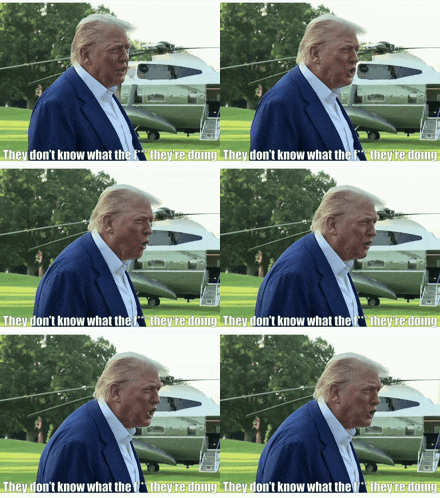
president-trump-they-don%27t-know.gif
 
I thought Heather was the fill-in until they found a replacement for Merrick.

Seems like she wants to do it all.

God help us.
Football Australia were never going to replace Ernie Merrick after retrenching him though and have done away with the technical director role in favour of the current model where they give full control to Heather Garriock with regards to setting the direction of football in Australia along with the day-to-day running of the national teams.
 
Back
Top