There is something uniquely romantic about France.
Firstly, there's Paris - the 'City of Love'.
It's a phrase first thought to be coined in the mid to late 1800s, by wealthy young American tourists and students who ventured across the Atlantic in the new fast-moving steamships to indulge themselves in the bounteous delights of Parisian life.
The 'City of Love' is full of scenic streets, candlelit cafes and bistros. There's the River Seine at sunset, and landmarks like Le Musee Rodin, Le Square Louis XIII, and Le Jardin du Luxembourg - all symbols of romance. For decades, artists, writers, and filmmakers have painted Paris as the ultimate setting for love stories.
Outside of Paris, there are the never-ending small villages of Provence, the cobblestone alleys of Mont Saint-Michel in Normandy, and the medieval settlements of Brittany. There's a timeless charm in the old architecture, warm lights, and a pace of life that invites lingering moments and meaningful glances. It's a gorgeously romantic country from top to bottom.
The Romance of French football
There's something uniquely romantic about French football too. It exudes a certain je ne sais quoi, to borrow a well-used French euphemism. It is not merely a game played on neat suburban pitches or in vast stadiums framed by blue smoke and song, it is a reflection of the country's soul; poetic, restless, and proudly individualistic. To fall in love with French football is to embrace contradiction: grace and grit, artistry and unpredictability, triumph and turbulence.
French football has always carried a certain aesthetic beauty. From Just Fontaine's exquisite finishing in the 1950s and 60s to the elegant sweeps of Michel Platini's passes in the 1980s, to the rhythmic fluency of Zinedine Zidane in the 1990s and early 2000s, and the mesmerising skill and imagination of Thierry Henry, the French game has been defined by artistry. Its players often appear to dance rather than run, painting moments of inspiration that linger long after the final whistle. Even today, when Kylian Mbappe accelerates past defenders with balletic ease, he continues that lineage of creativity born from the banlieues and nurtured on concrete playgrounds rather than manicured training pitches.
Yet this love affair is not built on beauty alone. French football has long mirrored the nation's social and cultural complexity. The diversity of its players - sons of immigrants from Africa, the Caribbean, and beyond - has turned the national team into a living symbol of modern France. When Les Bleus lifted the World Cup in 1998 and again in 2018, they embodied the country's multicultural identity, their victories sparking both celebration and debate about what it means to be French. And French football's vast cultural storytelling means engaging with that deeper conversation about identity, belonging, and unity through the game - something I think creates powerful personal stories that many of us fans connect with.
Albert Camus and the poetry of the game
The highly influential French philosopher, novelist, political activist, and sometime goalkeeper Albert Camus once said:
Clubs as cultural symbols
At club level, the cultural landscape tells its own story. Paris Saint-Germain's modern glamour, Marseille's gritty passion, Lyon's elegant dominance of the 2000s, Lens's working-class pride, RC Strasbourg - a club and city that sit at the crossroads of French and German cultures - a dual identity that strongly shapes both the club's and city's character, and the greatest club of all, St Etienne. In their iconic green kit, it's the club from the provinces and France's most historically rich and storied football club. These wonderful football clubs all reveal different shades of French life.
Then, there is AS Monaco - the club without a country. Although Monaco competes in France's Ligue 1, it's not technically a French club; it represents an independent micro-state. AS Monaco is often called "the billionaires' football club," and with good reason. Despite being a tiny principality rather than a typical French city, Monaco has long been associated with luxury, wealth, and tax-free glamour. Lots of tax-free glamour - something many footballers who have played there are extremely fond of.
Le Classique - where passion meets pride
The biggest club rivalry is between PSG and Olympique de Marseille. "Le Classique" captures the contrast between the capital's cosmopolitan ambition and the south's raw authenticity. Le Classique is more than a football match - it is a clash of culture, identity, and pride that defines French sport. Born in the early 1990s when PSG emerged to challenge Marseille's dominance, the rivalry grew into a symbol of France's north-south divide: the polished glamour of Paris against the passionate grit of Marseille.
While Marseille represents working-class authenticity and Mediterranean rebellion, PSG embodies modernity and wealth, especially since the Qatari takeover in 2011 which transformed the club into a global powerhouse. The contrast between the old pride of Marseille and the new ambition of PSG keeps the rivalry alive, even as their fortunes have somewhat diverged.
During an extended Christmas and New Year holiday to the UK in 2002-03, my wife and I decided to incorporate a long weekend in Paris towards the end of January. We did all the iconic sites - from the Eiffel Tower to the Louvre. We walked the charming neighbourhoods of Montmartre, Le Marais, and the artistic Latin Quarter. We ate in the gastronomy district of St Germain and visited the jazz clubs and bars of Pigalle.
But for me - thanks to a specialist sports ticket agency in London who were able to provide me with some tickets - the highlight was the Coupe de France tie between PSG and Marseille at the Parc des Princes. It was a quite brilliant game of football. A game that despite the chilly Parisian evening, had an electric atmosphere both inside and outside the stadium, culminating in a 2-1 win for PSG. It's a game I'll never forget attending - one that, fortunately, lives on YouTube.
Today, Le Classique remains France's most heated fixture, where history, emotion, and spectacle collide. It captures the essence of French football: rivalry, passion, and the eternal struggle for pride and recognition.
Paris FC, Red Star, and the new era
We must add, that in recent years we've seen the emergence of Paris FC. Formed in 1969, it initially merged with another small Parisian club - Stade Saint-Germain - to form Paris Saint-Germain in 1970. However, the partnership broke apart just two years later. Since then, Paris FC has had a fluctuating existence. Moving between the professional and amateur levels, it has recently become more stable. Suddenly, in November 2024, the club was taken over by the Arnault family, with Red Bull Football joining as a minority shareholder.
The head of the Arnault family is Bernard Arnault, who also happens to be Europe's richest man. You may not have heard much about him, but if you've ever walked around some of Australia's most salubrious shopping streets - such as Collins Street in Melbourne, Martin Place in Sydney, or Edward Street in Brisbane - you've seen some of his shops: Louis Vuitton, Dior, Tiffany & Co., Givenchy, Fendi, Marc Jacobs, Bulgari, to name just a few.
According to a report in the French sports daily, L'Equipe, the Arnault family, led by his eldest son, want to turn Paris FC into the next French footballing super club. They certainly have the financial power to do so. Ironically, they recently moved into a new stadium - the Stade Jean-Bouin - which, for anyone who has visited the Parc des Princes, is literally across the road. Talk about moving onto someone else's territory.
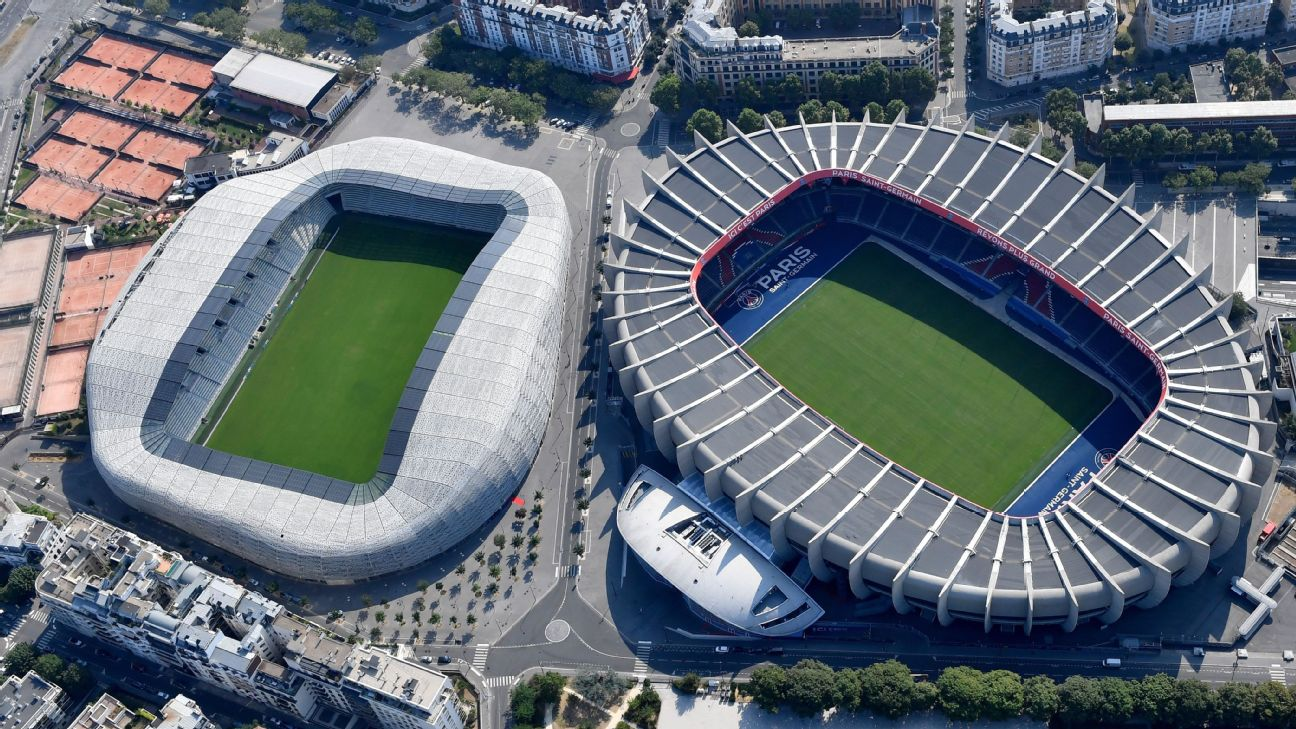
Stade Jean-Bouin and Parc De Princes taking the rivalry next door situated only 30-44 metres apart
And that's not all in Parisian footballing horse-trading. The American private investment company 777 Partners, which has investment stakes in numerous European and South American football clubs, has purchased a controlling stake in Red Star - Paris's oldest football club. Coming from the working-class community of Saint-Ouen, they are the club of Paris's left-wing activists, hipsters, and bohemians, much like their good Bundesliga friends St Pauli in Hamburg. Now taken over by an American private equity company?
These takeovers and makeovers that have played out over recent years in French football have not always been popular among various fan groups, commentators, and other traditionalists involved in the game. But personally, I think - at least from a business perspective - it's probably what was needed to reinvigorate Ligue 1, particularly as PSG's dominance continued to strengthen. And it will likely add more layers of intrigue to French football's beautiful cultural complexity.
The soul of Ligue 1
As many will attest, its domestic league has often battled with underfunding, empty stadiums, TV rights problems, and the shadow of more glamorous European competitions. But therein lies part of its charm. Ligue 1 remains a cradle of youth development and discovery - a place where unknown talents blossom before conquering the world. There is purity in its imperfection, a sense of genuine connection between fans and clubs that still feels local and real.
But as someone who loves French football, I hope its future will not be determined solely by super clubs, trophies, or television deals, but by the stories it continues to tell about identity, community, and belonging. If France can embrace its diversity, modernise its leagues responsibly, and protect the emotional connection between fans and clubs, football will remain not just a sport but one of the most vital expressions of French life.
I think that falling in love with French football is to appreciate its rhythm, the sighs of frustration, the bursts of brilliance, the quiet pride of a game that reflects a nation's heartbeat.
And like all true love affairs, it endures because it never stops surprising us.
Further reading
For the football tragics:
Va Va Voom - A Modern History of French Football by Tom Williams
Le Foot - The Legends of French Football by Christov Ruhn
Sacre Bleu - From Zidane to Mbappe by Matthew Spiro
Also:
France Football - one of the world's most prestigious monthly football journals - and L'Equipe, France's daily sports newspaper, are both available in either French or translated English via the PressReader app, which I subscribe to and thoroughly recommend.
And for the romantics amongst us:
Paris in Love by Eloisa James, the New York Times bestselling author who spent a year living in the 'City of Love'.
And of course, for the jazz cats:
The Parisian Jazz Chronicles - An Improvisational Memoir by Mike Zwerin
And listen:
French Football Weekly podcast
Le Classique - A Historical Journey Through French Football
Both available on your podcast provider.
Firstly, there's Paris - the 'City of Love'.
It's a phrase first thought to be coined in the mid to late 1800s, by wealthy young American tourists and students who ventured across the Atlantic in the new fast-moving steamships to indulge themselves in the bounteous delights of Parisian life.
The 'City of Love' is full of scenic streets, candlelit cafes and bistros. There's the River Seine at sunset, and landmarks like Le Musee Rodin, Le Square Louis XIII, and Le Jardin du Luxembourg - all symbols of romance. For decades, artists, writers, and filmmakers have painted Paris as the ultimate setting for love stories.
Outside of Paris, there are the never-ending small villages of Provence, the cobblestone alleys of Mont Saint-Michel in Normandy, and the medieval settlements of Brittany. There's a timeless charm in the old architecture, warm lights, and a pace of life that invites lingering moments and meaningful glances. It's a gorgeously romantic country from top to bottom.
The Romance of French football
There's something uniquely romantic about French football too. It exudes a certain je ne sais quoi, to borrow a well-used French euphemism. It is not merely a game played on neat suburban pitches or in vast stadiums framed by blue smoke and song, it is a reflection of the country's soul; poetic, restless, and proudly individualistic. To fall in love with French football is to embrace contradiction: grace and grit, artistry and unpredictability, triumph and turbulence.
French football has always carried a certain aesthetic beauty. From Just Fontaine's exquisite finishing in the 1950s and 60s to the elegant sweeps of Michel Platini's passes in the 1980s, to the rhythmic fluency of Zinedine Zidane in the 1990s and early 2000s, and the mesmerising skill and imagination of Thierry Henry, the French game has been defined by artistry. Its players often appear to dance rather than run, painting moments of inspiration that linger long after the final whistle. Even today, when Kylian Mbappe accelerates past defenders with balletic ease, he continues that lineage of creativity born from the banlieues and nurtured on concrete playgrounds rather than manicured training pitches.
Yet this love affair is not built on beauty alone. French football has long mirrored the nation's social and cultural complexity. The diversity of its players - sons of immigrants from Africa, the Caribbean, and beyond - has turned the national team into a living symbol of modern France. When Les Bleus lifted the World Cup in 1998 and again in 2018, they embodied the country's multicultural identity, their victories sparking both celebration and debate about what it means to be French. And French football's vast cultural storytelling means engaging with that deeper conversation about identity, belonging, and unity through the game - something I think creates powerful personal stories that many of us fans connect with.
Albert Camus and the poetry of the game
The highly influential French philosopher, novelist, political activist, and sometime goalkeeper Albert Camus once said:
He often spoke about how his experiences as a goalkeeper and young footballer profoundly influenced his philosophy, particularly his ideas on morality, solidarity, and the human condition. One of the most famous French thinkers of all time, his enduring philosophical and literary themes are embedded in the French psyche - a philosopher who saw football as existentialism.
Clubs as cultural symbols
At club level, the cultural landscape tells its own story. Paris Saint-Germain's modern glamour, Marseille's gritty passion, Lyon's elegant dominance of the 2000s, Lens's working-class pride, RC Strasbourg - a club and city that sit at the crossroads of French and German cultures - a dual identity that strongly shapes both the club's and city's character, and the greatest club of all, St Etienne. In their iconic green kit, it's the club from the provinces and France's most historically rich and storied football club. These wonderful football clubs all reveal different shades of French life.
Then, there is AS Monaco - the club without a country. Although Monaco competes in France's Ligue 1, it's not technically a French club; it represents an independent micro-state. AS Monaco is often called "the billionaires' football club," and with good reason. Despite being a tiny principality rather than a typical French city, Monaco has long been associated with luxury, wealth, and tax-free glamour. Lots of tax-free glamour - something many footballers who have played there are extremely fond of.
Le Classique - where passion meets pride
The biggest club rivalry is between PSG and Olympique de Marseille. "Le Classique" captures the contrast between the capital's cosmopolitan ambition and the south's raw authenticity. Le Classique is more than a football match - it is a clash of culture, identity, and pride that defines French sport. Born in the early 1990s when PSG emerged to challenge Marseille's dominance, the rivalry grew into a symbol of France's north-south divide: the polished glamour of Paris against the passionate grit of Marseille.
While Marseille represents working-class authenticity and Mediterranean rebellion, PSG embodies modernity and wealth, especially since the Qatari takeover in 2011 which transformed the club into a global powerhouse. The contrast between the old pride of Marseille and the new ambition of PSG keeps the rivalry alive, even as their fortunes have somewhat diverged.
During an extended Christmas and New Year holiday to the UK in 2002-03, my wife and I decided to incorporate a long weekend in Paris towards the end of January. We did all the iconic sites - from the Eiffel Tower to the Louvre. We walked the charming neighbourhoods of Montmartre, Le Marais, and the artistic Latin Quarter. We ate in the gastronomy district of St Germain and visited the jazz clubs and bars of Pigalle.
But for me - thanks to a specialist sports ticket agency in London who were able to provide me with some tickets - the highlight was the Coupe de France tie between PSG and Marseille at the Parc des Princes. It was a quite brilliant game of football. A game that despite the chilly Parisian evening, had an electric atmosphere both inside and outside the stadium, culminating in a 2-1 win for PSG. It's a game I'll never forget attending - one that, fortunately, lives on YouTube.
Today, Le Classique remains France's most heated fixture, where history, emotion, and spectacle collide. It captures the essence of French football: rivalry, passion, and the eternal struggle for pride and recognition.
Paris FC, Red Star, and the new era
We must add, that in recent years we've seen the emergence of Paris FC. Formed in 1969, it initially merged with another small Parisian club - Stade Saint-Germain - to form Paris Saint-Germain in 1970. However, the partnership broke apart just two years later. Since then, Paris FC has had a fluctuating existence. Moving between the professional and amateur levels, it has recently become more stable. Suddenly, in November 2024, the club was taken over by the Arnault family, with Red Bull Football joining as a minority shareholder.
The head of the Arnault family is Bernard Arnault, who also happens to be Europe's richest man. You may not have heard much about him, but if you've ever walked around some of Australia's most salubrious shopping streets - such as Collins Street in Melbourne, Martin Place in Sydney, or Edward Street in Brisbane - you've seen some of his shops: Louis Vuitton, Dior, Tiffany & Co., Givenchy, Fendi, Marc Jacobs, Bulgari, to name just a few.
According to a report in the French sports daily, L'Equipe, the Arnault family, led by his eldest son, want to turn Paris FC into the next French footballing super club. They certainly have the financial power to do so. Ironically, they recently moved into a new stadium - the Stade Jean-Bouin - which, for anyone who has visited the Parc des Princes, is literally across the road. Talk about moving onto someone else's territory.
Stade Jean-Bouin and Parc De Princes taking the rivalry next door situated only 30-44 metres apart
Sacre bleu!
These takeovers and makeovers that have played out over recent years in French football have not always been popular among various fan groups, commentators, and other traditionalists involved in the game. But personally, I think - at least from a business perspective - it's probably what was needed to reinvigorate Ligue 1, particularly as PSG's dominance continued to strengthen. And it will likely add more layers of intrigue to French football's beautiful cultural complexity.
The soul of Ligue 1
As many will attest, its domestic league has often battled with underfunding, empty stadiums, TV rights problems, and the shadow of more glamorous European competitions. But therein lies part of its charm. Ligue 1 remains a cradle of youth development and discovery - a place where unknown talents blossom before conquering the world. There is purity in its imperfection, a sense of genuine connection between fans and clubs that still feels local and real.
But as someone who loves French football, I hope its future will not be determined solely by super clubs, trophies, or television deals, but by the stories it continues to tell about identity, community, and belonging. If France can embrace its diversity, modernise its leagues responsibly, and protect the emotional connection between fans and clubs, football will remain not just a sport but one of the most vital expressions of French life.
I think that falling in love with French football is to appreciate its rhythm, the sighs of frustration, the bursts of brilliance, the quiet pride of a game that reflects a nation's heartbeat.
And like all true love affairs, it endures because it never stops surprising us.
Further reading
For the football tragics:
Va Va Voom - A Modern History of French Football by Tom Williams
Le Foot - The Legends of French Football by Christov Ruhn
Sacre Bleu - From Zidane to Mbappe by Matthew Spiro
Also:
France Football - one of the world's most prestigious monthly football journals - and L'Equipe, France's daily sports newspaper, are both available in either French or translated English via the PressReader app, which I subscribe to and thoroughly recommend.
And for the romantics amongst us:
Paris in Love by Eloisa James, the New York Times bestselling author who spent a year living in the 'City of Love'.
And of course, for the jazz cats:
The Parisian Jazz Chronicles - An Improvisational Memoir by Mike Zwerin
And listen:
French Football Weekly podcast
Le Classique - A Historical Journey Through French Football
Both available on your podcast provider.