Part I: Who Held the Remote
Stan Sport becomes the Premier League’s new Australian home following the closure of Optus Sport.
Football has always changed on the pitch. Tactics evolve. Players evolve. Even the shape of the game evolves. But the most important change of the last forty years did not happen between the touchlines. It happened on the screen.
For a long time, football on television was simple. You knew where it lived. You knew when it started. You knew who was talking you through it. The screen did not just show the game, it gave it structure. Money flowed back into the sport. Clubs planned. Fans complained, but they understood the system.
That version of football is disappearing.
The screen is still there, but it no longer means one thing. It sits across phones, televisions, tablets and apps that all want your attention and sometimes fail when you need them most. Where football once had single homes, it now has scattered addresses. What replaced certainty was not freedom, but friction.
Australia has felt this more clearly than most.
Australia is a difficult market for football broadcasting. The population is relatively small, but the interests are global. Fans follow leagues from England, Germany, Italy, Spain and beyond. That makes it hard to build a clean, affordable system. Instead, rights have bounced from pay television to telecommunications companies to streaming platforms, fragmenting the game as they go.
Stan Sport’s takeover of Optus Sport is not just another rights story. It is a sign that the fragmentation phase is running into economic reality.
WHEN THE SCREEN WAS SIMPLE
The World Game crew, circa 2005 (from left): Les Murray, Tony Palumbo, Craig Foster, Francis Awaritefe, Simon Hill, Damien Lovelock, Andrew Orsatti.
From the 1990s through to the mid-2010s, football broadcasting reached a workable balance. Pay television dominated. Free-to-air still had a role. Rights fees rose steadily. Competitions usually lived in one place.
It was not perfect, but it was navigable. Fans knew where to go. Leagues knew what money was coming. Clubs built budgets with confidence.
Streaming changed that.
THE STREAMING ERA
Streaming was sold as choice. What it really delivered was fragmentation. Football was sliced into packages, bundles and sub-rights. Leagues assumed live sport would survive untouched by the forces that reshaped music and entertainment. They believed streaming was just cable delivered differently.
That turned out to be wrong.
Streaming made football easier to distribute, but harder to follow coherently. Fans stacked subscriptions. Platforms chased growth rather than profit. The rights market became unstable in ways it had never been before.
Some fans quietly stopped trying to keep up.
HOW IT PLAYED OUT IN AUSTRALIA
The Australian shift accelerated in 2016 when Optus outbid Foxtel for the Premier League. It was surprising not because of the league involved, but because of who won it. A telecommunications company suddenly held the most valuable football rights in the world.
After early technical problems, Optus improved quickly and built a strong football identity. For a while, it worked. But Premier League rights are expensive, telcos have competing priorities, and the streaming market is crowded. As costs rose, consolidation became inevitable.
Stan’s acquisition of Optus Sport reflects that reality. It reduces duplication and concentrates rights in one place. For fans, that can feel like relief. It can also feel like yet another reshuffle in a system that never quite settles.
THE RIGHTS MODEL IS STRAINING
Selected A-League matches on 10, full coverage on Paramount+.
For decades, football rights behaved like a market that only went up. Each cycle broke records. Everyone assumed the next one would be bigger again.
That confidence is fading.
Subscriber growth is slowing. Platforms are under pressure to make money rather than just grow. Europe has already seen what happens when the numbers stop adding up. Australia, with a smaller and more fragile market, feels those pressures faster.
Consolidation is not accidental. It is correction.
WHAT THIS MEANS FOR FANS
Fragmentation has created an odd outcome. Fans technically have more access than ever, but watching football often feels harder. Each subscription makes sense on its own. Together, they feel exhausting.
The result is not just piracy or disengagement, but something quieter and more damaging. Football starts to feel less shared, less human, and less honest.
That is the deeper problem. And it is not really about platforms at all.
Part II: Losing the Signal
Football has always been a broadcast sport. You can be there in person, feel the noise and the tension, but most people experience the game through a screen. That is where football now lives.
What has changed is not just where we watch, but what the broadcast is asking us to feel.
FRAGMENTATION, INTIMACY, DISTRUST
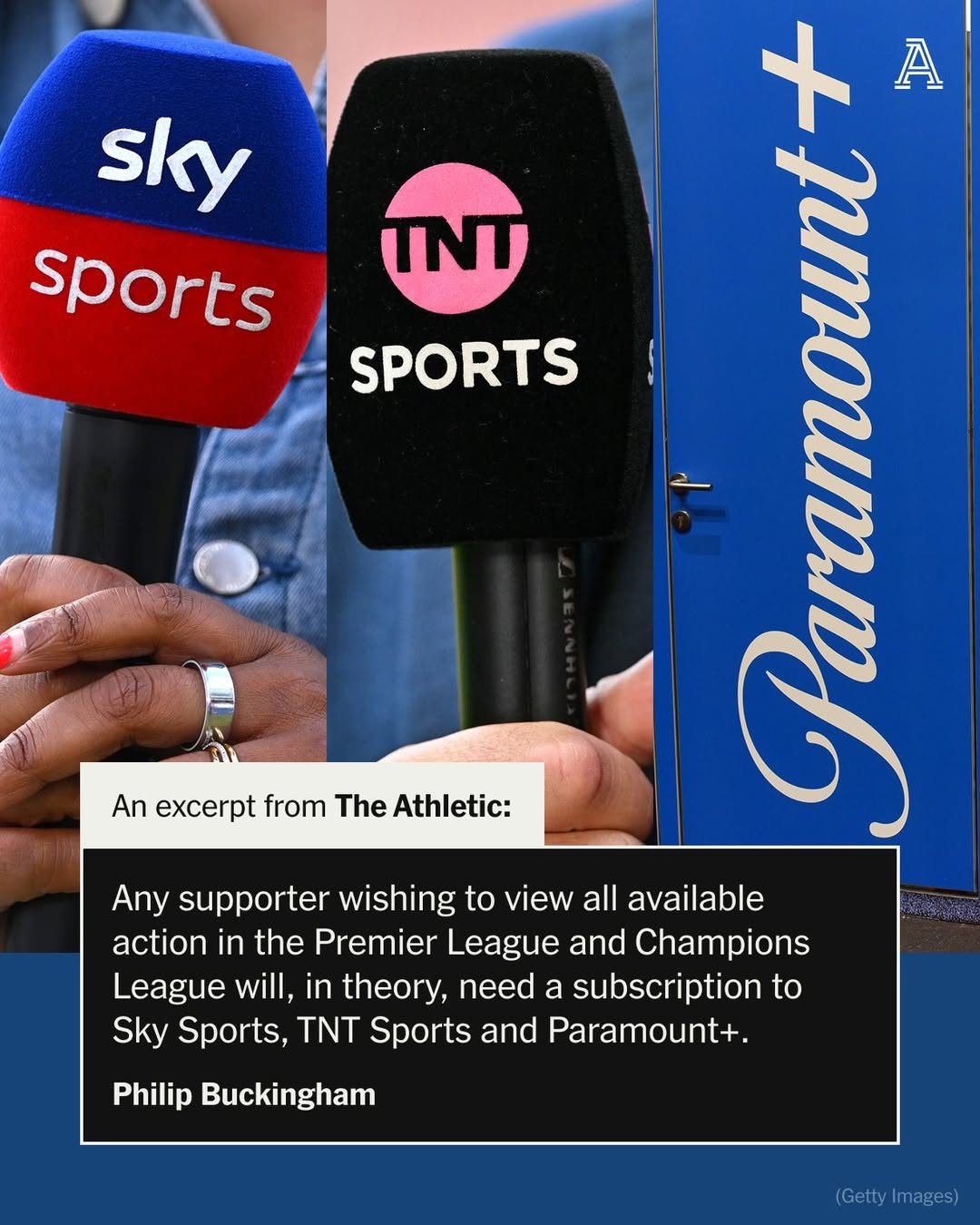
In the UK, following the Premier League and Champions League now means juggling Sky Sports, TNT Sports and Paramount+. Source: The Athletic
Modern football broadcasting sits under three pressures.
The industry’s response has mostly been to add more. More angles. More graphics. More data. More talking.
It often feels impressive. It rarely feels meaningful.
Football is not an information problem. Nobody fell in love with the game because of expected goals.
WHERE THE REAL CONNECTION IS
Football360, which launched on October 6, 2025, has been a hit with fans across all levels of the football pyramid.
Some of the most compelling football content of the last decade has existed outside traditional broadcasts. Fan channels. Player podcasts. Tactical videos. Clips that capture one moment, one reaction, one mistake.
They work because they feel human. They feel unfiltered. You are not being addressed by “the product”. You are listening to someone who cares.
Broadcasters have noticed and tried to replicate that feeling. This is where it gets awkward. Carefully managed banter. Supposedly unscripted moments. Familiar faces hired because they are recognisable, not because they say anything interesting.
Viewers can tell the difference.
TRUST IS THE SCARCE THING
The biggest problem facing football broadcasting is not piracy or short attention spans. It is trust.
Fragmentation did not just break access. It broke belief.
Fans know when debates are staged. They know when financial issues are softened. They know when player welfare is treated as content rather than concern.
The broadcasts that matter in the future will not be the slickest. They will be the ones people believe.
PERSONALISATION AND ITS COST
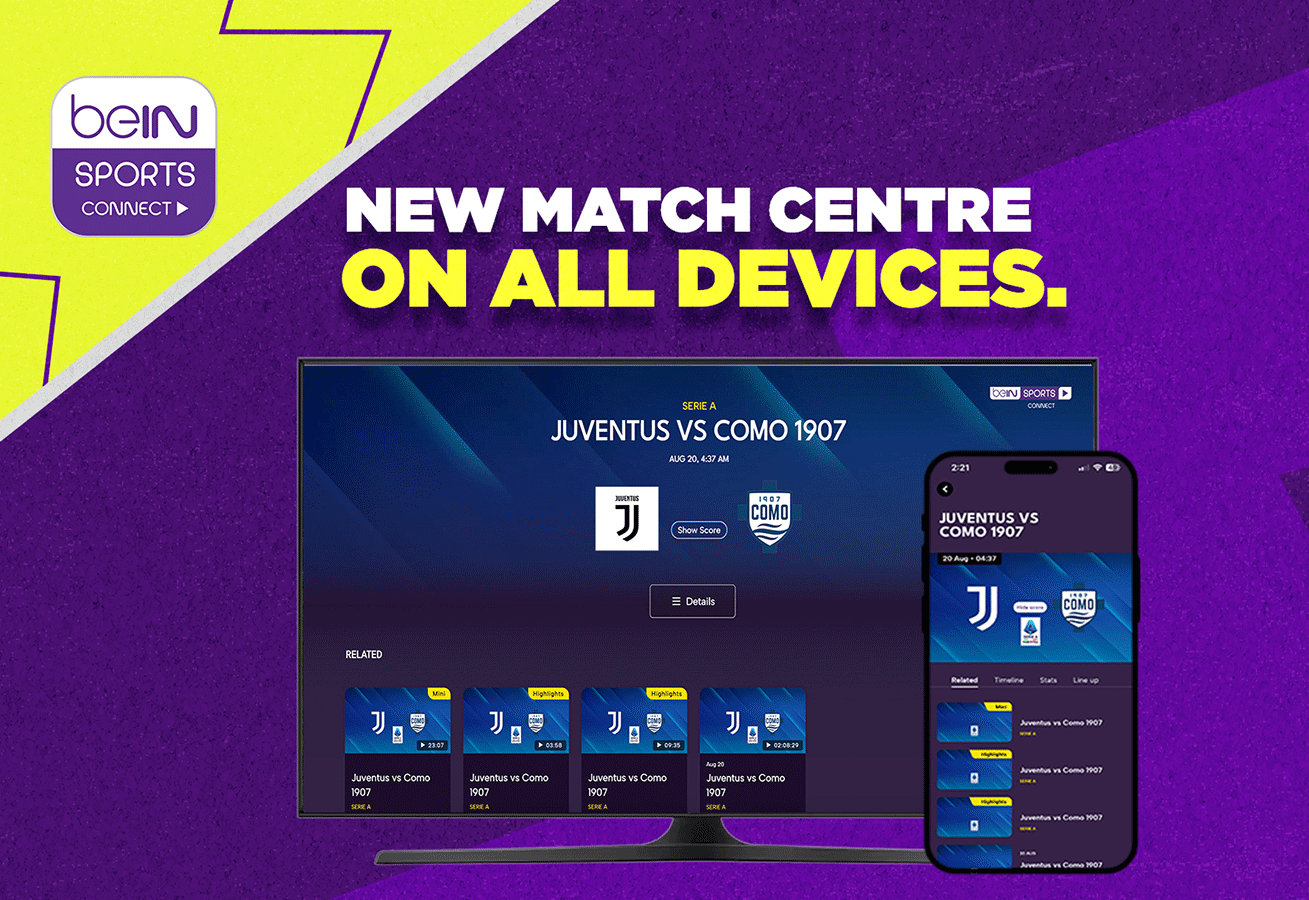
Serie A’s Australian broadcast now sits on beIN Sports Connect, another example of how leagues are scattered across platforms.
Technology will push personalisation further. Different feeds. Different commentary. Different ways to watch the same match.
That sounds empowering, and sometimes it will be. But football loses something when everyone watches a different version of the same game. One of its last shared rituals is watching together, then arguing about it afterwards.
Break that too far and it does not come back.
THE QUESTION NOBODY CAN AVOID
There is also a political question underneath all of this. Should football still be publicly accessible?
Anti-siphoning rules were built for free-to-air television, not streaming. As streaming becomes dominant, governments will have to decide what “free access” actually means in a digital world.
If football becomes something you only see if you can afford it, something important is lost.
WHERE THIS LEAVES US
Football broadcasting is at a turning point. One path leads to more personalisation, more polish, more distance. The other leads to something simpler and harder. Fewer voices. More honesty. Less pretending the game is fine.
The future will probably be messy and uneven.
But football does not need fixing.
It needs to be seen properly.
What has changed is not just where we watch, but what the broadcast is asking us to feel.
FRAGMENTATION, INTIMACY, DISTRUST
In the UK, following the Premier League and Champions League now means juggling Sky Sports, TNT Sports and Paramount+. Source: The Athletic
Modern football broadcasting sits under three pressures.
1. Fragmentation, because the audience is no longer one audience.
2. Intimacy, because fans expect closeness and personality.
3. Distrust, because viewers increasingly feel they are being sold a version of the game rather than shown it honestly.
The industry’s response has mostly been to add more. More angles. More graphics. More data. More talking.
It often feels impressive. It rarely feels meaningful.
Football is not an information problem. Nobody fell in love with the game because of expected goals.
WHERE THE REAL CONNECTION IS
Football360, which launched on October 6, 2025, has been a hit with fans across all levels of the football pyramid.
Some of the most compelling football content of the last decade has existed outside traditional broadcasts. Fan channels. Player podcasts. Tactical videos. Clips that capture one moment, one reaction, one mistake.
They work because they feel human. They feel unfiltered. You are not being addressed by “the product”. You are listening to someone who cares.
Broadcasters have noticed and tried to replicate that feeling. This is where it gets awkward. Carefully managed banter. Supposedly unscripted moments. Familiar faces hired because they are recognisable, not because they say anything interesting.
Viewers can tell the difference.
TRUST IS THE SCARCE THING
The biggest problem facing football broadcasting is not piracy or short attention spans. It is trust.
Fragmentation did not just break access. It broke belief.
Fans know when debates are staged. They know when financial issues are softened. They know when player welfare is treated as content rather than concern.
The broadcasts that matter in the future will not be the slickest. They will be the ones people believe.
PERSONALISATION AND ITS COST
Serie A’s Australian broadcast now sits on beIN Sports Connect, another example of how leagues are scattered across platforms.
Technology will push personalisation further. Different feeds. Different commentary. Different ways to watch the same match.
That sounds empowering, and sometimes it will be. But football loses something when everyone watches a different version of the same game. One of its last shared rituals is watching together, then arguing about it afterwards.
Break that too far and it does not come back.
THE QUESTION NOBODY CAN AVOID
There is also a political question underneath all of this. Should football still be publicly accessible?
Anti-siphoning rules were built for free-to-air television, not streaming. As streaming becomes dominant, governments will have to decide what “free access” actually means in a digital world.
If football becomes something you only see if you can afford it, something important is lost.
WHERE THIS LEAVES US
Football broadcasting is at a turning point. One path leads to more personalisation, more polish, more distance. The other leads to something simpler and harder. Fewer voices. More honesty. Less pretending the game is fine.
The future will probably be messy and uneven.
But football does not need fixing.
It needs to be seen properly.

