As the page turned on the calendar and May became June, Socceroos head coach Tony Popovic named the final 26-player list that would represent the nation and don the green and gold jersey at the upcoming World Cup in North America which gets underway in a couple of days from now, with two then-uncapped players in Tete Yengi and most notably Cristian Volpato, whose change of allegiance saga enthralled both this forum and Australia alike, included in the playing list alongside the likes of talismanic skipper Mathew Ryan, Jackson Irvine and Cam Devlin, to name a few, as is widely expected heading into the culmination of yet another major tournament cycle.
A point of contention in the final Socceroos squad for this latest edition of football's showpiece event, however, is the selection of Melbourne City winger Mathew Leckie, who is set to compete in his fourth straight World Cup despite only managing 237 minutes' worth of game time over the course of the A-League Men home and away season, having missed half the year after sustaining a hip injury and subsequently undergoing surgery in December 2025. Even though he brings plenty of experience to a Socceroos side without key players like Riley McGree and Mitch Duke, both of whom were mainstays throughout our qualification campaign as well as at the previous World Cup in Qatar, questions must inevitably be asked as to why he made the final squad ahead of Martin Boyle and Alex Robertson, who were arguably in better form at club level this season in addition to having significantly more consistent game time in contrast to Leckie, the second oldest player in our squad heading into this tournament behind only Aziz Behich.
The average age conundrum
From an average age perspective, the Socceroos are heading into the current World Cup cycle with a squad average age of 26.88 years which is marginally more youthful compared to the playing list from four years ago that had an average age of 27.15 years. In terms of where we rank in comparison to the other 47 teams vying for the right to be deemed champions of the world, Australia is 32nd overall with the powerhouse nations of England, France and Spain all boasting younger squads, and second in our group behind only co-hosts the United States. If we take additional permutations into account, as shown in the graph below, there are considerable improvements to the squad's average age when Leckie is either culled from the squad altogether or is replaced by either one of Alex Robertson or Martin Boyle. In the case of replacing Mathew Leckie with Alex Robertson, for example, this figure decreases to as low as 26.42 years of age which is on par with that of the USA, whereas if Martin Boyle were to be included instead there is a less noticeable decrease to 26.81 years, but this would still constitute an improvement on both the squad average ages from the past two cycles nonetheless.
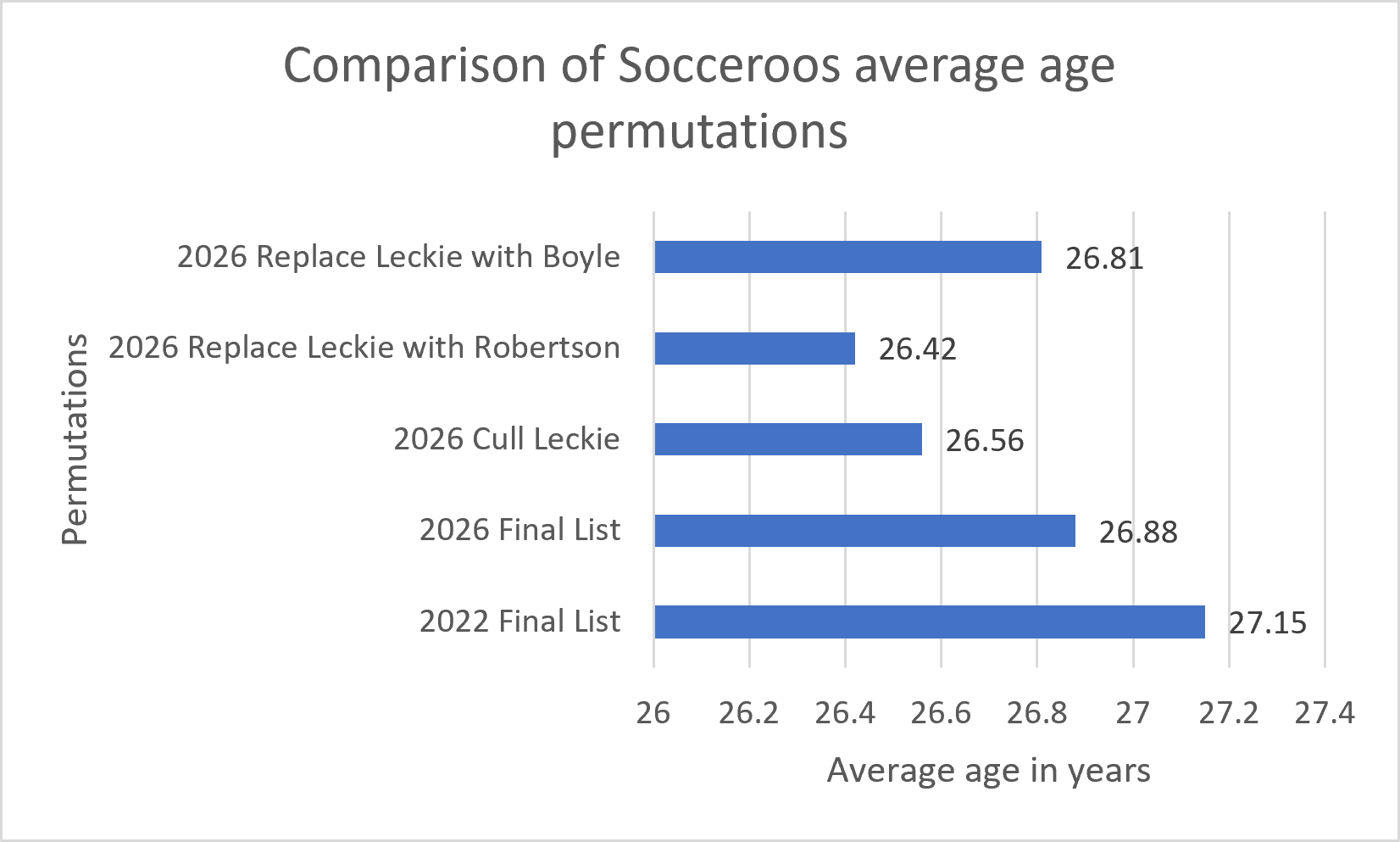
Figure 1. Average age of the Socceroos' 2022 and 2026 World Cup squads, including hypothetical scenarios where Mathew Leckie is omitted or replaced by Alex Robertson or Martin Boyle. The youngest possible squad average is achieved through the inclusion of Robertson.
More on the balance between experience and youth
Something which cannot be understated is the balancing act between experience and youth that has become such a fundamental part of selecting the Socceroos squad for the upcoming World Cup as we enter what will undoubtedly be a crucial period of nine months between now and February 2027 (spanning both the culmination of the current World Cup and 2027 Asian Cup cycles) and start laying down the foundations of our eventual squad heading into the 2030 World Cup and beyond. One thing which is immediately clear from comparing the playing lists from this year's edition and the previous one is that there seems to be more of an emphasis on youth as opposed to experience, although the nine retained players from four years ago have 520 combined caps at the time of writing, from which a fifth of that number stems from starting keeper and captain Mathew Ryan, who also holds the distinction of being the only centurion for the Australia men's national football team still active as a player to this day.
With regards to some of the youth prospects to keep an eye on as we approach the start of the Socceroos' World Cup campaign, the main ones to watch would be Mo Toure and Nestory Irankunda, along with Alessandro Circati, Lucas Herrington and Paul Okon-Engstler — all of them a fundamental part of the squad who have made waves for their respective clubs over the course of the past year or so; in particular former Brisbane Roar product Lucas Herrington, who has already defended against world-class players in Lionel Messi and Son Heung-min since making the move stateside to Colorado Rapids during the January transfer window, as well as Mo Toure, with the latter of the two becoming the first player in Norwich City's history to score two hat-tricks in his first ten appearances for the side, eventually posting a total of ten goals and three appearances in twelve appearances across all competitions despite missing a few weeks of the Championship season due to injury.
Are there problems with the selection policy?
Upon any squad announcement for both our national teams, men's and women's, it is of course necessary to address the elephant in the room and ask the question of whether there are problems with the current selection policy being implemented, something which the inclusion of Mathew Leckie in the final Socceroos playing list heading into our first major tournament campaign under Tony Popovic only serves to reiterate.
Many forumites will no doubt be aware that I have always been critical of the selection policy in recent times, having written a number of articles questioning the prioritisation of the old guard and the reliance on the tried-and-true formula of favouring experience over youth associated with the Matildas through our continued selection of Emily van Egmond; this is unfortunately no different for the Socceroos and is eventually going to lead to the same outcome where we experience a period of stagnation, inevitably being forced to play catch-up with the Asian powerhouse nations in Japan, South Korea and Saudi Arabia in addition to high-flying European and South American heavyweights as we fall behind instead of contending and challenging for silverware on the international stage, which many supporters, myself included, would consider to be the expectation for a team consistently performing well at the Asian Cup including going all the way in the 2015 edition of that tournament, in addition to making the round of 16 at the World Cup four years ago, where we would go on to push eventual world champions Argentina all the way before ultimately falling short.
Personally, I don't think that there are problems with the selection policy for the Socceroos as Popovic has done a much better job in comparison to his Matildas counterpart in Joe Montemurro in terms of rotating the playing list and bringing in new faces from the age grade sides to replace the old guard, in addition to balancing experience and youth as opposed to favouring one over the other, although there is still room for improvement especially regarding the dual national situation as we have already lost a promising dual international prospect in Adrian Segecic to Croatia, and until recently there was uncertainty surrounding the fate of Cristian Volpato and whether he would commit to donning the green and gold jersey or opt to represent Italy, as was previously the case for him at age grade level.
Conclusion
To conclude, the Socceroos are heading into this latest World Cup cycle with an air of expectancy and the hopes and dreams of a nation again resting on their shoulders, twenty years on from when the golden generation broke new ground and made the knockout stage of the World Cup for the first time — a feat which would only be equalled again in Qatar during the 2022 edition of the tournament under previous head coach Graham Arnold. The balancing act between experience and youth is a fundamental part of naming the twenty-six players that will have earned the right to don the green and gold jersey and represent Australia in football's showpiece event, and Tony Popovic has arguably selected, in his view, a mixture of players who have experience in previous World Cup campaigns along with those who have made waves in recent times at club level, with seventeen players set to make their tournament debuts, but most importantly, the players whom he sees fit to play within the tactical system and get the job done for us.
We have already progressed in leaps and bounds over the course of the past four years, and heading into the culmination of yet another major tournament cycle we can seize the opportunity to make the nation proud, writing another chapter in the storied history of the Australian national football team as we hope to become a force to be reckoned with on the international stage, but ultimately only time will tell whether our campaign will be a success or not, and only with hindsight will we be able to take the lessons we've learned from this campaign into future cycles to build on the foundations we have started to lay down, eventually paving the way towards the holy grail of an elusive major tournament trophy.
A point of contention in the final Socceroos squad for this latest edition of football's showpiece event, however, is the selection of Melbourne City winger Mathew Leckie, who is set to compete in his fourth straight World Cup despite only managing 237 minutes' worth of game time over the course of the A-League Men home and away season, having missed half the year after sustaining a hip injury and subsequently undergoing surgery in December 2025. Even though he brings plenty of experience to a Socceroos side without key players like Riley McGree and Mitch Duke, both of whom were mainstays throughout our qualification campaign as well as at the previous World Cup in Qatar, questions must inevitably be asked as to why he made the final squad ahead of Martin Boyle and Alex Robertson, who were arguably in better form at club level this season in addition to having significantly more consistent game time in contrast to Leckie, the second oldest player in our squad heading into this tournament behind only Aziz Behich.
The average age conundrum
From an average age perspective, the Socceroos are heading into the current World Cup cycle with a squad average age of 26.88 years which is marginally more youthful compared to the playing list from four years ago that had an average age of 27.15 years. In terms of where we rank in comparison to the other 47 teams vying for the right to be deemed champions of the world, Australia is 32nd overall with the powerhouse nations of England, France and Spain all boasting younger squads, and second in our group behind only co-hosts the United States. If we take additional permutations into account, as shown in the graph below, there are considerable improvements to the squad's average age when Leckie is either culled from the squad altogether or is replaced by either one of Alex Robertson or Martin Boyle. In the case of replacing Mathew Leckie with Alex Robertson, for example, this figure decreases to as low as 26.42 years of age which is on par with that of the USA, whereas if Martin Boyle were to be included instead there is a less noticeable decrease to 26.81 years, but this would still constitute an improvement on both the squad average ages from the past two cycles nonetheless.
Figure 1. Average age of the Socceroos' 2022 and 2026 World Cup squads, including hypothetical scenarios where Mathew Leckie is omitted or replaced by Alex Robertson or Martin Boyle. The youngest possible squad average is achieved through the inclusion of Robertson.
More on the balance between experience and youth
Something which cannot be understated is the balancing act between experience and youth that has become such a fundamental part of selecting the Socceroos squad for the upcoming World Cup as we enter what will undoubtedly be a crucial period of nine months between now and February 2027 (spanning both the culmination of the current World Cup and 2027 Asian Cup cycles) and start laying down the foundations of our eventual squad heading into the 2030 World Cup and beyond. One thing which is immediately clear from comparing the playing lists from this year's edition and the previous one is that there seems to be more of an emphasis on youth as opposed to experience, although the nine retained players from four years ago have 520 combined caps at the time of writing, from which a fifth of that number stems from starting keeper and captain Mathew Ryan, who also holds the distinction of being the only centurion for the Australia men's national football team still active as a player to this day.
With regards to some of the youth prospects to keep an eye on as we approach the start of the Socceroos' World Cup campaign, the main ones to watch would be Mo Toure and Nestory Irankunda, along with Alessandro Circati, Lucas Herrington and Paul Okon-Engstler — all of them a fundamental part of the squad who have made waves for their respective clubs over the course of the past year or so; in particular former Brisbane Roar product Lucas Herrington, who has already defended against world-class players in Lionel Messi and Son Heung-min since making the move stateside to Colorado Rapids during the January transfer window, as well as Mo Toure, with the latter of the two becoming the first player in Norwich City's history to score two hat-tricks in his first ten appearances for the side, eventually posting a total of ten goals and three appearances in twelve appearances across all competitions despite missing a few weeks of the Championship season due to injury.
Are there problems with the selection policy?
Upon any squad announcement for both our national teams, men's and women's, it is of course necessary to address the elephant in the room and ask the question of whether there are problems with the current selection policy being implemented, something which the inclusion of Mathew Leckie in the final Socceroos playing list heading into our first major tournament campaign under Tony Popovic only serves to reiterate.
Many forumites will no doubt be aware that I have always been critical of the selection policy in recent times, having written a number of articles questioning the prioritisation of the old guard and the reliance on the tried-and-true formula of favouring experience over youth associated with the Matildas through our continued selection of Emily van Egmond; this is unfortunately no different for the Socceroos and is eventually going to lead to the same outcome where we experience a period of stagnation, inevitably being forced to play catch-up with the Asian powerhouse nations in Japan, South Korea and Saudi Arabia in addition to high-flying European and South American heavyweights as we fall behind instead of contending and challenging for silverware on the international stage, which many supporters, myself included, would consider to be the expectation for a team consistently performing well at the Asian Cup including going all the way in the 2015 edition of that tournament, in addition to making the round of 16 at the World Cup four years ago, where we would go on to push eventual world champions Argentina all the way before ultimately falling short.
Personally, I don't think that there are problems with the selection policy for the Socceroos as Popovic has done a much better job in comparison to his Matildas counterpart in Joe Montemurro in terms of rotating the playing list and bringing in new faces from the age grade sides to replace the old guard, in addition to balancing experience and youth as opposed to favouring one over the other, although there is still room for improvement especially regarding the dual national situation as we have already lost a promising dual international prospect in Adrian Segecic to Croatia, and until recently there was uncertainty surrounding the fate of Cristian Volpato and whether he would commit to donning the green and gold jersey or opt to represent Italy, as was previously the case for him at age grade level.
Conclusion
To conclude, the Socceroos are heading into this latest World Cup cycle with an air of expectancy and the hopes and dreams of a nation again resting on their shoulders, twenty years on from when the golden generation broke new ground and made the knockout stage of the World Cup for the first time — a feat which would only be equalled again in Qatar during the 2022 edition of the tournament under previous head coach Graham Arnold. The balancing act between experience and youth is a fundamental part of naming the twenty-six players that will have earned the right to don the green and gold jersey and represent Australia in football's showpiece event, and Tony Popovic has arguably selected, in his view, a mixture of players who have experience in previous World Cup campaigns along with those who have made waves in recent times at club level, with seventeen players set to make their tournament debuts, but most importantly, the players whom he sees fit to play within the tactical system and get the job done for us.
We have already progressed in leaps and bounds over the course of the past four years, and heading into the culmination of yet another major tournament cycle we can seize the opportunity to make the nation proud, writing another chapter in the storied history of the Australian national football team as we hope to become a force to be reckoned with on the international stage, but ultimately only time will tell whether our campaign will be a success or not, and only with hindsight will we be able to take the lessons we've learned from this campaign into future cycles to build on the foundations we have started to lay down, eventually paving the way towards the holy grail of an elusive major tournament trophy.