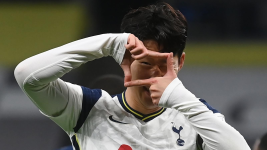
Son Heung-min always dreamed of being a footballer. Growing up in Chuncheon, South Korea, he was surrounded by the game from an early age and his father, Son Woong-jung, was a former professional player who became both mentor and strict coach. While other kids were playing for fun, Son was training tirelessly, perfecting his touch, balance, and movement under his father’s demanding eye.
He idolised players like Cristiano Ronaldo and wanted to follow in their footsteps, playing on the grandest stages of European football. His dream was not just to make it as a professional. It was to prove that a South Korean player could compete with the very best in the world.
That dream took him far from home as a teenager, joining Hamburg’s academy in Germany without speaking the language and with only football to guide him. Through relentless hard work and resilience, Son turned that childhood dream into a glittering reality, becoming a Premier League star, Tottenham captain, and one of Asia’s greatest ever players.
When Son Heung-min arrived in Germany as a teenager, he barely spoke a word of the language. He carried a few clothes, a pocket dictionary, and an obsession to become one of the best footballers in the world. Fifteen years later, he was the captain of Tottenham Hotspur and the beating heart of South Korean football, a player whose grin lights up stadiums but whose story is built on discipline, sacrifice, and steel.
His rise was not just the story of a footballer. It was the story of a pioneer, a bridge between continents, carrying the hopes of a nation while quietly rewriting what it means to be an Asian player in Europe.
The Father, the Training, and the Foundations
Before Son became “Sonny,” the smiling Premier League superstar adored not only by his own supporters but by almost every neutral fan, he was just a kid in Chuncheon with a ball that rarely left his feet and a father who believed perfection was the only standard worth chasing.
He was in third grade when he first asked his father to teach him the game. In his autobiography, Son remembers how his father Woong-jung initially refused. Known for his strict discipline and unwavering focus, Woong-jung warned his young son that football was not a hobby he could dip in and out of. If he truly wanted this life, he needed to understand what it demanded. It would not be fun. It would not be easy. It would require sacrifice, pain, and years of relentless work. It could shape the entire direction of his life. Only if he accepted all of that could he begin.
Woong-jung lived by those principles. He was famously uncompromising. Family holidays did not exist, training sessions did. Young Heung-min practised for up to six hours a day, working left foot, right foot, movement, and control until repetition became instinct. “My father always said football is not about tricks,” Son has recalled. “It is about control. If you cannot control the ball, you cannot control the game.”
Son has often reflected on how he endured such an unforgiving routine. “There were three reasons why I was able to withstand this kind of repetitive training,” he wrote in his autobiography. “First, soccer was so fun. Second, my father was so scary that I did not dare say I was bored. Third, we reached the point where I thought I guess I will do it because I need it.”
In an interview with David Hytner from The Guardian, Son recalled:
When scouts from Hamburg SV invited him to Germany at sixteen, he went alone, armed with that work ethic and a smile that concealed his homesickness. “He cried at night,” one former teammate said, “but he never stopped training.”
Hamburg and Lessons in the Bundesliga
Hamburg was a culture shock. Cold winters, unfamiliar food, and the physicality of German football all tested him. Yet Son adapted with the same quiet determination that would later define him in England. He learned German within months, integrated himself into the youth setup, and made his Bundesliga debut at just eighteen.
By 2010, he was Hamburg’s youngest ever goalscorer. The local press loved him, the polite Korean teenager with the thunderous right foot, but his teammates admired something deeper: his discipline. He stayed behind after training, practising sprints, finishing, and footwork until dusk.
When injuries came, as they inevitably do, he worked even harder. There was no ego, no sense of entitlement, only a sense of duty.
By the time Bayer Leverkusen came calling in 2013, Son had become one of the Bundesliga’s brightest young forwards. The €10 million fee raised eyebrows at the time. In hindsight, it was a bargain.
Leverkusen: The Finisher Emerges
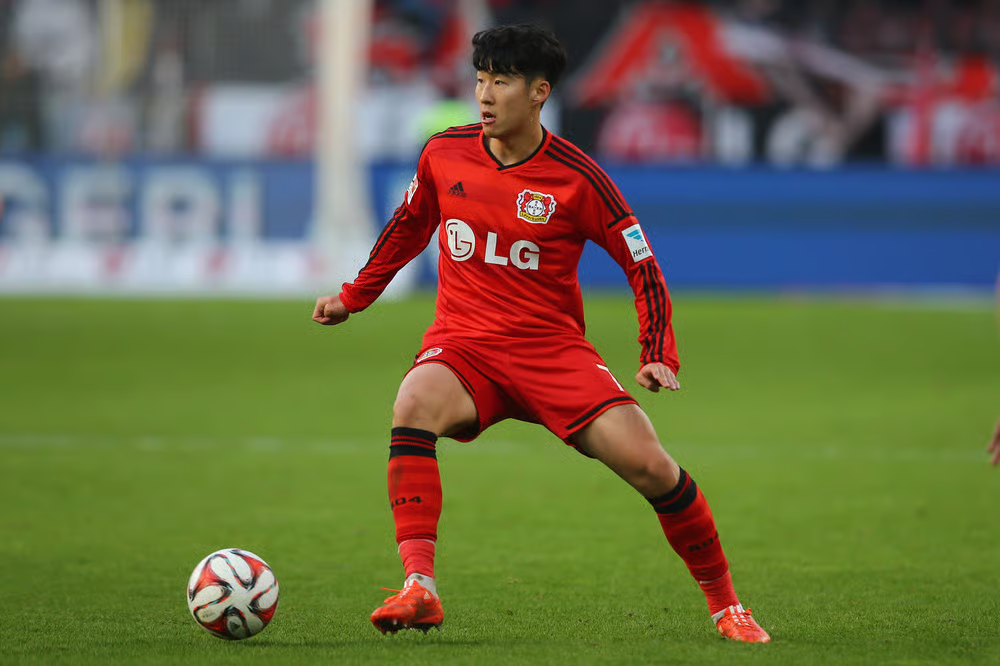
Leverkusen’s rising star: a young Son Heung-min developing into one of Europe’s most clinical forwards.
At Bayer Leverkusen, Son’s game evolved. No longer just a promising winger, he became a clinical forward and a master of timing his runs behind the defensive line. Under coaches who prized transition football, he flourished in the chaos of counter-attacks: fast, decisive, and ruthless.
He was equally lethal with both feet, an ambidexterity drilled into him by his father years earlier. Right or left, it did not matter. He could cut in from the flank and whip one into the far corner, or dart infield to latch onto a through ball.
German football appreciated efficiency, and Son embodied it completely. He scored 29 goals in two seasons, including a memorable hat-trick against Wolfsburg. Scouts from England began to take notice.
But the Premier League is a beast of its own, and in 2015, Tottenham Hotspur took a £22 million gamble on the smiling forward from South Korea. £22 million? Even Tottenham’s then hard-to-please chairman Daniel Levy could not deny it would become one of the bargains of the decade.
London Calling
It did not begin smoothly. Son’s first year at Spurs was rocky. The pace of English football was manic, and the media pressure was suffocating. He struggled for minutes under Mauricio Pochettino, and there were whispers that he might return to Germany after just one season.
But Son, as always, adapted. He watched, learned, and fought his way in. “I knew I was not good enough yet,” he admitted later. “So I worked harder.”
His second season changed everything. His understanding with Harry Kane blossomed, his pace terrified defences, and suddenly the Premier League had a new superstar. Not flashy, not outspoken, but devastatingly effective.
The Pochettino Years
Under Pochettino, Son’s energy and humility made him indispensable. He pressed like a man possessed, tracked back without complaint, and scored goals of impossible audacity. His solo run against Burnley in 2019, picking up the ball deep in his own half before gliding past seven players to score, remains one of the Premier League’s defining moments.
He was not just quick, he was clever. His movement off the ball opened space for Kane, Dele Alli, and Christian Eriksen. Spurs’ front line clicked because Son provided the glue through selfless running, smart decisions, and a sense of timing that seemed beyond coaching.
That Champions League run in 2019 was his masterpiece. Against Manchester City, he scored twice in the quarter-final second leg, fearless, clinical, and ice-cold. In Amsterdam, as Spurs clawed back from the brink, Son’s tireless running and belief carried the side.
He did not lift the trophy, but he earned something just as valuable: respect, the true footballing respect of fans, pundits, and fellow professionals.
Big Ange
When Ange Postecoglou arrived at Tottenham Hotspur with his easy grin and his philosophy of letting the team play their football, few players embodied his attacking ideals better than Son Heung-min. Under Big Ange, Son not only rediscovered his sharpness, he also evolved into a leader, captain, and talisman of what became a new Spurs era.
Appointing Son as captain was a masterstroke. With Harry Kane’s departure, Tottenham needed both goals and guidance, and Son provided both in abundance. The lingering fatigue from a gruelling World Cup season disappeared, replaced by a revitalised forward thriving in Postecoglou’s high-tempo, front-foot football.
Ange’s system, often referred to as Ange-ball, was fluid, fearless, and fast, and it unlocked Son’s instincts. Playing centrally more often, he became the cutting edge of Spurs’ dynamic front line, timing his runs to perfection and finishing with his trademark calm. Where he once drifted wide, he now dictated play through the middle, leading the press and setting the tone. He became one of those rare modern attackers who can do everything.
Yet it was not just about the goals. Son’s relationship with his manager was defined by trust. Postecoglou’s man-management, a blend of empathy and expectation, brought out Son’s maturity. It was clear in his gestures toward teammates, his relentless work rate, and his post-match words, always team-first and always humble.
The Europa League Winner
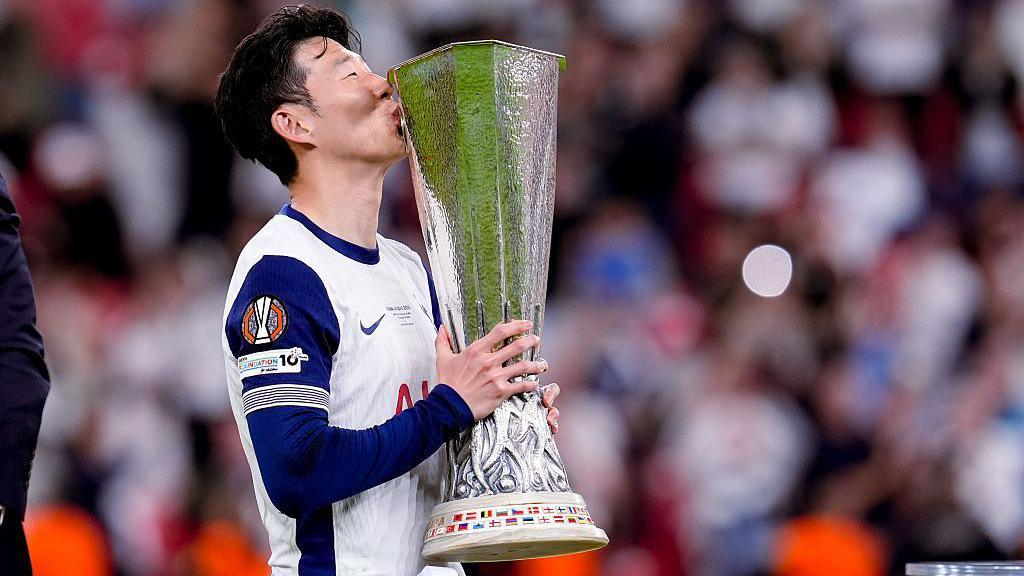
Son Heung-min savours the moment after guiding Tottenham Hotspur to a UEFA Europa League trophy in Bilbao.
After losing the Champions League final in 2019, a measure of European redemption arrived in 2025. Leading his side to Europa League glory, Son’s influence was unmistakable: the goals, the assists, the leadership, and that trademark grin under the stadium lights. For a player who had so often carried the hopes of a nation and a club, it was a moment of vindication.
Son Heung-min’s Europa League triumph is not just a personal milestone. It is a victory for every young Asian player who dares to dream beyond borders. From the fields of Chuncheon to Europe’s biggest nights, Son has shown that talent and humility can still create football’s most inspiring stories.
The Asian Icon
For years, European clubs viewed Asian players through a narrow lens. They were considered valuable for marketing, perhaps, but rarely trusted as stars. Son shattered that stereotype. He was not just an ambassador; he was an elite player.
In Korea, his fame is almost royal. His face appears on billboards, his commercials play on loop, and yet he carries it all with humility. When he returns for international duty, he trains as if he is fighting for a debut.
He is also a symbol of cultural pride. For a nation that values discipline and modesty, Son’s blend of humility and excellence feels almost poetic. The tears he shed after South Korea’s 2018 World Cup exit were not weakness. They were sincerity, an emotion that resonated deeply with fans.
When South Korea won the 2018 Asian Games, granting Son exemption from compulsory military service, the nation celebrated as if they had won the World Cup. It was a moment of relief and recognition that their golden boy could continue shining on Europe’s biggest stages.
Golden Boot and Captaincy
In 2022, Son won the Premier League Golden Boot, sharing the honour with Mohamed Salah. The achievement was made even sweeter by the fact that none of his 23 goals came from penalties. It was a testament to his efficiency, composure, and purity of finishing.
He celebrated as he always does: smiling, bowing, and thanking his teammates. But make no mistake, that was history. No Asian player had ever topped the Premier League scoring charts.
When Harry Kane departed for Bayern Munich in 2023, there was no debate over who should inherit the captain’s armband. Son was the natural leader, highly respected by every teammate and admired by every opponent.
His leadership is quiet but powerful. He motivates through example, not volume. “He is the nicest guy in football,” said one teammate, “but cross that line and he will run through you.”
The Cultural Power of Son
Son Heung-min is not just a footballer; he is a phenomenon. In London, Korean flags ripple in the stands. In Seoul, children wear Spurs shirts with 7 SON on the back. In markets from Sydney to Singapore, he is the face of both footballing excellence and personal integrity.
There is something universally appealing about his story, a humility that transcends football and crosses borders. In an era when superstars are often manufactured, Son feels refreshingly human. He still bows to fans. He still apologises when he misses. He still cries when he loses.
His father’s discipline shaped him, but Son’s empathy made him universally loved.
Legacy and the Road Ahead
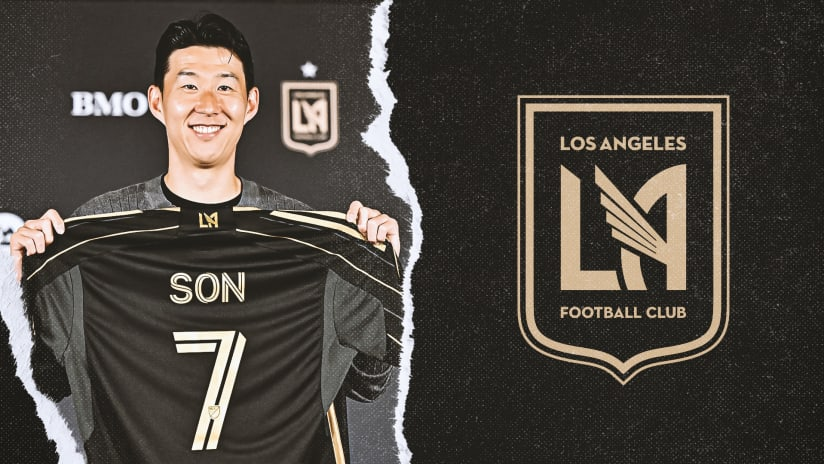
Son Heung-min is unveiled by LAFC after completing a $26.5 million transfer from Tottenham Hotspur.
As Son approaches the twilight of his career, discussions about his legacy intensify. Statistically, he is among the greatest Asian footballers of all time, perhaps the greatest. Yet his influence extends beyond numbers.
He changed perceptions. He opened doors. And he did it without a trace of arrogance.
When Son Heung-min touched down in Los Angeles, the city of bright lights and large personalities, there was a different kind of buzz. Hollywood has seen many global icons, but few carry the effortless charm and humility of the former Tottenham Hotspur and South Korea captain.
Whether it is a pre-season tour, a commercial shoot, or simply soaking up the Californian sun, Son’s presence in LA feels like a natural fit. The city’s obsession with celebrity meets a man whose appeal transcends football, a blend of superstar quality and genuine warmth.
Fans line up outside training grounds in Spurs shirts and Korean national team jerseys, shouting his name in English, Korean, and occasionally Spanish. He smiles, signs autographs, poses for selfies, and somehow makes everyone feel as if they have known him for years.
In Los Angeles, Sonny represents more than football. He embodies the global reach of the modern game, a player from Chuncheon inspiring young players from Koreatown to Compton. It is no surprise that brands flock to him or that his face appears on billboards along Sunset Boulevard.
Yet beneath the gloss, he is still the same Sonny, disciplined, team-first, and endlessly polite. Even in the land of flash and fame, he remains grounded, proof that humility travels just as far as talent.
Los Angeles may sparkle with stars, but when Son Heung-min visits, even Hollywood looks up.
And for Asia, he is proof that excellence has no postcode. His rise has inspired a new generation from Japan to Indonesia, from the K-League to the A-League, all dreaming not only of playing in Europe but of belonging there.
Epilogue and the Smile That Endures
Football is full of noise, the egos, the contracts, and the transfer sagas. But Son Heung-min’s story cuts through all that chaos. It is a story of craft over hype, kindness over controversy, and joy over cynicism.
When he sprints down the left flank, hair flying and grin wide, it feels as if football is exactly as it should be: pure, honest, and exhilarating.
From the backstreets of Chuncheon to Europe’s top table and finally to Los Angeles, his journey has never lost its sense of wonder.
He realised his footballing dream, and he did it smiling all the way.
He idolised players like Cristiano Ronaldo and wanted to follow in their footsteps, playing on the grandest stages of European football. His dream was not just to make it as a professional. It was to prove that a South Korean player could compete with the very best in the world.
That dream took him far from home as a teenager, joining Hamburg’s academy in Germany without speaking the language and with only football to guide him. Through relentless hard work and resilience, Son turned that childhood dream into a glittering reality, becoming a Premier League star, Tottenham captain, and one of Asia’s greatest ever players.
When Son Heung-min arrived in Germany as a teenager, he barely spoke a word of the language. He carried a few clothes, a pocket dictionary, and an obsession to become one of the best footballers in the world. Fifteen years later, he was the captain of Tottenham Hotspur and the beating heart of South Korean football, a player whose grin lights up stadiums but whose story is built on discipline, sacrifice, and steel.
His rise was not just the story of a footballer. It was the story of a pioneer, a bridge between continents, carrying the hopes of a nation while quietly rewriting what it means to be an Asian player in Europe.
The Father, the Training, and the Foundations
Before Son became “Sonny,” the smiling Premier League superstar adored not only by his own supporters but by almost every neutral fan, he was just a kid in Chuncheon with a ball that rarely left his feet and a father who believed perfection was the only standard worth chasing.
He was in third grade when he first asked his father to teach him the game. In his autobiography, Son remembers how his father Woong-jung initially refused. Known for his strict discipline and unwavering focus, Woong-jung warned his young son that football was not a hobby he could dip in and out of. If he truly wanted this life, he needed to understand what it demanded. It would not be fun. It would not be easy. It would require sacrifice, pain, and years of relentless work. It could shape the entire direction of his life. Only if he accepted all of that could he begin.
Woong-jung lived by those principles. He was famously uncompromising. Family holidays did not exist, training sessions did. Young Heung-min practised for up to six hours a day, working left foot, right foot, movement, and control until repetition became instinct. “My father always said football is not about tricks,” Son has recalled. “It is about control. If you cannot control the ball, you cannot control the game.”
Son has often reflected on how he endured such an unforgiving routine. “There were three reasons why I was able to withstand this kind of repetitive training,” he wrote in his autobiography. “First, soccer was so fun. Second, my father was so scary that I did not dare say I was bored. Third, we reached the point where I thought I guess I will do it because I need it.”
In an interview with David Hytner from The Guardian, Son recalled:
When scouts from Hamburg SV invited him to Germany at sixteen, he went alone, armed with that work ethic and a smile that concealed his homesickness. “He cried at night,” one former teammate said, “but he never stopped training.”
Hamburg and Lessons in the Bundesliga
Hamburg was a culture shock. Cold winters, unfamiliar food, and the physicality of German football all tested him. Yet Son adapted with the same quiet determination that would later define him in England. He learned German within months, integrated himself into the youth setup, and made his Bundesliga debut at just eighteen.
By 2010, he was Hamburg’s youngest ever goalscorer. The local press loved him, the polite Korean teenager with the thunderous right foot, but his teammates admired something deeper: his discipline. He stayed behind after training, practising sprints, finishing, and footwork until dusk.
When injuries came, as they inevitably do, he worked even harder. There was no ego, no sense of entitlement, only a sense of duty.
By the time Bayer Leverkusen came calling in 2013, Son had become one of the Bundesliga’s brightest young forwards. The €10 million fee raised eyebrows at the time. In hindsight, it was a bargain.
Leverkusen: The Finisher Emerges
Leverkusen’s rising star: a young Son Heung-min developing into one of Europe’s most clinical forwards.
At Bayer Leverkusen, Son’s game evolved. No longer just a promising winger, he became a clinical forward and a master of timing his runs behind the defensive line. Under coaches who prized transition football, he flourished in the chaos of counter-attacks: fast, decisive, and ruthless.
He was equally lethal with both feet, an ambidexterity drilled into him by his father years earlier. Right or left, it did not matter. He could cut in from the flank and whip one into the far corner, or dart infield to latch onto a through ball.
German football appreciated efficiency, and Son embodied it completely. He scored 29 goals in two seasons, including a memorable hat-trick against Wolfsburg. Scouts from England began to take notice.
But the Premier League is a beast of its own, and in 2015, Tottenham Hotspur took a £22 million gamble on the smiling forward from South Korea. £22 million? Even Tottenham’s then hard-to-please chairman Daniel Levy could not deny it would become one of the bargains of the decade.
London Calling
It did not begin smoothly. Son’s first year at Spurs was rocky. The pace of English football was manic, and the media pressure was suffocating. He struggled for minutes under Mauricio Pochettino, and there were whispers that he might return to Germany after just one season.
But Son, as always, adapted. He watched, learned, and fought his way in. “I knew I was not good enough yet,” he admitted later. “So I worked harder.”
His second season changed everything. His understanding with Harry Kane blossomed, his pace terrified defences, and suddenly the Premier League had a new superstar. Not flashy, not outspoken, but devastatingly effective.
The Pochettino Years
Under Pochettino, Son’s energy and humility made him indispensable. He pressed like a man possessed, tracked back without complaint, and scored goals of impossible audacity. His solo run against Burnley in 2019, picking up the ball deep in his own half before gliding past seven players to score, remains one of the Premier League’s defining moments.
He was not just quick, he was clever. His movement off the ball opened space for Kane, Dele Alli, and Christian Eriksen. Spurs’ front line clicked because Son provided the glue through selfless running, smart decisions, and a sense of timing that seemed beyond coaching.
That Champions League run in 2019 was his masterpiece. Against Manchester City, he scored twice in the quarter-final second leg, fearless, clinical, and ice-cold. In Amsterdam, as Spurs clawed back from the brink, Son’s tireless running and belief carried the side.
He did not lift the trophy, but he earned something just as valuable: respect, the true footballing respect of fans, pundits, and fellow professionals.
Big Ange
When Ange Postecoglou arrived at Tottenham Hotspur with his easy grin and his philosophy of letting the team play their football, few players embodied his attacking ideals better than Son Heung-min. Under Big Ange, Son not only rediscovered his sharpness, he also evolved into a leader, captain, and talisman of what became a new Spurs era.
Appointing Son as captain was a masterstroke. With Harry Kane’s departure, Tottenham needed both goals and guidance, and Son provided both in abundance. The lingering fatigue from a gruelling World Cup season disappeared, replaced by a revitalised forward thriving in Postecoglou’s high-tempo, front-foot football.
Ange’s system, often referred to as Ange-ball, was fluid, fearless, and fast, and it unlocked Son’s instincts. Playing centrally more often, he became the cutting edge of Spurs’ dynamic front line, timing his runs to perfection and finishing with his trademark calm. Where he once drifted wide, he now dictated play through the middle, leading the press and setting the tone. He became one of those rare modern attackers who can do everything.
Yet it was not just about the goals. Son’s relationship with his manager was defined by trust. Postecoglou’s man-management, a blend of empathy and expectation, brought out Son’s maturity. It was clear in his gestures toward teammates, his relentless work rate, and his post-match words, always team-first and always humble.
The Europa League Winner
Son Heung-min savours the moment after guiding Tottenham Hotspur to a UEFA Europa League trophy in Bilbao.
After losing the Champions League final in 2019, a measure of European redemption arrived in 2025. Leading his side to Europa League glory, Son’s influence was unmistakable: the goals, the assists, the leadership, and that trademark grin under the stadium lights. For a player who had so often carried the hopes of a nation and a club, it was a moment of vindication.
Son Heung-min’s Europa League triumph is not just a personal milestone. It is a victory for every young Asian player who dares to dream beyond borders. From the fields of Chuncheon to Europe’s biggest nights, Son has shown that talent and humility can still create football’s most inspiring stories.
The Asian Icon
For years, European clubs viewed Asian players through a narrow lens. They were considered valuable for marketing, perhaps, but rarely trusted as stars. Son shattered that stereotype. He was not just an ambassador; he was an elite player.
In Korea, his fame is almost royal. His face appears on billboards, his commercials play on loop, and yet he carries it all with humility. When he returns for international duty, he trains as if he is fighting for a debut.
He is also a symbol of cultural pride. For a nation that values discipline and modesty, Son’s blend of humility and excellence feels almost poetic. The tears he shed after South Korea’s 2018 World Cup exit were not weakness. They were sincerity, an emotion that resonated deeply with fans.
When South Korea won the 2018 Asian Games, granting Son exemption from compulsory military service, the nation celebrated as if they had won the World Cup. It was a moment of relief and recognition that their golden boy could continue shining on Europe’s biggest stages.
Golden Boot and Captaincy
In 2022, Son won the Premier League Golden Boot, sharing the honour with Mohamed Salah. The achievement was made even sweeter by the fact that none of his 23 goals came from penalties. It was a testament to his efficiency, composure, and purity of finishing.
He celebrated as he always does: smiling, bowing, and thanking his teammates. But make no mistake, that was history. No Asian player had ever topped the Premier League scoring charts.
When Harry Kane departed for Bayern Munich in 2023, there was no debate over who should inherit the captain’s armband. Son was the natural leader, highly respected by every teammate and admired by every opponent.
His leadership is quiet but powerful. He motivates through example, not volume. “He is the nicest guy in football,” said one teammate, “but cross that line and he will run through you.”
The Cultural Power of Son
Son Heung-min is not just a footballer; he is a phenomenon. In London, Korean flags ripple in the stands. In Seoul, children wear Spurs shirts with 7 SON on the back. In markets from Sydney to Singapore, he is the face of both footballing excellence and personal integrity.
There is something universally appealing about his story, a humility that transcends football and crosses borders. In an era when superstars are often manufactured, Son feels refreshingly human. He still bows to fans. He still apologises when he misses. He still cries when he loses.
His father’s discipline shaped him, but Son’s empathy made him universally loved.
Legacy and the Road Ahead
Son Heung-min is unveiled by LAFC after completing a $26.5 million transfer from Tottenham Hotspur.
As Son approaches the twilight of his career, discussions about his legacy intensify. Statistically, he is among the greatest Asian footballers of all time, perhaps the greatest. Yet his influence extends beyond numbers.
He changed perceptions. He opened doors. And he did it without a trace of arrogance.
When Son Heung-min touched down in Los Angeles, the city of bright lights and large personalities, there was a different kind of buzz. Hollywood has seen many global icons, but few carry the effortless charm and humility of the former Tottenham Hotspur and South Korea captain.
Whether it is a pre-season tour, a commercial shoot, or simply soaking up the Californian sun, Son’s presence in LA feels like a natural fit. The city’s obsession with celebrity meets a man whose appeal transcends football, a blend of superstar quality and genuine warmth.
Fans line up outside training grounds in Spurs shirts and Korean national team jerseys, shouting his name in English, Korean, and occasionally Spanish. He smiles, signs autographs, poses for selfies, and somehow makes everyone feel as if they have known him for years.
In Los Angeles, Sonny represents more than football. He embodies the global reach of the modern game, a player from Chuncheon inspiring young players from Koreatown to Compton. It is no surprise that brands flock to him or that his face appears on billboards along Sunset Boulevard.
Yet beneath the gloss, he is still the same Sonny, disciplined, team-first, and endlessly polite. Even in the land of flash and fame, he remains grounded, proof that humility travels just as far as talent.
Los Angeles may sparkle with stars, but when Son Heung-min visits, even Hollywood looks up.
And for Asia, he is proof that excellence has no postcode. His rise has inspired a new generation from Japan to Indonesia, from the K-League to the A-League, all dreaming not only of playing in Europe but of belonging there.
Epilogue and the Smile That Endures
Football is full of noise, the egos, the contracts, and the transfer sagas. But Son Heung-min’s story cuts through all that chaos. It is a story of craft over hype, kindness over controversy, and joy over cynicism.
When he sprints down the left flank, hair flying and grin wide, it feels as if football is exactly as it should be: pure, honest, and exhilarating.
From the backstreets of Chuncheon to Europe’s top table and finally to Los Angeles, his journey has never lost its sense of wonder.
He realised his footballing dream, and he did it smiling all the way.