Growing up in Zimbabwe, I had two options on where my football allegiances lay, Manchester United or Liverpool. One was on the precipice of being the powerhouse club in football. A club that was the fiercest rival to the dominant Liverpool side of the 80’s. As such, if you wanted to barrack against your friend, United was the side for you. On the other hand, Liverpool was home to a local hero – Bruce Grobbelaar. Famous for his spaghetti legs antics in Rome in the Champions League final which led to him being the first footballer from an African nation to win the Champions League. Grobbelaar is one of the immortals of Zimbabwean football. His impact on football following in my home nation was immense.
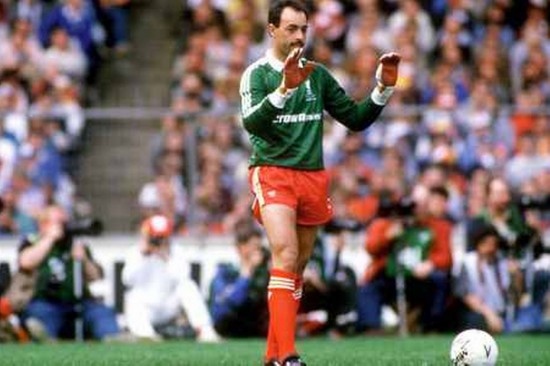
Bruce Grobbelaar, the charismatic Zimbabwean goalkeeper who made over 400 appearances for Liverpool, renowned for his eccentric style and unforgettable 'wobbly legs' heroics in the 1984 European Cup final.
The year was 1992 and tt was the start of a new era for football. The English Premier League (EPL) was formed, and 22 clubs in England were going to battle it out for what would eventually become the biggest league in the world. As a former British colony, Zimbabwe was impacted by all things from England. We love tea and biscuits, spend our summers in a field hitting a ball for 5 days, couldn’t get enough of Mr Bean, but above all, we go mad for football. Zimbabwe’s obsession with the English league was cemented on 19 August 1992. Mercurial striker, Peter Ndlovu took to the field for Coventry against Tottenham Hotspur at White Hart Lane. In doing so, Ndlovu became the fist player from Africa to play in the EPL. Another milestone for Zimbabwean football. It is no surprise that English football would play a big part of any Zimbabweans life.
As the EPL rolled around, I made the choice to be a Manchester United supporter. I was only 4 years old at the time, but it was a choice that formed a lifelong passion. Fast forward to 2004. I’ve been living in Australia for just over a year, and the nation is witnessing a transformation. The A-league was established as the new premier competition for Australian Football. There was a buzz and excitement around the news, and speculation spread about which teams would form the league. As a football fan, I was excited. Until now, football seemed rather non-existent on the Australian sporting landscape. In 2005, the first ball was kicked, and the excitement around the new league was palpable. Fans from across the country flocked to watch their teams play, and on the back of Australia’s qualification for the 2006 World Cup, interest in football was at an all time high. With Australia’s World Cup campaign cut short by a diving Italian - I will argue this case to the very end – there was a sadness at how the team was eliminated, but the interest in football remained high. The A-league capitalised on this. We saw marquee talents sign, and the level of football gradually progress.
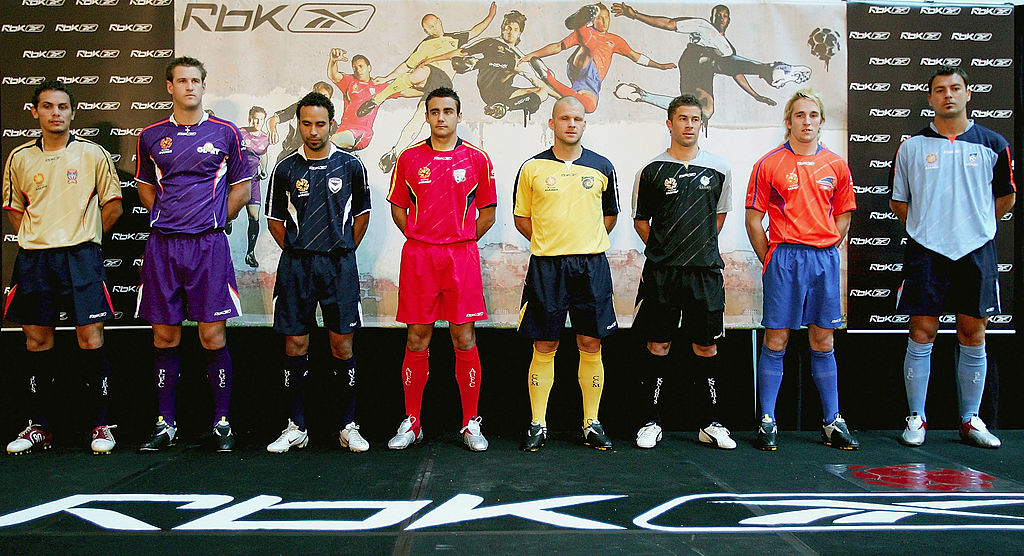
The launch of the A-League in 2005.
As a Brisbane Roar fan, I would be extremely biased to say the best football the A-league has ever seen were the boys in Orange under Ange Postecoglou. It was a sensational time to be a football fan in this country, and stadium numbers reflected this. Unfortunately, the buzz quickly died down. Marquee signings stopped, the football played became turgid, and the sport was struggling financially. Fans at games reflected these changes. Many began to turn away from the game, and with the league trying to make up for lost money, TV deals meant football got put behind a paywall. Despite all of this, one thing remained consistent, me being labelled a “Eurosnob”.
At first, I took no real offence to this. I was simply expressing my views on football, and had nothing but high expectations. I wanted football in our country to reach lofty heights, and genuinely felt we could. At the start of the 2014 A-league season, I was invited to a launch for the new league. All the big football bosses, select media, and then Brisbane Roar coach Mike Mulvey, were in attendance. We watched a bit of a theatrical trailer, some marketing clips, and heard the spiel of what the A-league was bringing that year. After, we made our way into the mingling area to share in drinks and nibbles. I found myself in a huddle with Damien De Bohun and 2 other members of media. As we were talking, I responded to a comment Damien posed about trying to capture new fans. “There’s plenty who follow football, but perhaps don’t see a standard they are used to”. After a quick glance my way De Bohun responded, “Well, that’s just the eurosnobs, we’re not interested in them”. A few little chuckles were had, but I wore a wry smile.
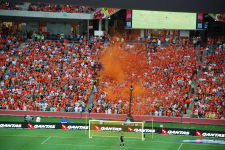
I get it. You can’t expect the A-league to be like any European league straight away. Rome was not built in a day, and football in Australia was always playing second fiddle to some other sport, depending on the state you lived in. This, however, is no excuse to scoff at the only people who would be the easiest to bring over. Suddenly, I went from someone who viewed this statement as nothing of substance, to something that offended me. I love football. Is it so hard to ask that football in this country aimed for heights that are possible? Football bosses in this country have always done their very best to get rid of the European football vibe and ethos. Flares are a complete no-no. Sections of stadiums standing and dancing all game are treated as criminals having their one hour of yard time. The quality of football is often turgid and slow – weather playing a big part of it – yet the architects of this are rewarded with hefty contracts and higher positions.
Being a Eurosnob is a badge I wear proudly. It is also a badge that won’t allow me to run to Australian football any time soon. Australian football has its issues at various levels, yet the longer it continues to be run like a business mafia, the less it will grow to the heights it is capable of. I know many will fight me on my stance - and will claim that the quality of the A-league is better than I’m making it out to be - but that there are many hardcore football fans not taking an interest in the local product is quite telling.
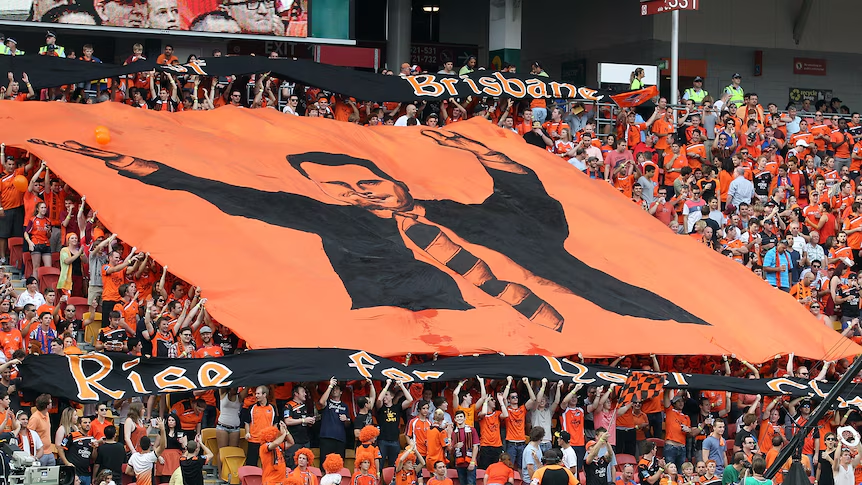
Brisbane Roar fans unveil a tifo of coach Ange Postecoglou during the 2012 A-League Grand Final at Suncorp Stadium.
It's hard to let go of your first love. Your first football team will always be your first and only. However, in a nation founded on migrants, Australian football cannot play the strict closed off game it wishes to by banishing people to a corner and refusing to engage. Any person willing to wake up at 2 am to watch their team kick a ball around for 90 minutes knowing that it can ruin their whole week, is not a person you don’t want on your side. The person who does that is a freak and a maniac. They are choosing a ball instead sleep. You don’t need to convince them to learn the sport or take an interest in it. The groundwork is already there. You only just need to show them that your version can be just as good as the other.
Bruce Grobbelaar, the charismatic Zimbabwean goalkeeper who made over 400 appearances for Liverpool, renowned for his eccentric style and unforgettable 'wobbly legs' heroics in the 1984 European Cup final.
The year was 1992 and tt was the start of a new era for football. The English Premier League (EPL) was formed, and 22 clubs in England were going to battle it out for what would eventually become the biggest league in the world. As a former British colony, Zimbabwe was impacted by all things from England. We love tea and biscuits, spend our summers in a field hitting a ball for 5 days, couldn’t get enough of Mr Bean, but above all, we go mad for football. Zimbabwe’s obsession with the English league was cemented on 19 August 1992. Mercurial striker, Peter Ndlovu took to the field for Coventry against Tottenham Hotspur at White Hart Lane. In doing so, Ndlovu became the fist player from Africa to play in the EPL. Another milestone for Zimbabwean football. It is no surprise that English football would play a big part of any Zimbabweans life.
As the EPL rolled around, I made the choice to be a Manchester United supporter. I was only 4 years old at the time, but it was a choice that formed a lifelong passion. Fast forward to 2004. I’ve been living in Australia for just over a year, and the nation is witnessing a transformation. The A-league was established as the new premier competition for Australian Football. There was a buzz and excitement around the news, and speculation spread about which teams would form the league. As a football fan, I was excited. Until now, football seemed rather non-existent on the Australian sporting landscape. In 2005, the first ball was kicked, and the excitement around the new league was palpable. Fans from across the country flocked to watch their teams play, and on the back of Australia’s qualification for the 2006 World Cup, interest in football was at an all time high. With Australia’s World Cup campaign cut short by a diving Italian - I will argue this case to the very end – there was a sadness at how the team was eliminated, but the interest in football remained high. The A-league capitalised on this. We saw marquee talents sign, and the level of football gradually progress.
The launch of the A-League in 2005.
As a Brisbane Roar fan, I would be extremely biased to say the best football the A-league has ever seen were the boys in Orange under Ange Postecoglou. It was a sensational time to be a football fan in this country, and stadium numbers reflected this. Unfortunately, the buzz quickly died down. Marquee signings stopped, the football played became turgid, and the sport was struggling financially. Fans at games reflected these changes. Many began to turn away from the game, and with the league trying to make up for lost money, TV deals meant football got put behind a paywall. Despite all of this, one thing remained consistent, me being labelled a “Eurosnob”.
At first, I took no real offence to this. I was simply expressing my views on football, and had nothing but high expectations. I wanted football in our country to reach lofty heights, and genuinely felt we could. At the start of the 2014 A-league season, I was invited to a launch for the new league. All the big football bosses, select media, and then Brisbane Roar coach Mike Mulvey, were in attendance. We watched a bit of a theatrical trailer, some marketing clips, and heard the spiel of what the A-league was bringing that year. After, we made our way into the mingling area to share in drinks and nibbles. I found myself in a huddle with Damien De Bohun and 2 other members of media. As we were talking, I responded to a comment Damien posed about trying to capture new fans. “There’s plenty who follow football, but perhaps don’t see a standard they are used to”. After a quick glance my way De Bohun responded, “Well, that’s just the eurosnobs, we’re not interested in them”. A few little chuckles were had, but I wore a wry smile.
I get it. You can’t expect the A-league to be like any European league straight away. Rome was not built in a day, and football in Australia was always playing second fiddle to some other sport, depending on the state you lived in. This, however, is no excuse to scoff at the only people who would be the easiest to bring over. Suddenly, I went from someone who viewed this statement as nothing of substance, to something that offended me. I love football. Is it so hard to ask that football in this country aimed for heights that are possible? Football bosses in this country have always done their very best to get rid of the European football vibe and ethos. Flares are a complete no-no. Sections of stadiums standing and dancing all game are treated as criminals having their one hour of yard time. The quality of football is often turgid and slow – weather playing a big part of it – yet the architects of this are rewarded with hefty contracts and higher positions.
Being a Eurosnob is a badge I wear proudly. It is also a badge that won’t allow me to run to Australian football any time soon. Australian football has its issues at various levels, yet the longer it continues to be run like a business mafia, the less it will grow to the heights it is capable of. I know many will fight me on my stance - and will claim that the quality of the A-league is better than I’m making it out to be - but that there are many hardcore football fans not taking an interest in the local product is quite telling.
Brisbane Roar fans unveil a tifo of coach Ange Postecoglou during the 2012 A-League Grand Final at Suncorp Stadium.
It's hard to let go of your first love. Your first football team will always be your first and only. However, in a nation founded on migrants, Australian football cannot play the strict closed off game it wishes to by banishing people to a corner and refusing to engage. Any person willing to wake up at 2 am to watch their team kick a ball around for 90 minutes knowing that it can ruin their whole week, is not a person you don’t want on your side. The person who does that is a freak and a maniac. They are choosing a ball instead sleep. You don’t need to convince them to learn the sport or take an interest in it. The groundwork is already there. You only just need to show them that your version can be just as good as the other.