
tsf
Club Veteran
- Joined
- Oct 23, 2024
- Replies
- 2,958
Hegseth is retard but what would YOU call Irans leadership ... normal?
As retarded as each other.
Just a different sort of shithead.
By registering with us, you'll be able to discuss, share and private message with other members of our community.
Sign Up Now!
Hegseth is retard but what would YOU call Irans leadership ... normal?
Some examples of the gender discriminating laws in Iran are as follows:1. Child marriage: By law an Iranian girl can marry from the age of 13and girls even as young as 9, can marry with judicial and paternalconsent. One study shows in only 6 months 16,000 girls aged between10 and 14 years have married.2. Divorce: A woman can only get a divorce with a judge’s order, andonly if a man is mentally ill, physically abusive or an addict. A manon the other hand can file for divorce at any given time and is free tobe married to up to 4 women simultaneously.3. Child custody: A divorced woman forfeites child custody if sheremarries, even if her husband dies.4. Travel: A woman or girl is not permitted to obtain a passport and toexit the country and without the written consent of a male guardian5. Inheritance: A widow only inherits one eighth of her husband'sestate, while a widower inherits the entirety of his wife’s estate.


Sure but they have a population of nearly 100 million people that, even though they may not 100% agree at least tolerate the religious ridiculousness of whats going, those that dont fled years ago.And I have been to Iran. I know lots of Iranians. Well versed on their stance etc. Nobody with a brain thinks their rulers are good.
That sounded a little rude. I wasnt trying to be.child marriage was legal in every state in the US until 2018 or something
And there are still nuances in some southern parts where it is still essentially legal
And spare me with the US being a bastion of women's rights and equal opportunity. They are all cunts
Do you know female literacy rates, and higher education are higher in Iran than the US?
Thats not me defending them, thats me just saying they are both not good.
I think the US is worse than Iran.... don't have to convince me in the least mate.child marriage was legal in every state in the US until 2018 or something
And there are still nuances in some southern parts where it is still essentially legal
And spare me with the US being a bastion of women's rights and equal opportunity. They are all cunts
Do you know female literacy rates, and higher education are higher in Iran than the US?
Thats not me defending them, thats me just saying they are both not good.
Hahahah not at all.. I hear what you are saying.. Trust me I am a bigger critic of the US than you .. failed bible thumping nation that is actively eating itself from the inside... Everything they do is an extension of extremism...That sounded a little rude. I wasnt trying to be.
I know quite a few here too and they are amazing warm hearted people.... I totally agree. Its the ones over there that Im not too convinced about, and NO I ofcourse dont mean the poor young protesters trying to drag their country into the 21st century.And I have been to Iran. I know lots of Iranians. Well versed on their stance etc. Nobody with a brain thinks their rulers are good.

free to be married to up to 4 women simultaneously
I know, how many appliances does one kitchen need am I right? hahahahahah OK Ill say goodnight now ...Difficult


Coffee served from the right. Feta salad from the left. You wouldn't want those chess fingers on the remote control either.I know, how many appliances does one kitchen need am I right? hahahahahah OK Ill say goodnight now ...


It’s not just the oil, it’s fertiliser: strait closure’s deep global impact on food
The Observer
Isabel Coles reports
When Russia invaded Europe’s breadbasket in 2022, food prices surged to all-time highs. Global hunger reached record levels as the war choked off exports of grain and other agricultural products from Ukraine. Four years on, conflict is raging in an arid region where little is grown, but the impact on food security may be deeper and longer lasting.
The closure of the Strait of Hormuz has not just dramatically reduced the global supply of oil and gas, it has also prevented the flow of about one-third of the world’s supply of fertiliser. Fertiliser prices have spiked, translating into higher costs for farmers, who are also grappling with the effects of surging energy costs on everything from irrigation to transport.
Food experts believe that, if the Strait of Hormuz isn’t reopened within weeks, it could lead to an unprecedented global food crisis.
“If this conflict continues, it will send shockwaves across the globe,” said Carl Skau, deputy executive director of the World Food Programme (WFP) . “Families who already cannot afford their next meal will be hit the hardest.” Unless the war ends by mid2026, and oil prices come down, the WFP expects that the number of people experiencing acute food insecurity could hit a recordhigh of 363 million.
The lag between disruptions in fertiliser supply and rising food prices is measured in seasons rather than days. Faced with surging fertiliser costs, farmers are likely to use less of it, which could result in lower yields when crops come to be harvested later in the year. Alternatively, farmers might choose to grow crops that don’t require as much fertiliser, like soybeans. That may impact the supply of fertiliser-intensive crops such as wheat, rice and maize. By the time the disruption is reflected on supermarket shelves in 2027, the war is likely to be long over.
The impact will depend on how long the strait remains closed. President Donald Trump extended to 6 April a deadline for Iran to reopen it, but the regime’s conditions for ending the conflict are incompatible with those of the US and Israel.
Even if the strait reopened tomorand row, it would take months for shipping to return to normal. On top of the physical constraints to navigation, insurance costs have surged. Damage to facilities that produce liquefied natural gas – a key input for fertiliser – can’t be repaired overnight.
If the disruption lasts less than one month, the impact is likely to remain contained, said Máximo Torero, chief economist of the Food and Agriculture Organization of the United Nations (FAO). Global food stocks are currently sufficient, and markets could stabilise within approximately three months, he said.
If, however, disruption persists for three months or longer, it could affect global planting decisions for 2026 and beyond.
Countries in sub-Saharan Africa and Asia that rely on imports of food fuel are most vulnerable. Somalia, Kenya, Tanzania, and Mozambique are particularly exposed due to high dependence on fertiliser imports.
Across Asia, governments are already taking steps to save energy. In Thailand, civil servants have been asked to work from home for the duration of the conflict, use stairs instead of lifts and wear short-sleeved shirts rather than suits to reduce cooling costs in offices.
Pakistan and the Philippines have both introduced a four-day work week for public officials to reduce commuting.
The disruption of natural gas supplies from Qatar has forced India and Pakistan to shut down domestic fertiliser production. At this time of year, India would usually be building stocks of urea in preparation for the planting season after the monsoon rains.
“These are crucial months for building their stocks so they are heavily exposed if they don’t start getting a bit more urea,” said Harry Minihan, an expert in urea for Argus Media. “It’s basically a mad scramble among all of the importers for this season.”
Russia and China – both leading producers of fertiliser – have restricted exports to secure domestic stocks, further tightening supplies.
Farmers in the northern hemisphere, who are planting their crops now, may have enough fertiliser to get by this spring, said Dawid Heyl, a co-portfolio manager for the Global Natural Resources strategy. “But crop cycles that are commencing in the second half of the year, or next year, might [see] shortages because of the current situation.”
The US produces most of the fertiliser it consumes but farmers there are already feeling a pinch. In a plaintive letter to Trump, the president of the American Farm Bureau Federation warned that soaring fertiliser costs could lead to a shortfall in crops. “We are deeply concerned that failure to act could lead to disruptions to the food supply chain not seen since 2022,” wrote Zippy Duvall.
Fertiliser prices have yet to reach the levels they did in 2022. But unlike then, crop prices haven’t increased much, which means farmers are less able to absorb the higher costs.
One of the main beneficiaries is likely to be Russia. After China, it is the world’s second-largest fertiliser producer, and its export infrastructure is completely independent of the Strait of Hormuz. Beyond financial benefits, the Kremlin could leverage its fertiliser into political influence over countries whose neutrality is vital for the west.
“The Kremlin did not sow this harvest,” wrote Alexandra Prokopenko, a fellow for the Carnegie Russia Eurasia Center. “But it will most likely reap it.”
Worries for food producers...



 www.bbc.com
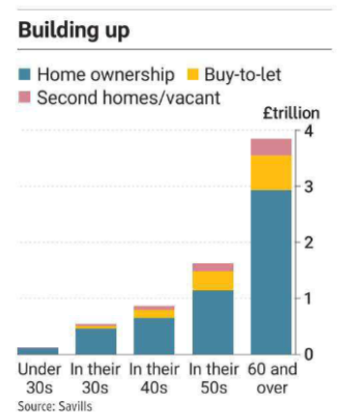
Over-60s own £3.84 trillion Over‐60s hold the majority of UK of country’s housing housing wealth, those under 40 hold wealth just 10%
David Byers - Deputy Property Editor
Baby boomers own the majority of Britain’s housing wealth — worth a record £3.84 trillion without mortgages — while those under the age of 40 have just 10 per cent, according to an analysis that lays bare the extent of the UK’s generational housing divide.
Data supplied by Savills, the estate agency, shows that those aged 60 or more own 55 per cent of the country’s entire property equity — which includes main and second homes, plus buy-to-let — as they increasingly pay off their mortgages, while younger generations stretch to buy homes financed by ever-larger amounts of debt.
Over-60s own £2.925 trillion outright in their main homes in 2025, £35 billion more than only a year before and a record high. They also have £623 billion of equity in buy-to-let and have sunk £291 billion of cash into second homes, making £3.84 trillion in total.
By contrast, those in their 40s own £860 billion in housing wealth, equivalent to 12 per cent of the total. Those in their 30s have £536 billion, or 8 per cent. The under-30s have just 2 per cent, or £130 billion. The scale of the housing wealth accumulated by baby boomers has increased in recent decades as they have paid off mortgages in large numbers. The value of housing has soared, and younger generations can only get on the ladder with large amounts of debt.
“Housing is clearly a massive store of wealth in the UK, especially for older homeowners,” said Lucian Cook, the head of residential research at Savills.
Cook added that downsizing was the answer to unlocking housing wealth, although this has been hindered in recent years by a lack of suitable homes to move to, such as bungalows. In 1990, about 11 per cent of all homes built in the UK were bungalows but this has fallen to barely 1 per cent, according to the National House Building Council.
Many boomers are also choosing not to downsize, as younger generations live with them or they have grandchildren to care for. “Overcoming some of the psychological, economic and practical barriers to downsizing would potentially have a bigger overall impact on the housing market,” Cook said.
Jennie Hancock, the founder of Property Acquisitions, which helps wealthy buyers find homes, says older sellers were also being unrealistic about the price they expect to get for their homes in a slow market. “They want to downsize, but the idea of crystallising a loss is very difficult to reconcile.”
Meanwhile, the cost of mortgages is creating larger debt piles for first-time buyers purchasing properties today, making their chances of paying down their mortgages by their 60s small.
The estate agency Hamptons said last week that the proportion of firsttime buyers taking loans with rates higher than 5 per cent has gone up from 8 per cent to 21 per cent in the past three weeks, as the global economic fallout from the war forces lenders to increase rates. More than half also rely on handouts from parents to supplement their deposit, with £38.5 billion handed out in the last four years.
However, analysts say that such is the level of property wealth that there will be a record inheritance-based wealth transfer in the coming decades which will make the millennial generation “the richest generation in history”.
The only problem is that many will have to wait until they are in their 50s — or older — to benefit from it.
