I can copy pasta
The game's theme was clear before kick-off and it became apparent again in the opening minutes: how disciplined could Australia remain without the ball to contain Turkey's dominance and attacking threat?
The game started as expected, with Turkey looking to exploit gaps in Australia's defensive structure as Australia established themselves in their 5-4-1 block. Güler was flexible in moving outside while also looking for combinations inside in the right half-space, and Turkey were able access players in these zones partly due to Irankunda's positioning, which reduced the compactness of the midfield line on multiple occasions.

Kökçü exploiting the right half-space.

Güler and Kökçü with a nice 'dummy pass' combination.
One of the differences from the Mexico and Switzerland matches was that Australia were much more of a threat when attacking open spaces quickly, whether this was after turnovers or from deep build-up play to attract Turkey's high pressure. After 6 minutes, there were instructions from Popovic to both of his dangerous attacking players (Toure and Irankunda) to be ready to find areas where they could hurt Turkey. They provided a warning in this moment, with Italiano deep to draw Kadioğlu high, Turkey's LB was caught in no man's land and this presented an opportunity for Toure to attack the right-side channel.

Kadioğlu attracted to Italiano, opening up space beyond.

Circati finds Toure's run.
The disadvantage to this type of direct play is that it's harder for players to attack the box due to the distances they need to cover, but it helped Australia gain valuable territory and win a corner.
— Set-piece deliveries need to improve against the USA.
Australia were brave on the ball deep in their own half, with more movement to receive and disrupt Turkey's press, while also mixing short and direct play. Paul Okon-Engstler rolled outside the block into LB areas to overload Turkey's first line, this also allowed Bos to push high. This is the advantage you can create with a left-footed 6, let alone one of his quality. Metcalfe, who is also comfortable in central zones, would shift across to maintain Australia's central presence in these moments while the other attacking players (plus WBs) tested Turkey's last line.

Okon-Engstler progressing play as a situational LB, Metcalfe as a central 8/10.
It was the same intent in this moment, except this time Metcalfe commits even further to overload the ball-side. This is the type of movement in midfield that I've been wanting to see from this team for quite some time, and there wasn't a more important game to make it happen.

Okon-Engstler receiving deep on the left, O'Neill and Metcalfe now the double 6.
Metcalfe was also encouraged to create a similar situation on the opposite side, rolling outside Turkey's press to release Italiano into advanced areas. While possession did remain low for Australia, it was much more purposeful than we have seen recently, and they moved away from trying to find the 10s with back-to-goal straight balls and instead looked to clear space for the runners higher up.

Metcalfe receiving as a situational RB.
It's important to have variety in your movements and progressions to not become predictable, and Australia were also comfortable with their more typical wide play. Similar to the moment when Italiano dropped deep and released Toure, Bos was deep here, drawing Çelik high to create space for Irankunda on that side.

Bos deep which attracts Çelik high. Potential to expose the CBs against Irankunda and Toure.
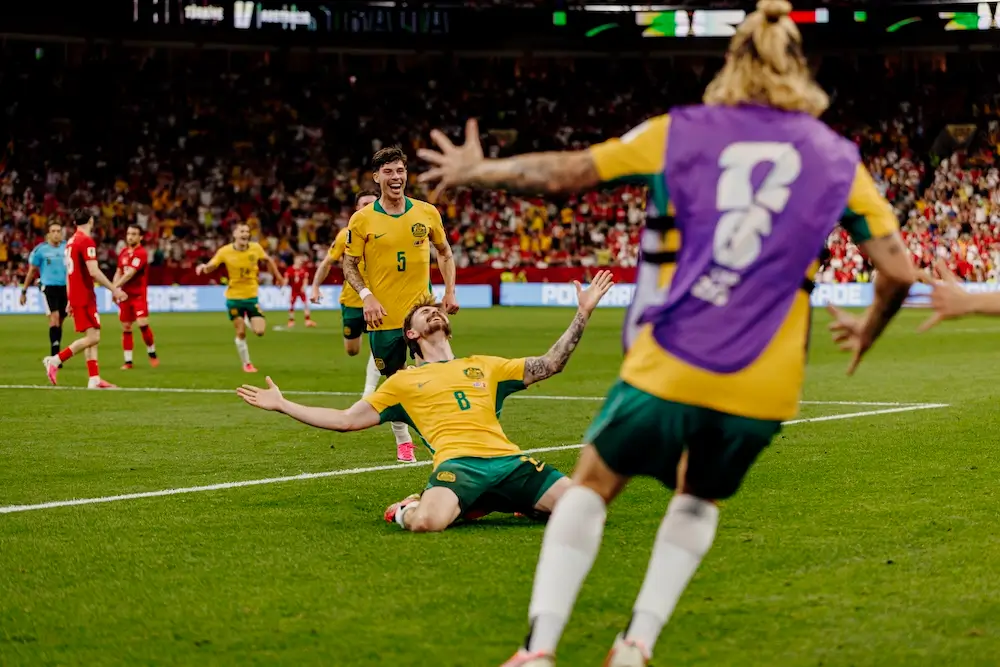
The opening goal was a result of a similar picture. Bos remained deep in Australia's build-up which attracted Çelik and cleared space for Irankunda to attack. After a great pass from Okon-Engstler into the space and a superb first touch, Irankunda became only the 4th Australian player to score on their FIFA World Cup debut.

Bos below, Irankunda beyond.

Create the conditions for Irankunda to attack any CB in group D.
Different view of the goal (with an emphasis on the pass):
From Turkey's goal kicks (that weren't taken quickly), Australia moved into an aggressive man-to-man structure. The 10s looked after the CBs, and Irankunda curved his run to show play to one side. Toure drops onto the 6, while the WBs are ready to jump to the FBs. This is a good strategy when you have the CBs that we do, because forcing the opposition long in these moments means you're more likely to clean up at the other end courtesy of Burgess, Souttar and Circati. It also required big efforts from the MFs and WBs to drop back in for second and third balls.

Man-to-man high, Irankunda doing two jobs to lock play to one side.

Uncontested header for Souttar, MFs and WBs dropping aggressively for seconds/thirds.
On this occasion, they missed the detail due to a lack of communication from the CBs or O'Neill, and it meant Okon-Engstler was caught focusing on the higher midfielder in Turkey's box. Turkey used the deeper player to move the ball to the right, and the ease of possession meant Australia retreated back into their block.

Turkey's box midfield with a 4v3 advantage.
An important detail in the low-block was how to keep the half-spaces protected when the WB shifts across to the wide player. If you're relying on the WCBs to cover these spaces, it removes an important player from the box who will be taking care of crosses and making important blocks (Turkey had 8 shots blocked by Australian players). It can also create big gaps in the defensive line when it's constantly being asked to shift horizontally as the opponent circulates the ball.
Metcalfe was tasked with dropping to protect this area on Australia's right, while asymmetrically, it was Paul Okon-Engstler on the left. This utilised his ground-covering qualities out of possession and meant Irankunda didn't have as much defensive responsibility as Metcalfe, reducing the risk of mistakes while also preserving his energy and keeping him closer to the areas where he could help progress the team up the pitch.

Metcalfe dropping to protect the half-space.

Okon-Engstler dropping to protect the half-space.
This is also a simpler chain of movements for doubling up on the wide player while leaving the CBs at home, which became important in the second half against Yildiz and the desperate defending that was required centrally. I thought Turkey attacked down Australia's right-hand side too often and failed to test the left enough. 13 of their 15 crosses from wide areas came from their left, Australia's right. Good luck making crosses stick against three blokes that are ~1.9m anyway.

Metcalfe and Italiano doubling Yildiz.
Metcalfe doubled the lead in the second half following a long goal kick and good proximity in midfield for the second and third ball. He then received in a nice pocket of space and drove inside from the right-half space to produce a wonderful finish. Interestingly, Australia scored not long after the hydration break in both halves (if only we had a view that wasn't advertising).
After this, the game become even more about Australia's compact deep defending to protect the lead. 16m average compactness in this phase of play to be exact, 22m average in the mid-block. That is very, very little space between the lines to play with.

Credit: FIFA Training Centre
Overall, Australia couldn't have made a better start to their campaign, but it's important to remember that you don't win many games when allowing 30 shots on your goal. There were glimpses of more positive dynamics in-possession which helped create more of a threat in forward areas, and we can only hope that this will be built upon to reduce the amount of time spent defending deep against the hosts and Paraguay.
It will also be interesting to see how the approach is adjusted in different game states. Most of the defensive hard work yesterday was done while protecting a lead, but when level or behind, more risks will need to be taken with higher positions in the group on the line.


www.bing.com