Welcome!
By registering with us, you'll be able to discuss, share and private message with other members of our community.
Sign Up Now!You are using an out of date browser. It may not display this or other websites correctly.
You should upgrade or use an alternative browser.
You should upgrade or use an alternative browser.
Big Ange thread
- Thread starter Quicky
- Start date



HonestSpursFan
National Star
- Joined
- Aug 31, 2025
- Replies
- 7,206
You can also finish second and go up, you don’t have to win either the league or the playoff final because three teams go up, not two. And winning the Championship is easier as the teams are of a lower standard.People are forgetting two things.
1. To get out of the championship you either have to win the league or a playoff final, something foreign to Spurs only until recently but they sacked the manager who achieved it.
2. Spurs hoping for “Daddy” Pochetino to come home, not realising the irony that even with Spurs’ greatest ever squad in recent memory, he never won a major trophy.
It tells you everything you need to know about the club. It’s all vibes. I’d be very concerned for Spurs, don’t think it would be as easy as it looks to bounce straight back up.

riquelmes_laces
First Team Regular
- Joined
- Nov 11, 2024
- Replies
- 728
You can also finish second and go up, you don’t have to win either the league or the playoff final because three teams go up, not two. And winning the Championship is easier as the teams are of a lower standard.
Yes it is and law of averages would say Spurs bounce straight back.
However, it’s going to be a reckoning. The pressure on Spurs to bounce straight back will be monumental. Hope the club can deal with that pressure.
riquelmes_laces
First Team Regular
- Joined
- Nov 11, 2024
- Replies
- 728
This is a great read:
HonestSpursFan
National Star
- Joined
- Aug 31, 2025
- Replies
- 7,206
This is a great read:
Was indeed a great read! Some excellent points there too!

- Joined
- Oct 17, 2024
- Replies
- 14,263

This is a great read:
Interesting, some Indian bloke is saying that Greeks aren't "full" European now??? Yeah no worries champ, on your way.
Last edited:

Football us life
Vice Captain
- Joined
- Jun 27, 2025
- Replies
- 1,962
Wolves will win next seasons Championship....Probably by a country mile. Their judas manager is a Championship specialist.
Burnley will probably finish second. As a club, Burnley know this league very well and are seasoned returnee's....
Whichever other club goes down will finish in the play off positions!
Burnley will probably finish second. As a club, Burnley know this league very well and are seasoned returnee's....
Whichever other club goes down will finish in the play off positions!

theFOOTBALLlover
Key Player
- Joined
- Nov 14, 2024
- Replies
- 898

I think he meant because Ange grew up in Australia which makes him "more of an" Aussie. It wasn't a dig at Greeks.Interesting, some Indian bloke is saying that Greeks aren't "full" European now??? Yeah no worries champ, on your way.
"A big part of this “Ange normalized losing” narrative comes from people who went early on the Thomas Frank hype train but refuse to accept how wrong they were. Or the people who just hate that a Greek-Australian did what none of the full Europeans could."
HonestSpursFan
National Star
- Joined
- Aug 31, 2025
- Replies
- 7,206
I think he means that people don’t consider Aussies true Europeans since we weren’t born in Europe, not that Greeks aren’t European.Interesting, some Indian bloke is saying that Greeks aren't "full" European now??? Yeah no worries champ, on your way.
HonestSpursFan
National Star
- Joined
- Aug 31, 2025
- Replies
- 7,206
Yeah nah. I mean Wolves could win it if Spurs stay up but “by a country mile”? Nah. The Championship is typically a highly competitive league.Wolves will win next seasons Championship....Probably by a country mile. Their judas manager is a Championship specialist.
Burnley will probably finish second. As a club, Burnley know this league very well and are seasoned returnee's....
Whichever other club goes down will finish in the play off positions!
Football us life
Vice Captain
- Joined
- Jun 27, 2025
- Replies
- 1,962
Yeah nah. I mean Wolves could win it if Spurs stay up but “by a country mile”? Nah. The Championship is typically a highly competitive league.
Coventry are running away with it this season....8 points clear.
Sure they're bunched up after that...
Wolves will be next season's Coventry.
I don't think Tottenham will be relegated to be honest.
HonestSpursFan
National Star
- Joined
- Aug 31, 2025
- Replies
- 7,206
Eight is a big margin but it’s not a country mile. I would’ve expected you to be referring to a 15-point lead or something.Coventry are running away with it this season....8 points clear.
Sure they're bunched up after that...
Wolves will be next season's Coventry.
I don't think Tottenham will be relegated to be honest.
riquelmes_laces
First Team Regular
- Joined
- Nov 11, 2024
- Replies
- 728
It takes a massive amount of hubris to call the league the “bread and butter” in light of winning a major European trophy when Spurs haven’t been in the conversation of winning leagues since they bottled it to Leicester under the guidance of Daddy Pochetino.
I know Spurs were a top 4 club, but in all honesty they had an incredible first XI and some decent subs.
Spurs are not that now.
Ange worked miracles with what he had. He lost Kane a week out from his first game, he had to revive an out of form Son, had to galvanise a wounded squad, dealt with a horrific injury crisis and a media circle that never took him seriously because he was an Aussie.
Yet he walks away having done something nobody else has done for decades at that club and frankly won’t ever will for a very long time.
Only got themselves to blame for this whole mess.
I know Spurs were a top 4 club, but in all honesty they had an incredible first XI and some decent subs.
Spurs are not that now.
Ange worked miracles with what he had. He lost Kane a week out from his first game, he had to revive an out of form Son, had to galvanise a wounded squad, dealt with a horrific injury crisis and a media circle that never took him seriously because he was an Aussie.
Yet he walks away having done something nobody else has done for decades at that club and frankly won’t ever will for a very long time.
Only got themselves to blame for this whole mess.
Football us life
Vice Captain
- Joined
- Jun 27, 2025
- Replies
- 1,962
It takes a massive amount of hubris to call the league the “bread and butter” in light of winning a major European trophy when Spurs haven’t been in the conversation of winning leagues since they bottled it to Leicester under the guidance of Daddy Pochetino.
I know Spurs were a top 4 club, but in all honesty they had an incredible first XI and some decent subs.
Spurs are not that now.
Ange worked miracles with what he had. He lost Kane a week out from his first game, he had to revive an out of form Son, had to galvanise a wounded squad, dealt with a horrific injury crisis and a media circle that never took him seriously because he was an Aussie.
Yet he walks away having done something nobody else has done for decades at that club and frankly won’t ever will for a very long time.
Only got themselves to blame for this whole mess.
Yesterday's Times...
Spurs chief hits out at Levy era
Peter Rutzler
Venkatesham joined Tottenham last April
The chief executive of Tottenham Hotspur, Vinai Venkatesham, has painted a damning picture of the way the club was run under former chairman Daniel Levy, implying that on-field success had not been the club’s No 1 priority and that Spurs may need to sell players to comply with financial regulations after years of loss-making.
Venkatesham, who joined Tottenham in April 2025, made the wideranging critique of the club’s governance and structure during a meeting with the club’s fan advisory board on March 3, the minutes of which were released yesterday.
At the meeting Venkatesham revealed that an internal review of performance and structural issues had brought to light multiple areas of concern, affecting both the men’s and women’s teams, and that “significant change” was required to resolve them.
Levy, who combined the roles of chief executive and chairman, left Tottenham in September 2025 after almost a quarter of a century with the club.
Tottenham are at present a point outside the relegation zone in the Premier League, with the fan advisory board highlighting a lack of trust from supporters about the club’s direction.
The minutes, published by Tottenham, read: “VV [Venkatesham] explained that since joining the club in June 2025, there has been a comprehensive review of the organisation to determine the issues and actions required.
While the club has made strong progress in areas such as the stadium, training facilities, commercial growth and stadium operations, several areas were identified as falling short of what is required to compete at the highest level.”
The key issues identified in the minutes included:
• Insufficient focus across the organisation on on-pitch success.
• A lack of specialist expertise in certain areas and insufficient empowerment of experts in others.
•A wage structure and player transaction approach that had affected competitiveness in the transfer market.
•A men’s squad requiring strengthening in terms of quality, experience and leadership.
• Insufficient prioritisation of the women’s team.
• Financial pressures arising from heavy transfer spending and limited player sales, increasing the relevance of financial fair play constraints to future planning.
•A growing disconnect between the club and its supporter base.
Venkatesham suggested that Tottenham have removed the previous wage structure and explained that “there is now complete clarity across the club that on-pitch success is our number one priority and focus”.
Regarding the club’s financial position, Venkatesham highlighted financial fair play rules as a concern. “VV noted that the club has been loss-making for a number of years, which means compliance with financial fair play rules need to be actively monitored and planned for,” the minutes read, citing four consecutive years where Tottenham have recorded losses, per their accounts. “An increased emphasis will therefore be placed on player sales alongside continued revenue growth.”
Meanwhile, Harry Redknapp has said that Levy told him that if he were still at the club he would appoint him as manager until the end of the season. “I got a phone call last week from Daniel, funny enough. He did say to me, ‘Look, if I was there now, I would bring you back into it to the end of the season.’ So it would have been interesting.”
Dougie Freedman, Tiago Pinto and Cristiano Giuntoli are among the names being considered by an executive search company leading Spurs’ search for a new sporting director.
HonestSpursFan
National Star
- Joined
- Aug 31, 2025
- Replies
- 7,206
Please FIFA change the rules so Sega can be a Roo. I have a decent income, I can pay a bribe.Rumours and reports that Spurs have approached Ange for a return but I think Segecic will renounce his Croatia switch before that happens.
Football us life
Vice Captain
- Joined
- Jun 27, 2025
- Replies
- 1,962
The Scottish newspaper The Herald, which is a brilliant paper for football coverage have a big interview with 'Big Ange' today....
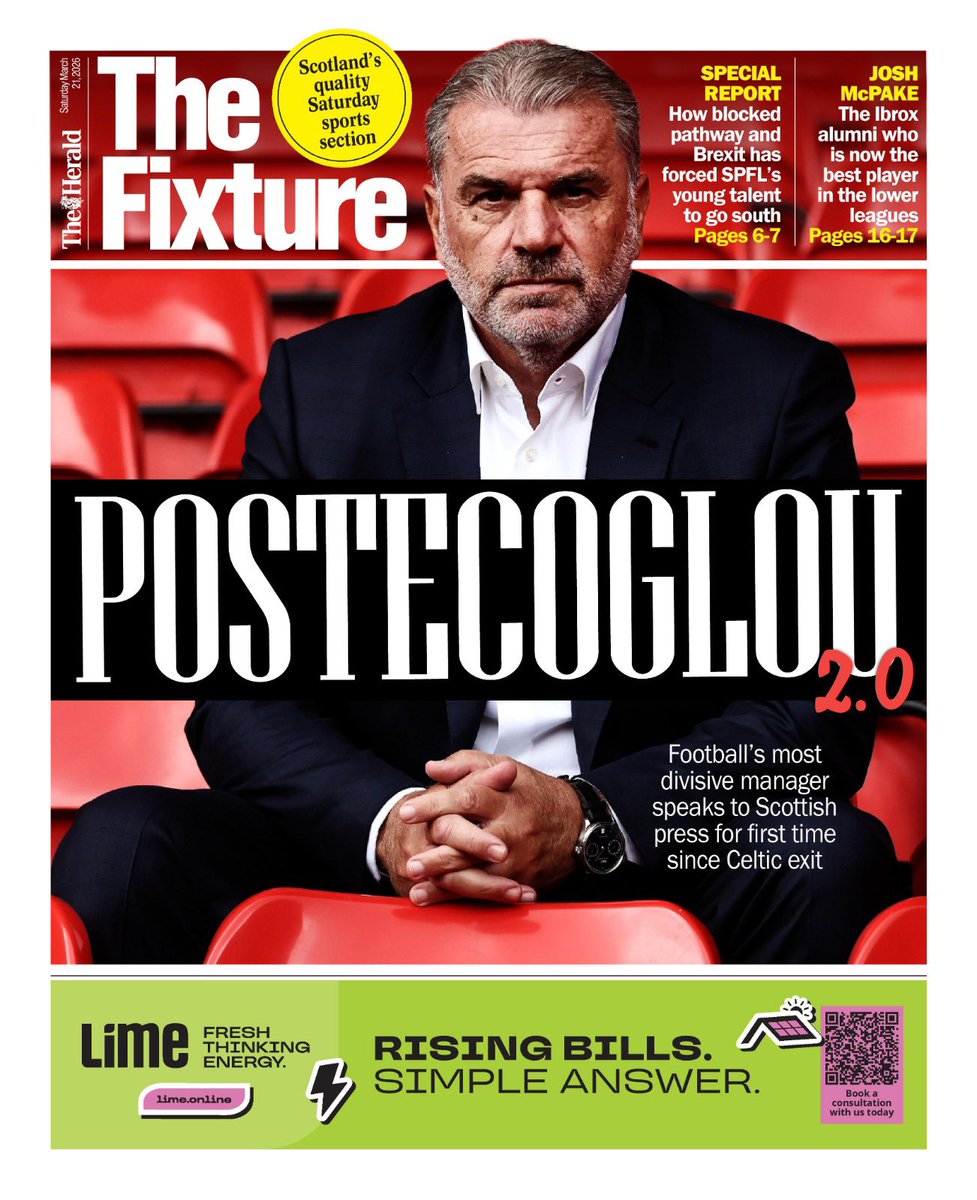
Passion still there for Postecoglou
I don’t think the game ever leaves you. Just ask any manager who is kind of getting on in years. I certainly don’t feel like I’m in a space of winding down at all
The Herald - Herald SportMatthew Lindsay Chief football writer
TALK about learning at the feet of the master. The coaches from Belarus, Finland, Georgia, Kazakhstan, Montenegro and Scotland who attended the UEFA Pro Licence Student Exchange this week were fully expecting, as previous alumni like Xabi Alonso, Raul Gonzalez, Roberto Martinez, Giovanni van Bronckhorst and Andriy Shevchenko all found, it to be an enlightening experience.
When Ange Postecoglou, who was appointed as a technical observer by European football’s governing body in January, turned up at Nyon in Switzerland to speak to them about his long managerial career and give his thoughts on the latest developments in the modern game, they were not disappointed.
The group, which included, among others, Charlie Adam, Scott Brown, Kris Doolan, David Gray, Jonny Hayes, Shaun Maloney and Steven Naismith, listened intently as their special guest provided detailed breakdowns of the tactics he deployed during his time at Spurs and offered other pieces of invaluable advice.
The Greek-Australian clearly enjoyed himself enormously. He was hopeful he was as inspiring as his own mentor Ferenc Puskas had been when he was an industrious defender with South Melbourne and the Hungarian legend was in charge at Middle Park Stadium back in the late 1980s and early 1990s.
Yet, the former Celtic manager, whose love of the 4-3-3 formation, use of inverted full-backs and insistence on a high defensive line would have been well known to everyone who was present in the auditorium in the House of European Football, felt the last point he made, which had nothing to do with low blocks or counter pressing, was perhaps the most crucial.
“In the final slide, I stated that success is always important,” he said during a chat with Herald Sport following his presentation. “But I stressed the most important part is the stuff that you don’t see – the human relationships, the connection to the story, being able to drive people to go beyond the normal, the average.
“You can have the best tactics in the world, the fittest team and the best quality players, but if they’re not united then you won’t achieve what you want to. That is still the most important thing you can possess – the ability to unite people and get players to go beyond what they feel is their limit.
“Yes, Ferenc Puskas had a massive impact on me. But it wasn’t so much about his coaching, it was about who he was as a person. He was a guy who achieved everything in the game he could possibly achieve, but he was so humble about it. The way he interacted with people really made an impact on me.
“It wasn’t like he gave us a lot of guidance. He loved us to play attacking football and score goals, but we actually wanted to play for him because of the kind of person he was. I always figured if I could get people to believe in me as much as I believed in him when I started my coaching journey it would make an impact. I’ve tried to do that my whole career.”
Postecoglou certainly succeeded in that regard during his two unforgettable years in Scotland. He took over a club which had finished trophyless the previous season, quickly overhauled his entire squad, got a sceptical fan base firmly onside by playing an exciting brand of attacking football, won a double and then completed the treble.
They go down on one bended knee in the East End of Glasgow when his name is mentioned to this day.
The 60-year-old – who has been out of work since his 39-day tenure at
Nottingham Forest, the second shortest in Premier League history, came to an end in September – still takes a keen interest in how his former club are faring. He has been watching the three-way title race north of the border closely from afar.
It is fair to say the current Parkhead side is, with Cameron CarterVickers, Arne Engels, Alistair Johnston and Jota sidelined and Liel Abada, Kyogo Furuhashi, Joe Hart, Aaron Mooy, Matt O’Riley and Greg Taylor long departed, inferior to the one he led to a clean sweep of domestic silverware during the 2022/23 campaign.
However, Postecoglou believes that Celtic have an individual in charge who commands exactly the same total devotion from his charges that he has always strived for in Martin O’Neill and is convinced that will be key during what promises to be a tension-packed run-in.
“Martin is one in a million,” he said. “I was fortunate enough to bump into him a few times when I was up there and he was always very, very respectful towards me. What a man! What a great storyteller!
“I’m sure he’s one of these guys who has a dressing room full of players that don’t want to let him down. There has been a couple of different moments where you have seen that this season. He’s got them into position again where they can have success.”
Postecoglou was responsible for all kinds of noteworthy achievements at Celtic. The 114 goals his side netted in the league in his final term broke the post-war scoring record which the Lisbon Lions set in the 1966/67 season. The domestic treble he oversaw was a world record eighth.
Whenever he was asked about his accomplishments, though, he always had the same reply. “I’ll reflect on it when I’m an old man and I am sitting on a Greek island somewhere,” he would say. For him, the next challenge was always more important than basking in the afterglow of a triumph.
But has seeing O’Neill, who returned to the dugout in October after a six-year sabbatical, and who
turned 74 at the beginning of March, show that he can still excel in a demanding role both in Scotland and Europe well into his eighth decade not made him push back his retirement plans?
“Absolutely it has!” he said. “I don’t think the game ever leaves you. Just ask any manager who is kind of getting on in years. I certainly don’t feel like I’m in a space of winding down at all. I’m still really passionate about the things I want to do and things that are at the forefront of my mind.”
Postecoglou was far more concerned with helping coaches who are at the start of their careers than his own future this week when he turned up at the UEFA headquarters on the shores of Lake Geneva to give his talk.
He recognised a few of the faces in the crowd from his time managing in this country and was impressed they had taken time out of their busy schedules at their clubs and made the journey to the canton of Vaud. But their desire to further themselves came as no great surprise to him.
He told his audience at the UEFA Pro Licence Student Exchange that whenever they get the chance to speak to an experienced older manager about their profession they should “shut up and listen”. He recalled how the Scots who were in attendance always did exactly that when he encountered them.
“I’m really passionate about coaching,” he said. “But I’m also passionate about coaching education, the development of coaches. A lot of the assistant coaches I’ve had are now senior coaches. I believe the way I behave and what I say can have an impact on people in a positive way.
“Because of my journey, I’ve always tried to embrace and understand the landscape I’m entering wherever I’ve landed. I enjoyed my time in Scotland immensely because the people there are really passionate about their football and their football club.
“That passion permeates into the coaches. That’s fertile ground to produce top coaches. Because that’s where it all starts – having enthusiasm and passion for the game.
“They were always very respectful to me even though I come from the other side of the world. They were always asking questions and asking for guidance. There was a humbleness to them. That showed me there is the potential there to produce topclass coaches.
“I would talk to anyone who was genuinely interested, anyone I came across. Guys like Scotty Brown and Steven Naismith, who are both here, and a few others who were either assistants or coaches.
“You need to be really humble in yourself in that moment and understand that if you’re going to get anything out of the interaction, because obviously they’re usually brief, is to ask the right question and just listen. They always did that.”
He is confident that Celtic are, despite the turbulent season they have had on and off the park and the difficulties they are still contending with, well placed for quality coaching staff as they enter the business end of what has been a remarkable season. Not least their assistant Maloney.
“I came across Shaun a couple of times in Scotland,” he said. “He’s well connected at Celtic and is very passionate about the club. My understanding is that he’s a very good coach as well. Martin trusts him a great deal to drive a lot of the programme which is important. I think you should delegate to the people around you. Shaun’s a big part of it.
“Martin has Mark Fotheringham as well. They’ve got a good group there. The circumstances have been difficult because they’ve come in twice. That’s really hard as a management team, to drive a really successful club through a tough period. They’ve done an outstanding job and that’s a credit to all of them.”
POSTECOGLOU, who was sacked by Spurs last summer shortly after winning the Europa League, remains as ambitious as any of the 100 or so coaches who were on the course in Nyon this week despite his unfortunate spell at Forest.
Asked how much he had reflected on what went wrong at the City Ground, he said: “I’ve always been pretty good at sort of doing that anyway. What it has done for me, is just sort of reaffirmed certain things in me as a person. Namely, that I’m still very driven to do what I do. It would have been an easy time for me to relax because I’ve been doing it for 26 or 27 straight years. I had Celtic, Tottenham, Forest, all in quick succession. I’m starting to relax a little bit. But I don’t get that sense [of wanting to slow down]. After the first week I was ready to go again with a new energy.
“I’m at a point in my life where I know what’s important for me, what I stand for and what I believe. Forget about the current noise around football and the instability of it. The path that I chart is the one that I believe in and still believe allows me to have an impact wherever I am.
“It probably has helped me [to take stock]. Maybe it has. But I’m just grumpy so it doesn’t feel like it. But I know as soon as I get back into work it’ll be 100 miles per hour. You don’t ease your way back into it. So when I get back into it I’m probably
going to be thankful for the time I’ve had to re-energise.”
There has been no shortage of offers in the past six months. None of them, however, has felt quite right. He will be far more careful about what job he accepts next than he was last time around.
“The Forest thing?” he said. “That was on me. It wasn’t the right decision and I’ve got to take responsibility for that. I’m just the kind of person who is going to go for a challenge if you put a challenge, the biggest possible challenge, the challenge that I shouldn’t take, before me.
“I love a challenge. Everywhere I’ve gone I’ve faced a challenge. When I took over at Celtic, it was just after the season they didn’t win anything. But I loved the fact that I was coming in after that because I could make an impact. Tottenham obviously hadn’t won anything in a long time. Yokohama hadn’t won the league in 14 years.
“I love big assignments like that. There’s no doubt whatever I take on next, it has to have that element, it must be somewhere where hopefully I can make a big impact. The difference this time is I’ve got people around me who are going to stop me taking the wrong challenge.”
It will be fascinating to see where Postecoglou rocks up next. Whatever project he takes on, he is sure to have an interesting new chapter in his managerial career to tell aspiring coaches about in future.
Last edited:
Football us life
Vice Captain
- Joined
- Jun 27, 2025
- Replies
- 1,962
The Times also did an interview with Big Ange this weekend which is more aimed at the Premier League side of things.
‘I’ve come up with a plan to beat teams sucking life out of football’
In a season when control has been preferred to flair, the Australian tells Hamzah Khalique-Loonat why fast, attacking play is best way to win
ANGE POSTECOGLOU THE BIG INTERVIEW
This will not be a campaign that ranks highly for beautiful football. When analyses of the 2025-26 Premier League season are written, set pieces and skulduggery in the penalty box will be two big themes, while tactics such as man-toman marking have stifled creativity in open play.
Why has the game evolved in this way? What are the chances of fullthrottle, attacking football returning any time soon? For better or worse, Ange Postecoglou is a coach committed to delivering an entertaining style of play and believes he has the answers.
“The Premier League now is going through a cycle where it is very hard to gain momentum and fluency in a game, because of stoppages,” he says.
“Some natural, some artificial, whether it’s technology or set pieces.
“We enjoy all different cuisines; when we go out to a restaurant, we don’t just eat Japanese every night, because you’d get sick of it. That’s what each manager can bring. You can bring your own football, or vision.
“The Premier League has been coming over the past couple of years, gradually, to a space where it is very, very structured and hard to gain momentum. The sort of rock’n’roll or heavy metal football of Jürgen [Klopp] today is almost impossible to do because of how many stoppages there are in the game. But somebody clever enough will come along and say, ‘I’ll show you how to break through.’ ”
Postecoglou was speaking in Geneva having delivered a lecture entitled “Angeball” to candidates on the Uefa Pro Licence coaching course.
The audience was packed with coaches leaning forward and listening intently as he discussed his love of football and playing for Ferenc Puskas in Australia, and talked through some of his favourite attacking and defensive sequences.
He has taken time to reflect on a turbulent period in which he was sacked by Tottenham Hotspur despite winning the Europa League — Spurs’ first major trophy for 17 years — then lasted only 39 days at Nottingham Forest, where he failed to win any of his eight matches in charge.
“In terms of the Forest thing, that was on me. It wasn’t the right decision [to take the job], I’ve got to take responsibility for that,” the 60-yearold Australian says. “At the same time, I’m just the kind of person that if you put a challenge before me, the biggest possible challenge, the one that I shouldn’t take — that’s the one I’m going to go for. The difference this time is I’ve got people around me that are going to stop me doing that.
“I love a challenge, everywhere I’ve gone, even at Celtic. I loved the fact that I was coming in a year after they had not won anything, because I could make an impact; Tottenham hadn’t won anything in a long time; Yokohama [F Marinos] hadn’t won the league in 14 years. I love big assignments like that and there’s no doubt whatever I take on next, it has to have that element of me hopefully making a big impact.”
During Postecoglou’s more difficult moments at Spurs, his critics argued that he was too wedded to a singular way of playing. However, his experiences over the past year have “reaffirmed” his core beliefs that a coach needs a distinct style to be truly successful.
“I love football that’s fast-paced, that creates chances and scores goals and is played a certain way,” he says.
“If I fail to deliver that, then that’s on me, not on the other teams to allow me to do that. [So] yeah, I think there’s ways to break through that.
“I’ve always felt whenever you approach a new role, you take a look at what the competition is doing. If you’re going to make an impact and inroads, there’s no point doing what everyone else is doing, because they’re already 50 miles down the track. You’ve got to try to create your own path and say, ‘How can we take advantage of what they do through the way we want to play?’ There are ways you can minimise the disruption in games when you have control of the game, ways you can maintain momentum while the opposition are trying to suck it out. It’s not a fully formed plan yet, but I’m looking forward to seeing how it works out.”
That plan sounds familiar: Postecoglou’s Tottenham were unique for a few reasons, not least their neardogmatic commitment to attacking in their first season, when he guided them to fifth in the Premier League.
As injuries mounted and domestic form plummeted in the second campaign, that flair fell away, yet Spurs retained a commitment to keeping the ball in play. Most top teams want the ball in play as much as possible because that means their more talented players have a better chance to score. Typically, these teams have higher ball-in-play rates than the average, while their opponents often attempt to stymie those matches. One thing remains true for almost all teams: everyone tends to slow the game down when leading. Tottenham were unique in that they had a higher ball-in-play time when leading.
“Correct,” Postecoglou says with pride. Such relentless football is fabulous to watch, but can come at the cost of fatigue and injuries, which wrecked Postecoglou’s second season at Spurs; equally, get it right and it can deliver spectacular results.
It was the hope of achieving the spectacular that drove Postecoglou to take the Forest job. Spurs and Forest play each other tomorrow, in a crucial clash at the bottom of the table. The fact that both clubs have struggled without him — and are embroiled in a relegation battle — reflects better on Postecoglou, and raises questions about the hierarchy of those clubs.
Does he think the coaches of tomorrow should be mindful of the institution they are joining? “Yeah, that’s important, but even if you’re an old coach, like me, you have still got to try to make decisions,” he says.
“A big part of it is understanding the people you’re going to work with.
Because that can be separate from the club. The club is an institution that’s been there for a century and beyond.
The people who are actually involved in that club at that time are the most important thing: is the connection there, do they know what you’re about, what you’re going to bring to the table, or is it just because you’re available, or the next hottest thing as a manager, whatever it is? “Sometimes, you look at the club and think, ‘Oh, it’s a great club to work for,’ but then maybe the people who are involved at the club at that time aren’t the right people for you. And that becomes the important part.”
Postecoglou accepts that elite football is increasingly impatient towards managers, but urges young coaches not to compromise unnecessarily. “There’s less propensity for people to build,” he says. “But the real successfuls, they’ll only come if you’re prepared to be really strong in your principles from day one.
“The reality is, none of us know how much time we have at any club. I think I did 101 games with Spurs, and I still got sacked, and we won a trophy in my 100th game. [But] if you worry about the uncertainty of it, I don’t think the right time ever comes.
“The right time is always, for me, at the beginning; that’s where you’ve got to embed your principles. Ignore whatever the timeline may or may not be, because that’s what you believe in. People need to see in you a conviction about something, for them to follow what you want them to do, and that can only happen if you’re true to yourself on the first day.”
riquelmes_laces
First Team Regular
- Joined
- Nov 11, 2024
- Replies
- 728
Big Ange still being blamed by Spurs faithful for this seasons woes

onedaywinners...
Key Player
- Joined
- Oct 17, 2024
- Replies
- 857
Oh please please relegate the stupid sodsBig Ange still being blamed by Spurs faithful for this seasons woes