
The National Second Tier competition is taking on a different approach from the traditionally planned home-and-away format, with Football Australia announcing it will be a ‘Champions League’ style format starting in October 2025.
With the introduction of this format, Football Australia announced the following in regards to fixturing:
– NPL season will conclude in September before all clubs take three weeks off in preparation.
– In October, they will move in to the nationwide NST format involving the eight foundation clubs.
– There will be a group stage where the final positions will determine the fixtures for the Quarter Finals stage followed by the Semi-finals and Final which will wrap up by December.
– It will be a precursor to a full home-and-away NST.
For historic clubs like Preston Lions, one of the eight foundation clubs getting involved next season, it provides an opportunity to take that next step towards professionalism and bring back the passion that football has been missing in the top flight.
In a conversation with Soccerscene, Preston Lions President David Cvetkovski touched on several important topics surrounding the recent announcement.
He discussed the financial success of the Preston Lions, how the new format is enhancing the development of young talent, the importance of preserving the traditions of clubs founded by migrant communities, and the need to celebrate these historic ethnic clubs by bringing people together as a united football community.
PLFC’s Financial success
Preston Lions have emerged as one of Australia’s most successful football clubs, known for drawing massive crowds, strong merchandise sales, and a dedicated membership base. But what’s the secret behind their financial success, and how have they set the blueprint for other clubs moving into the NST?
Club president David Cvetkovski attributes this success to identifying and maximising key revenue streams that go beyond just match-day ticket sales.
“The key pillar of our strategy was to pinpoint the main revenue areas for football clubs—not just ours, but for all clubs,” he said.
“The success started by elevating the gameday experience for football fans, who on average might spend $20-25 dollars on a Canadian Club, chips and Kebapi roll so there’s a $25 to $55 per head potential there when the product is right.
“We then went to sponsors, we have 120+ sponsors but what’s the value proposition for them? What’s the merchandise like? Well the improvement in our merchandise sales in the last four years is incredible. What we’ve done is provide custom ranges that our merchandise team have designed the T-shirts that people enjoy. We love the fact that every Preston supporter has a Preston garment.”
Cvetkovski emphasised that match-day revenue is only part of the equation. “Every club has loyal supporters, but how can they buy that hoodie or Canadian Club or Kebapi at the right price? Because canteen and gates revenue make clubs but merchandise and sponsors elevate them” he continued.
“It’s no secret that we have the biggest attendance figures in Victorian football and with the South game, we had over 6,000 people, and we had an online portal to capture ticket sales so we’ve been innovative in driving the key revenue streams otherwise without it, you’re at risk as a club.”
 David Cvetkovski at the 2024 Preston in Business launch event. (Image credit: Preston Lions Football Club Facebook)
NST format improving player development
The introduction of the new NST format is providing clubs with greater flexibility to secure player contracts and create optimal conditions for their development.
While Australia continues to produce top-tier talent, the path to recapturing the golden generation of 2006 lies in ensuring that the NST system allows players to focus on football full-time.
Cvetkovski highlighted how this change will transform clubs like Preston and others, offering younger players more opportunities to shine on the biggest stages.
“From a footballer’s perspective, I have to usually contract them for 26 weeks in VPL1, next year in NPL1 would’ve been 26 weeks + potentially three finals so 29 games, but with the NST I’ve been able to contract and take better care of both our young and mature footballers,” he said.
“They’re now being contracted for 40 plus weeks of games but they also need to do 8 weeks of preseason so it’s over 40 weeks. This makes football richer, not only financially, but us being able to play younger kids.
“40% of our team is under 23 years of age. The A-League this weekend had heaps of kids involved because of the budget reduction and this is fantastic for the game. How do we create a platform for kids to play and let these kids find out at 22, 23 or 24 that they are still a baller.
“Look at Jordy Bos who played through the City academy, broke through at 18 almost 19 and played a few years before making a move to Belgium and now he’s playing for the Socceroos at 21. We need 17 Jordy Bos’ in the Australian team, that’s a generation! and Preston are following the same path,” he concluded.
Return of cultural heritage
During the transition from the NSL to the creation of the A-League, many of today’s NPL clubs boasted a proud history of players and staff representing their cultural heritage with passion.
These clubs served as symbols of identity, reflecting not just individual families but entire communities, offering a sense of belonging through football.
Cvetkovski is committed to preserving these traditions at Preston, ensuring that the club’s strong Macedonian roots remain a core part of its identity as they move forward whilst also encouraging the other NPL clubs to work together to achieve the same goal.
“It is the first time in a while, that we have signed 6 or 7 Macedonian boys to stay true to our heritage, the response from supporters, sponsors and members has been incredible and I’m encouraging other clubs like Avondale, Knights, Heidelberg, South [Melbourne] etc to do the same,” he said.
“You can’t get away from South’s Greek community or Marconi’s Italian community and this makes the fabric of the game richer.
“People ask why is Preston so successful? Because we stay true to our community in one sense, yes, we’re Australian but how good is the multicultural landscape of Australian football!
“I want to work together with our rivals, who are also our friends, so that when Preston plays away at these grounds, they make money.
“There’s no secret to enjoying a game. We go there, have a few drinks and something to eat on a Friday or Sunday night out and watch a good game, it’s entertaining. We’re in the entertainment business at the end of the day.”
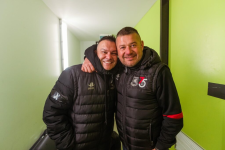 Cvetkovski at Preston vs Pascoe Vale 2023 (Image credit: Preston Lions Football Club Facebook)
Uniting the many cultures in Australian football
These historic ethnic clubs, built by migrant communities with a deep love for football, are making a significant return to the mainstream.
They represent the foundation upon which the beautiful game in Australia was built, and the generational loyalty fans have for their local clubs and communities is finally being recognised again.
Cvetkovski passionately spoke about the importance of uniting all cultures in the top flight of football, regardless of background, to celebrate the shared love of the game and foster a sense of community across the sport.
“There’s opportunity to respect the cultural backgrounds of the clubs. I think we went too far towards cleansing the game but the migrant story of Australia is something that should be celebrated,” he said.
“My best friends are Greek, Italian, Croatian, Bosnian, I don’t care, do I? I’ll sit in any coffee shop; I don’t care where I sit. Let’s bring that friendship to football.
“The new way of thinking is making it about the game, removing any political agendas and making football the star.
“The South [Melbourne] game there was no animosity, there was nothing but celebration of football between two communities who traditionally are rivals.
“They realise now they have a lot more to lose if they get it wrong versus working with each other to make it right,” he concluded.
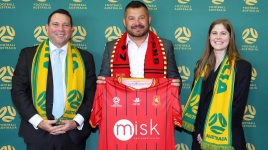 David Cvetkovski with Football Australia (Image credit: Preston Lions Football Club Facebook)
Football Australia is beginning to recognise that the true beating heart of the game lies with these foundation clubs, which have not only survived but thrived since the dissolution of the NSL.
Their passion, rich history, and deep-rooted respect are unmatched in Australian football and this announcement signals an exciting new era for fans across the country.
If the South Melbourne vs Preston match earlier this year is any indication, the spirit of the game is well and truly alive, bringing back the sense of unity and pride that Australian football has been missing.



 Look forward to it.,