With the Socceroos out of the knock-out rounds of the World Cup at the hands of a penalty shootout, and the ever looming prospect of more to come, I think I ought to unleash unto the world my own art and science when it comes to facing or taking penalties.
I had a most unusual football career. I played at a decent level – never higher than 3rd Division State League which these days equates approximately to Football NSW League 2 – but it was serious football. I also played inter-varsity which was very high standard indeed (with lots of NSL Youth and top division State League players augmenting the various state league teams of all universities).
What made my senior football unusual was that I played both as a striker/winger, and as a goalkeeper, in different teams. Accordingly, when it comes to taking or facing penalties, I have a great deal of experience doing both. In fact, when I was playing as a goalkeeper in the upper levels of the Gladesville-Hornsby league, I was also the delegated penalty taker given my insight and confidence.
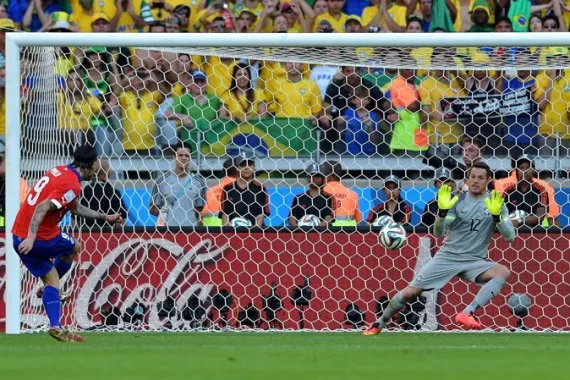
Julio Cesar saving a penalty during the 2014 World Cup
It amounts to this…
When you are in goals, the taker looks like he’s only a few feet away and can’t possibly miss.
But when you’re taking the penalty, the keeper looks enormous and the goals look tiny.
Both are daunting, but if you have this knowledge you can use it to your advantage.
If you step up to take a penalty, you must understand that the keeper feels like he has no chance of saving your shot. If you are facing a penalty, you must understand that the taker is riven with doubt and nerves. You can take confidence from both scenarios.
Taking a Penalty
The most important part of taking a penalty is knowing that the keeper doesn’t expect to save your shot and also knowing what you will do in advance.
When I moved up to the Central Coast in 2000, I started playing for the Avoca FC Gummysharks (O35s), for whom I still turn out occasionally.
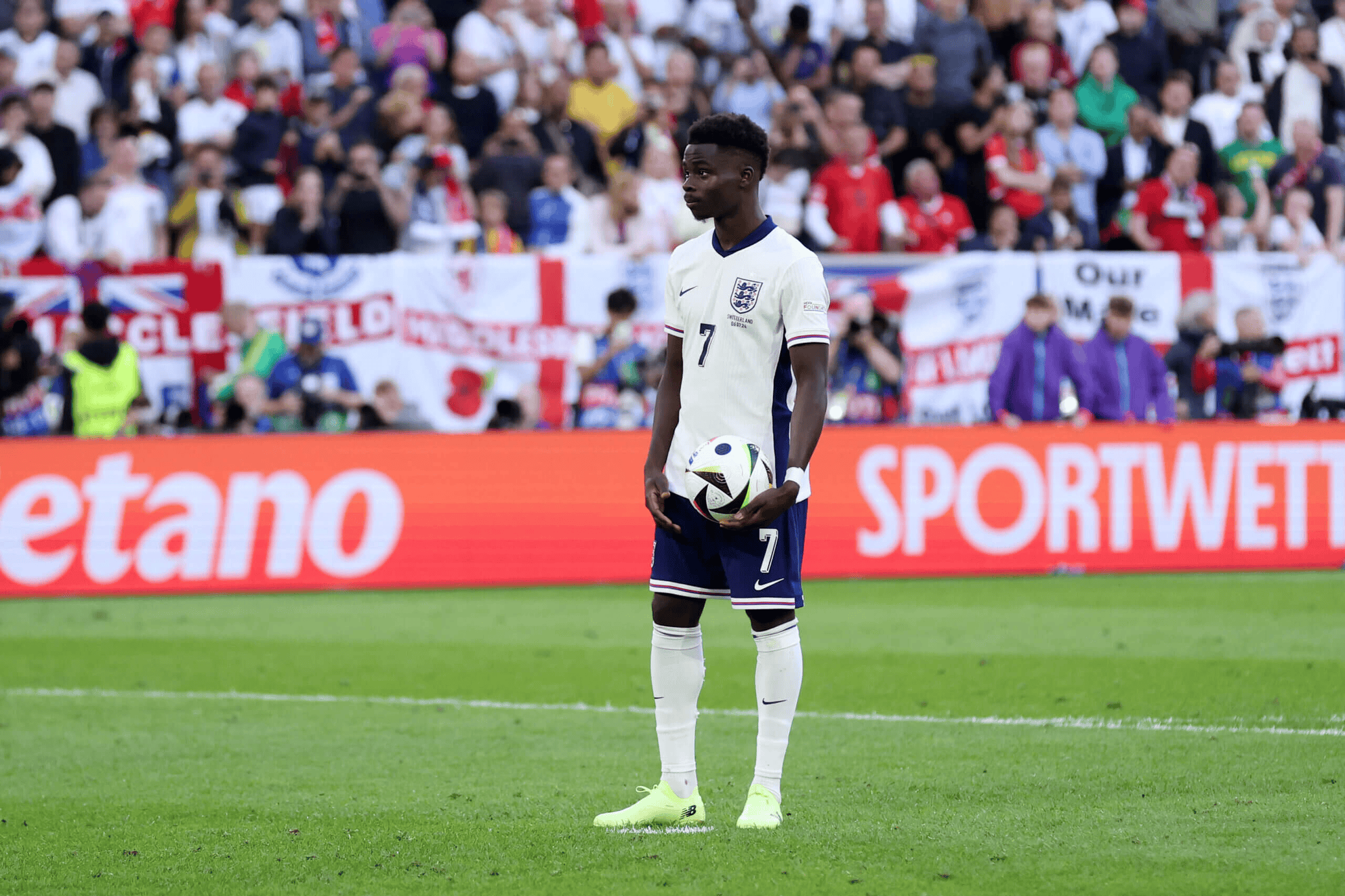
Bukayo Saka lining up before missing for England in the final of Euro 2020
Between about 2003 and 2018 I went 15 years without missing a penalty. I’ve no idea how many I took in that time but it would have to be somewhere between 80 and 120. Let’s say a hundred (approx. six per year).
This was my process…
On matchday, when I woke up, the first thing I did was to think about what I would do if I had to take a penalty that day.
I had two basic penalties. Penalty A was to smash the ball as hard as I could low and hard to the keeper’s right (my left). If I hit the ball cleanly then the keeper had almost zero chance of saving the shot unless he did something I’ll deal with later. Penalty B was to run at the ball – shaping as though I would hit the ball to my left – but then at the last moment twist back to the right and place the ball inside the right-hand post.
Both made the keeper’s task very difficult but the most important thing was for me to know before the game exactly what I was going to do if we had a penalty. There were other parts of the ritual. Knowing where I was going to hit the shot, I would place the ball on the spot and look at exactly the place I needed to hit it to make it go where I wanted. Then I would pace backwards to the top of the box, breathing evenly and settling my nerves.
I would look again at the place I intended to hit the ball (let’s call it the X spot). When the whistle blew, I would take a couple more calm breaths, then move towards the ball – ensuring I could see the X spot – and execute.
As I said above, I went 15 years without missing and had actually acquired a bit of a reputation on the Central Coast as the bloke who’d never missed. I was very proud of that reputation and players from other clubs occasionally spoke to me about it. Alas, this changed one fateful day in about 2018. I’d had the flu for a couple of days and wasn’t a hundred percent. When I woke up I’d forgotten to make my usual decision: Penalty A or Penalty B.
The game commenced and, after only a couple of minutes, the referee pointed to the spot.
‘Oh no!’ I thought in panic. ‘What am I to do?’ I made the long walk to the spot (I played left back in those days) and decided: Penalty A. I placed the ball and paced backwards, then at the top of the box realised I hadn’t looked at the X spot as I placed the ball. The whistle blew and I moved towards the ball thinking: “Penalty A.” But just before I got to the ball I changed my mind: “Penalty B!”
I actually hit the ball pretty well. After feigning left I shifted right and struck the ball firmly towards the bottom corner, but the (very tall) keeper had guessed right, flung himself left, and just tipped the ball around the post.
I couldn’t sleep for four nights.
Okay, missing a penalty in Z Grade fossil ball is not the end of the Earth, but it wasn’t the miss that upset me. It was the loss of my 15 year record that absolutely did my head in. Anyway, I suppose 100 out of 101 isn’t a bad record.
Facing a Penalty
I’ve written about this at length in my novel (Mr Cleansheets) but, in a nutshell, the secret is knowing how anxious the taker will be. Mark Schwarzer’s advice is to stand tall as long as possible – to watch where the ball is hit – rather than just guess and dive one way or the other.
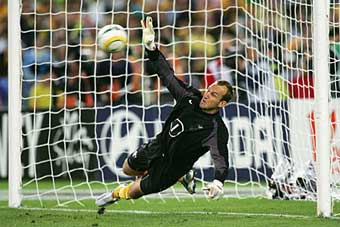
Mark Schwarzer making one of his 2 famous saves against Uruguay in a World Cup Qualifier in 2005
He is, after all, a pretty good facer of penalties, but I’ve faced a lot of penalties also and have a decent record. I don’t have exact figures but I’d guess that I have about a 20% success rate. (I do count misses as saves though.) For starters, if I’ve faced a particular taker before I’ll remember where he placed his shot last time and go to that spot hoping that’s his default shot. You’d be surprised how often this has worked.
More typically, if I don’t know or remember a taker, my process will be as follows (assuming a right footer but it works the same for a left footer): The goal (20 feet by 8 feet) measures 160 square feet and an adult male – assuming good reflexes and diving – can probably cover about ten square feet. My system can do better.
When the taker places the ball and looks up, I’ll be watching his eyes. Too many takers can’t help but look at the spot (in the goal) they want to hit the ball. Bearing in mind that some will be smart enough to send you a decoy – ie, look at a different place to where they intend – I’ll assume that’s where the ball is going.
Unlike Schwarzer, I don’t believe in standing still. If I think a taker wants to hit the ball to my left, I will dance about on the line erring to my right – confirming his choice. As the taker takes his last step (with his right foot) before the kick, I will suddenly dart back to my left – knowing it is now too late for him to change his mind.
I will stay on my feet, knowing that I can reach in all dimensions much better with either hand or foot. The goal (20 feet by 8 feet) measures 160 square feet and an adult male – assuming good reflexes – can probably cover almost a quarter of that.
By the time he hits his shot I am suddenly in place in the middle left of the goal. If I guess right, I’ve suddenly given myself about a one in four chance of saving the shot. As I said above, I’d estimate my save rate over the years at about 20% - one in five.
And yet, I’ve almost never seen a professional goalkeeper use my system of staying on his feet after guessing the right direction when facing a penalty.
This changed a few days ago when the Paraguayan keeper (Orlando Gill) stayed on his feet and danced right – for one penalty only – during the shootout vs Germany. He also saved another shot but why use the standing up method for only one kick?
In any case, I believe that the staying upright method is the best for improving your saving chances. If you dive, you limit yourself to covering about ten square feet and can’t adjust if the ball is just slightly away from you. If you stay on your feet you cover closer to 20 square feet and can adjust (a little). The maths (if not the technique) are compelling.
I’m amazed the professional football world has not cottoned on yet.
I had a most unusual football career. I played at a decent level – never higher than 3rd Division State League which these days equates approximately to Football NSW League 2 – but it was serious football. I also played inter-varsity which was very high standard indeed (with lots of NSL Youth and top division State League players augmenting the various state league teams of all universities).
What made my senior football unusual was that I played both as a striker/winger, and as a goalkeeper, in different teams. Accordingly, when it comes to taking or facing penalties, I have a great deal of experience doing both. In fact, when I was playing as a goalkeeper in the upper levels of the Gladesville-Hornsby league, I was also the delegated penalty taker given my insight and confidence.
Julio Cesar saving a penalty during the 2014 World Cup
It amounts to this…
When you are in goals, the taker looks like he’s only a few feet away and can’t possibly miss.
But when you’re taking the penalty, the keeper looks enormous and the goals look tiny.
Both are daunting, but if you have this knowledge you can use it to your advantage.
If you step up to take a penalty, you must understand that the keeper feels like he has no chance of saving your shot. If you are facing a penalty, you must understand that the taker is riven with doubt and nerves. You can take confidence from both scenarios.
Taking a Penalty
The most important part of taking a penalty is knowing that the keeper doesn’t expect to save your shot and also knowing what you will do in advance.
When I moved up to the Central Coast in 2000, I started playing for the Avoca FC Gummysharks (O35s), for whom I still turn out occasionally.
Bukayo Saka lining up before missing for England in the final of Euro 2020
Between about 2003 and 2018 I went 15 years without missing a penalty. I’ve no idea how many I took in that time but it would have to be somewhere between 80 and 120. Let’s say a hundred (approx. six per year).
This was my process…
On matchday, when I woke up, the first thing I did was to think about what I would do if I had to take a penalty that day.
I had two basic penalties. Penalty A was to smash the ball as hard as I could low and hard to the keeper’s right (my left). If I hit the ball cleanly then the keeper had almost zero chance of saving the shot unless he did something I’ll deal with later. Penalty B was to run at the ball – shaping as though I would hit the ball to my left – but then at the last moment twist back to the right and place the ball inside the right-hand post.
Both made the keeper’s task very difficult but the most important thing was for me to know before the game exactly what I was going to do if we had a penalty. There were other parts of the ritual. Knowing where I was going to hit the shot, I would place the ball on the spot and look at exactly the place I needed to hit it to make it go where I wanted. Then I would pace backwards to the top of the box, breathing evenly and settling my nerves.
I would look again at the place I intended to hit the ball (let’s call it the X spot). When the whistle blew, I would take a couple more calm breaths, then move towards the ball – ensuring I could see the X spot – and execute.
As I said above, I went 15 years without missing and had actually acquired a bit of a reputation on the Central Coast as the bloke who’d never missed. I was very proud of that reputation and players from other clubs occasionally spoke to me about it. Alas, this changed one fateful day in about 2018. I’d had the flu for a couple of days and wasn’t a hundred percent. When I woke up I’d forgotten to make my usual decision: Penalty A or Penalty B.
The game commenced and, after only a couple of minutes, the referee pointed to the spot.
‘Oh no!’ I thought in panic. ‘What am I to do?’ I made the long walk to the spot (I played left back in those days) and decided: Penalty A. I placed the ball and paced backwards, then at the top of the box realised I hadn’t looked at the X spot as I placed the ball. The whistle blew and I moved towards the ball thinking: “Penalty A.” But just before I got to the ball I changed my mind: “Penalty B!”
I actually hit the ball pretty well. After feigning left I shifted right and struck the ball firmly towards the bottom corner, but the (very tall) keeper had guessed right, flung himself left, and just tipped the ball around the post.
I couldn’t sleep for four nights.
Okay, missing a penalty in Z Grade fossil ball is not the end of the Earth, but it wasn’t the miss that upset me. It was the loss of my 15 year record that absolutely did my head in. Anyway, I suppose 100 out of 101 isn’t a bad record.
Facing a Penalty
I’ve written about this at length in my novel (Mr Cleansheets) but, in a nutshell, the secret is knowing how anxious the taker will be. Mark Schwarzer’s advice is to stand tall as long as possible – to watch where the ball is hit – rather than just guess and dive one way or the other.
Mark Schwarzer making one of his 2 famous saves against Uruguay in a World Cup Qualifier in 2005
He is, after all, a pretty good facer of penalties, but I’ve faced a lot of penalties also and have a decent record. I don’t have exact figures but I’d guess that I have about a 20% success rate. (I do count misses as saves though.) For starters, if I’ve faced a particular taker before I’ll remember where he placed his shot last time and go to that spot hoping that’s his default shot. You’d be surprised how often this has worked.
More typically, if I don’t know or remember a taker, my process will be as follows (assuming a right footer but it works the same for a left footer): The goal (20 feet by 8 feet) measures 160 square feet and an adult male – assuming good reflexes and diving – can probably cover about ten square feet. My system can do better.
When the taker places the ball and looks up, I’ll be watching his eyes. Too many takers can’t help but look at the spot (in the goal) they want to hit the ball. Bearing in mind that some will be smart enough to send you a decoy – ie, look at a different place to where they intend – I’ll assume that’s where the ball is going.
Unlike Schwarzer, I don’t believe in standing still. If I think a taker wants to hit the ball to my left, I will dance about on the line erring to my right – confirming his choice. As the taker takes his last step (with his right foot) before the kick, I will suddenly dart back to my left – knowing it is now too late for him to change his mind.
I will stay on my feet, knowing that I can reach in all dimensions much better with either hand or foot. The goal (20 feet by 8 feet) measures 160 square feet and an adult male – assuming good reflexes – can probably cover almost a quarter of that.
By the time he hits his shot I am suddenly in place in the middle left of the goal. If I guess right, I’ve suddenly given myself about a one in four chance of saving the shot. As I said above, I’d estimate my save rate over the years at about 20% - one in five.
And yet, I’ve almost never seen a professional goalkeeper use my system of staying on his feet after guessing the right direction when facing a penalty.
This changed a few days ago when the Paraguayan keeper (Orlando Gill) stayed on his feet and danced right – for one penalty only – during the shootout vs Germany. He also saved another shot but why use the standing up method for only one kick?
In any case, I believe that the staying upright method is the best for improving your saving chances. If you dive, you limit yourself to covering about ten square feet and can’t adjust if the ball is just slightly away from you. If you stay on your feet you cover closer to 20 square feet and can adjust (a little). The maths (if not the technique) are compelling.
I’m amazed the professional football world has not cottoned on yet.