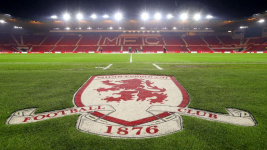
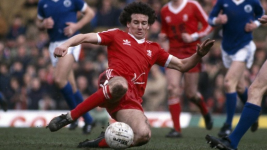
For the uninitiated, Middlesbrough is a once-thriving industrial town in the north-east of England. Not the most glamorous of places by any stretch of the imagination. Shipbuilding, chemical production, steelmaking and heavy engineering dominated the town’s economy for over 150 years. One of its oldest civil engineering companies, Dorman Long, was instrumental in building global landmarks such as the Sydney Harbour Bridge, which I’m sure many on this message board would agree is one of the most iconic bridges in the world.
When I was a young boy in the late 1970s, my family relocated from the leafy outer suburbs of South London to Middlesbrough. In those days, the town was a major centre for iron and steel production, with blast furnaces and chemical works dominating the skyline. The heavy industry produced a lot of smoke and pollution, which often hung over the town. My mother, a farmer’s daughter originally from the countryside in Ireland who had moved to London in the 1960s to become a nurse, was aghast at her new home in the industrial north-east of England.
We soon settled into our new neighbourhood and made friends with the locals. One such family in our street had two boys of similar ages to my brother and me. It was the Waites family who introduced my dad and me to the town’s major sporting club, Middlesbrough FC.
We would often attend games at Middlesbrough's old ground, Ayresome Park, with our new friends and stand in the family enclosure. In those days, apart from the Yugoslavian striker Bosko Jancovic, Middlesbrough's squad was predominantly British players. In fact, a foreign player anywhere in the English First Division was a complete rarity. But coming through the ranks at Middlesbrough was another foreign player, a young footballer named Craig Johnston. Born in Johannesburg, South Africa, to Australian parents, Johnston moved back to Australia when he was a small child. Growing up in the Lake Macquarie region of New South Wales, he became a child footballing prodigy, which at the age of 15 led him to England and eventually to Middlesbrough to try his luck in the professional game. The industrial north-east of England was about as far removed from the pristine surf beaches of Lake Macquarie as one could possibly imagine, a geographical and cultural change like no other.
After a stop-start beginning to his time at Middlesbrough due to the wariness of then manager Jack Charlton, Johnston soon won over his boss, became a first-team regular and one of the club’s best players. A lively but classy midfielder and a firm favourite among the Ayresome Park regulars. I can remember a particular game against Manchester United in which he scored and completely dominated the match in a 1-1 draw. I remember this game and performance thanks to my friend’s dad’s remark after the match:
"I never thought I'd see a kangaroo hopping around in Middlesbrough, but here it is, and this one is one of the best footballers I've seen playing for the Boro."
Or words to that effect, but it made us laugh.
Of course, it was well known that Johnston’s nickname among both players and fans at Middlesbrough was "Skippy".
Original? Perhaps not.
Craig Johnston was brilliant at Middlesbrough. A classy manipulator of the ball, strong as an ox in the hurly-burly of the English First Division, and one of the best players at the club. He soon became one of the most sought-after footballers in the league. All the big clubs were after him, including Brian Clough's Nottingham Forest, the then European champions. However, it was the most successful club in the country who wanted him the most. Johnston eventually signed for league champions Liverpool for a then huge fee of £650,000. At the time, he could probably have played for any major European club, Real Madrid, Bayern Munich, Juventus and all.
Liverpool in the 1970s and 80s were not just a great football club, they were an empire. One of the most dominant clubs in world football, building a dynasty that defined an era in English and European football. A club that strode around the cathedrals of European football like they owned the place, which for the eight-year period from 1977 to 1985 they did. World-class footballers filled the club throughout that era. Players like Kevin Keegan, Ray Clemence, Emlyn Hughes, Phil Neal, Tommy Smith, Graeme Souness, Alan Kennedy, Kenny Dalglish, Terry McDermott, Phil Thompson, Ian Rush, Alan Hansen, Bruce Grobbelaar, Ronnie Whelan, Jan Molby, Steve Nicol, John Barnes, Peter Beardsley and, of course, Craig Johnston, who settled into one of the most formidable squads of footballing geniuses the English game had ever seen with absolute ease. Not bad for a young man with a relatively modest football background. Certainly an extraordinary achievement for someone who, as a child, nearly lost one of his legs.
In his early years, Johnston was a skinny but enthusiastic young footballer who was clearly blessed with natural talent. His hopes of forging a career in the sport were almost snuffed out when he developed a serious leg condition aged six. Initially, doctors told the family that the young Johnston had contracted polio and that they would probably have to amputate his leg. It was only the intervention of a specialist doctor from the United States that prevented it. He correctly diagnosed osteomyelitis, a bone infection that can cause permanent damage if left untreated. Johnston underwent surgery and the leg was saved. In a recent interview with The Athletic, Johnston said:
“It was 1966 and England were hosting the World Cup, so when I was in the hospital with my leg, that’s when I fell in love with British football,” he recalled. “I told one of the nurses, ‘I’m going to go to England and be a soccer player, and I’m going to score at Wembley one day.’ She patted me on the head, laughed and said, ‘Yes, of course you are.’”
As a fan, I've never been one to begrudge any of our players a transfer to a bigger club. It's the natural progression of a professional footballer’s career, and I've always followed our former players when they moved on, especially a fan favourite like Craig Johnston, whose career at Liverpool went from strength to strength. He became a major player at Anfield, a star in a team of superstars. During his time at Liverpool, Johnston won a host of trophies, five league titles, one European Cup, one FA Cup and two League Cups.
In the 1983-84 season, he was part of the Liverpool team that claimed the treble, League Champions, European Cup and League Cup winners. Two years later, he helped the club secure the League and FA Cup double.
Craig Johnston’s retirement from professional football came as a shock to everyone. He decided to hang up his boots following the 1988 FA Cup final against Wimbledon. He was only 28 years old, at the peak of his fantastic career and still very much an essential part of that great Liverpool side. However, he chose to call it quits and move back to Australia to care for his sister, who had suffered permanent brain damage in a horrendous gas inhalation accident while travelling in Morocco in 1986. It was an incident that hit Craig very hard by all accounts.
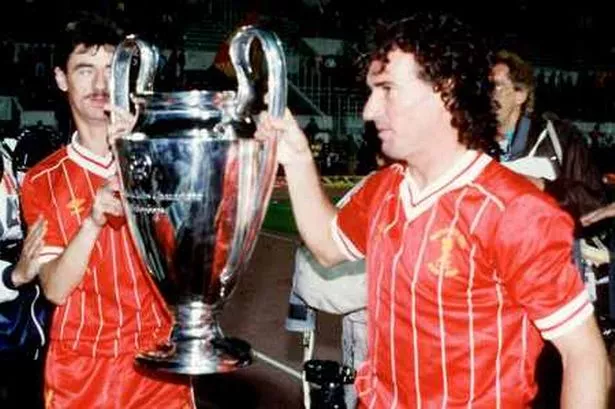
Craig Johnston celebrates Liverpool’s European Cup triumph (now known as the UEFA Champions League), proudly lifting the trophy during the club’s golden era of the 1980s.
Giving up your entire career at its absolute peak, with everything you've built as a person, to look after a sick relative is the ultimate act of unselfishness. Not just for a top-level professional sportsman, but for anyone. It shows a level of moral decency and generosity of spirit few of us could match.
In 1988, I left Middlesbrough and returned to live in London, but I still regarded Middlesbrough FC as my team and continued to follow them, travelling to games most weekends, home and away. It was somewhat ironic that as one of the first clubs in England to have an Australian in their team, Middlesbrough later became a prolific destination for many other great Australian players, Mark Schwarzer, probably our greatest ever goalkeeper, the legendary Mark Viduka, Scott McDonald, Tony Vidmar, Paul Okon, Luke Wilkshire, Rhys Williams and Brad Jones, just to name a few.
But for me, Craig Johnston was the best of them all. And despite never representing the Socceroos, he was quite possibly the best Australian football player of all time.
The brilliant Craig Johnston was one of Middlesbrough's most famous players, a club legend and one of my personal favourites. So yes, I'm slightly biased here. I might just leave it to the legion of devotees of Australian football on this message board to make that call.
As a footnote, I have to say that there have been many footballers who like to market themselves as one-offs, but few truly are.
Craig Johnston is one of the exceptions. This iconic Australian is a footballer with a mantelpiece overflowing with trophies and medals, but his footballing achievements are perhaps the least remarkable thing about him.
Over the years, I've read numerous articles about Craig Johnston and his post-football life. He is an engineer and businessman, a chart-topping musician, the creator of the biggest-selling football boot of all time, the Adidas Predator, the creator of a television game show and the inventor of a hotel minibar security system. He retired at the peak of his sporting powers, went bankrupt after investing millions in a football skills test for children in schools, and in the twilight of his working life has become a passionate and highly sought-after professional photographer.
It’s an extraordinary life that has spanned 65 years and three continents, a life that surely makes him one of the most remarkable footballers who has ever lived.
On G & G FC, as well as discussing the many happenings in the world of football, we also like to touch on politics, politicians and the pursuit of social and political well-being.
But it remains a mystery to me why people of Craig Johnston’s calibre, people with almost immeasurable life experience and skills, who have lived amazing purpose-driven lives, do not involve themselves in the political game.
So there he is. Craig Johnston, not just an extraordinary great Australian football player, but an extraordinary great Australian.
Discuss.
When I was a young boy in the late 1970s, my family relocated from the leafy outer suburbs of South London to Middlesbrough. In those days, the town was a major centre for iron and steel production, with blast furnaces and chemical works dominating the skyline. The heavy industry produced a lot of smoke and pollution, which often hung over the town. My mother, a farmer’s daughter originally from the countryside in Ireland who had moved to London in the 1960s to become a nurse, was aghast at her new home in the industrial north-east of England.
We soon settled into our new neighbourhood and made friends with the locals. One such family in our street had two boys of similar ages to my brother and me. It was the Waites family who introduced my dad and me to the town’s major sporting club, Middlesbrough FC.
We would often attend games at Middlesbrough's old ground, Ayresome Park, with our new friends and stand in the family enclosure. In those days, apart from the Yugoslavian striker Bosko Jancovic, Middlesbrough's squad was predominantly British players. In fact, a foreign player anywhere in the English First Division was a complete rarity. But coming through the ranks at Middlesbrough was another foreign player, a young footballer named Craig Johnston. Born in Johannesburg, South Africa, to Australian parents, Johnston moved back to Australia when he was a small child. Growing up in the Lake Macquarie region of New South Wales, he became a child footballing prodigy, which at the age of 15 led him to England and eventually to Middlesbrough to try his luck in the professional game. The industrial north-east of England was about as far removed from the pristine surf beaches of Lake Macquarie as one could possibly imagine, a geographical and cultural change like no other.
After a stop-start beginning to his time at Middlesbrough due to the wariness of then manager Jack Charlton, Johnston soon won over his boss, became a first-team regular and one of the club’s best players. A lively but classy midfielder and a firm favourite among the Ayresome Park regulars. I can remember a particular game against Manchester United in which he scored and completely dominated the match in a 1-1 draw. I remember this game and performance thanks to my friend’s dad’s remark after the match:
"I never thought I'd see a kangaroo hopping around in Middlesbrough, but here it is, and this one is one of the best footballers I've seen playing for the Boro."
Or words to that effect, but it made us laugh.
Of course, it was well known that Johnston’s nickname among both players and fans at Middlesbrough was "Skippy".
Original? Perhaps not.
Craig Johnston was brilliant at Middlesbrough. A classy manipulator of the ball, strong as an ox in the hurly-burly of the English First Division, and one of the best players at the club. He soon became one of the most sought-after footballers in the league. All the big clubs were after him, including Brian Clough's Nottingham Forest, the then European champions. However, it was the most successful club in the country who wanted him the most. Johnston eventually signed for league champions Liverpool for a then huge fee of £650,000. At the time, he could probably have played for any major European club, Real Madrid, Bayern Munich, Juventus and all.
Liverpool in the 1970s and 80s were not just a great football club, they were an empire. One of the most dominant clubs in world football, building a dynasty that defined an era in English and European football. A club that strode around the cathedrals of European football like they owned the place, which for the eight-year period from 1977 to 1985 they did. World-class footballers filled the club throughout that era. Players like Kevin Keegan, Ray Clemence, Emlyn Hughes, Phil Neal, Tommy Smith, Graeme Souness, Alan Kennedy, Kenny Dalglish, Terry McDermott, Phil Thompson, Ian Rush, Alan Hansen, Bruce Grobbelaar, Ronnie Whelan, Jan Molby, Steve Nicol, John Barnes, Peter Beardsley and, of course, Craig Johnston, who settled into one of the most formidable squads of footballing geniuses the English game had ever seen with absolute ease. Not bad for a young man with a relatively modest football background. Certainly an extraordinary achievement for someone who, as a child, nearly lost one of his legs.
In his early years, Johnston was a skinny but enthusiastic young footballer who was clearly blessed with natural talent. His hopes of forging a career in the sport were almost snuffed out when he developed a serious leg condition aged six. Initially, doctors told the family that the young Johnston had contracted polio and that they would probably have to amputate his leg. It was only the intervention of a specialist doctor from the United States that prevented it. He correctly diagnosed osteomyelitis, a bone infection that can cause permanent damage if left untreated. Johnston underwent surgery and the leg was saved. In a recent interview with The Athletic, Johnston said:
“It was 1966 and England were hosting the World Cup, so when I was in the hospital with my leg, that’s when I fell in love with British football,” he recalled. “I told one of the nurses, ‘I’m going to go to England and be a soccer player, and I’m going to score at Wembley one day.’ She patted me on the head, laughed and said, ‘Yes, of course you are.’”
As a fan, I've never been one to begrudge any of our players a transfer to a bigger club. It's the natural progression of a professional footballer’s career, and I've always followed our former players when they moved on, especially a fan favourite like Craig Johnston, whose career at Liverpool went from strength to strength. He became a major player at Anfield, a star in a team of superstars. During his time at Liverpool, Johnston won a host of trophies, five league titles, one European Cup, one FA Cup and two League Cups.
In the 1983-84 season, he was part of the Liverpool team that claimed the treble, League Champions, European Cup and League Cup winners. Two years later, he helped the club secure the League and FA Cup double.
Craig Johnston’s retirement from professional football came as a shock to everyone. He decided to hang up his boots following the 1988 FA Cup final against Wimbledon. He was only 28 years old, at the peak of his fantastic career and still very much an essential part of that great Liverpool side. However, he chose to call it quits and move back to Australia to care for his sister, who had suffered permanent brain damage in a horrendous gas inhalation accident while travelling in Morocco in 1986. It was an incident that hit Craig very hard by all accounts.
Craig Johnston celebrates Liverpool’s European Cup triumph (now known as the UEFA Champions League), proudly lifting the trophy during the club’s golden era of the 1980s.
Giving up your entire career at its absolute peak, with everything you've built as a person, to look after a sick relative is the ultimate act of unselfishness. Not just for a top-level professional sportsman, but for anyone. It shows a level of moral decency and generosity of spirit few of us could match.
In 1988, I left Middlesbrough and returned to live in London, but I still regarded Middlesbrough FC as my team and continued to follow them, travelling to games most weekends, home and away. It was somewhat ironic that as one of the first clubs in England to have an Australian in their team, Middlesbrough later became a prolific destination for many other great Australian players, Mark Schwarzer, probably our greatest ever goalkeeper, the legendary Mark Viduka, Scott McDonald, Tony Vidmar, Paul Okon, Luke Wilkshire, Rhys Williams and Brad Jones, just to name a few.
But for me, Craig Johnston was the best of them all. And despite never representing the Socceroos, he was quite possibly the best Australian football player of all time.
The brilliant Craig Johnston was one of Middlesbrough's most famous players, a club legend and one of my personal favourites. So yes, I'm slightly biased here. I might just leave it to the legion of devotees of Australian football on this message board to make that call.
As a footnote, I have to say that there have been many footballers who like to market themselves as one-offs, but few truly are.
Craig Johnston is one of the exceptions. This iconic Australian is a footballer with a mantelpiece overflowing with trophies and medals, but his footballing achievements are perhaps the least remarkable thing about him.
Over the years, I've read numerous articles about Craig Johnston and his post-football life. He is an engineer and businessman, a chart-topping musician, the creator of the biggest-selling football boot of all time, the Adidas Predator, the creator of a television game show and the inventor of a hotel minibar security system. He retired at the peak of his sporting powers, went bankrupt after investing millions in a football skills test for children in schools, and in the twilight of his working life has become a passionate and highly sought-after professional photographer.
It’s an extraordinary life that has spanned 65 years and three continents, a life that surely makes him one of the most remarkable footballers who has ever lived.
On G & G FC, as well as discussing the many happenings in the world of football, we also like to touch on politics, politicians and the pursuit of social and political well-being.
But it remains a mystery to me why people of Craig Johnston’s calibre, people with almost immeasurable life experience and skills, who have lived amazing purpose-driven lives, do not involve themselves in the political game.
So there he is. Craig Johnston, not just an extraordinary great Australian football player, but an extraordinary great Australian.
Discuss.